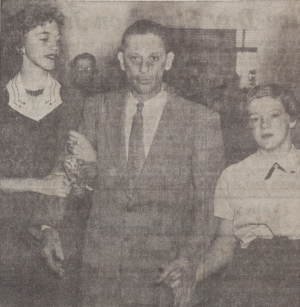
Being the reincarnation of Leonardo da Vinci, Everett is primarily and foremost a modest man, his single tiny fault being the habit of speaking about himself in the second person. His life is an open book.
Everything else is as private as a politician's sex scandal in the hands of an investigative reporter.
Most amendments that aim to restructure our government are going to be a bit more ‘radical’ than your average, run-of-the-mill amendment. Today, we tackle the Supreme Court:
The Renewing the Supreme Court Amendment
The number of Supreme Court Justices shall be one for every twenty million residents of the States, Districts, and Territories, rounded to the nearest twenty million, that number being calculated after each decennial census. If the number grows, additional Justice(s) shall be appointed for the next annual term of the Court. If the number shrinks, the longest serving Justice(s) must retire at the end of the current annual term of the Court. The Supreme Court Justices shall be chosen from the ranks of active and Senior Federal Appellate Judges who have served at least eight years as a Federal Appellate Judge and have not already held a position as a Supreme Court Justice, and shall be selected by a series of votes by the active and Senior Appellate Judges until a nominee emerges. The President shall be able to veto the selection of a nominee if said nominee receives less than 2/3 of the votes of the Appellate judges. The Supreme Court Justices shall be ruled by and abide by the same Code of Ethics, established by the Judicial Conference and/or legislative Acts, as all other Federal judges. Reported violations of the Code of Ethics by any Supreme Court Justice shall be handled by the Judicial Conference. If the reported Justice is part of the Judicial Conference, they shall be excluded from any and all investigations, hearings, deliberations, and findings on the matter. Congress retains the ability to impeach and remove Judges and Justices.
The Chief Supreme Court Justice, from the beginning of each session until the beginning of the next session, shall be the longest serving Supreme Court Justice at the beginning of the session.
Originally, there were 6 Supreme Court Justices (in 1790), and has been as high as 10 (during the Civil War), then settled at 9 (in 1869). Meanwhile, the population of the United States has gone from 3.9 million people in 1790, to 38.5 million in 1870, to 331 million in 2020. The Federal District courts and the Appellate Courts have grown in number and size, and the Supreme Court should be adjusted reasonably to handle the much heavier case load. At one Justice per 20 million residents (rounded up, in this case), that would equate to 17 Justices as of 2020.
More Justices would support better handling of the heavier case load, and would “average out” the “philosophical differences” between the Justices, avoiding wild swings to the Left or the Right. Drawing the Justices solely from the Appellate ranks with at least 8 years experience in Appellate work would guarantee that the the Supreme Court would be ‘stocked’ with mostly very well-qualified people. Further, having them selected by the “Appellate Court” (currently 179 judges, plus some number of Senior judges), would tend to remove the politicization of the Supreme Court that happens with Presidential nominations. Allowing the President some veto power acts as a counter-balance to a runaway Appellate.
As history has shown us, being a Supreme Court Justice does not inherently mean that it guarantees moral and ethical behavior. The unenforced ‘suggestion’ of a code of ethics that was adopted in 2023 is a sham, a toothless mouse trying to gum lions into submission. Just because they’re called ‘Supreme’ does not make them “supreme beings.” They are people. They may be well educated, they may be experienced (or not…), but that doesn’t make them infallible. They often hold the future (or, at least, the near future) of our country in their hands, and those hands should certainly be slapped when they fail our country.
The Chief Supreme Court Justice has a stronger role (somewhat) than the other Justices, yet is chosen and appointed (for life) exactly the same as all the other Justices, by whatever President that happens to be in office when the current Chief dies or retires. That seems, somehow, less than appropriate. By choosing the Justice who has been on the Supreme Court bench the longest, at least the period of “greater sway” is reduced for any given Chief Justice, and greater experience is ensured. How long a Justice should serve, is the subject for a later discussion…
This one is pretty much a no-brainer for most folks:
The National Popular Vote for President Amendment
Presidential Electors and the Electoral College is abolished, and the candidates for President and Vice-President with the greatest national vote total in the General Election shall be elected.
Originally, the Electors system was set up to achieve two things: to avoid election by the general population because the general population was generally uneducated nimb-bobs (or so thought the educated, upper-class businessmen and/or slave-owning nimb-bobs who designed and wrote the Constitution), and to deal with the logistics of operating elections over great distances with no means of communication faster than a horse.
Education is now provided and available to most citizens. While many citizens are still nimb-bobs, many of our representatives are, too, so this should no longer be a valid argument for lessened levels of democracy in our government, merely an argument for wider, cheaper, and better education. As for speed of communication, we usually know the outcome of every election within hours of the polls closing, if not before. Speed, too, is no longer an argument for lessened democracy.
Either we believe that most people can be educated and trained to be responsible citizens, capable of making reasonably wise and balanced choices, or we should give up on the dream of democracy and settle for living under kings, dictatorships, and the rule of those able to grab the most reins of power.
The current Electors system favors Presidential candidates who pour all their attention and favor into a handful of swing states, ignoring all the others. In a National Popular Vote election, those candidates would need to pay attention to ALL the States and Territories, because EVERY VOTE WOULD COUNT. Now, in too many states, it truly does NOT matter who you vote for in Presidential elections, as most states so heavily lean one way or the other that the outcome is pretty much pre-ordained. Without Electors, even though the candidate for one party almost always wins the “winner take all” Electors in a state, there’s still a huge chunk of voters that vote for the another party’s candidate, and a sizeable collection of “swing voters” who can be swayed. In a National Popular Vote election, those “losing voters” would still get counted and added together with numbers from other states.
I’ve grouped my proposed Amendments into three broad groups:
Restructuring Government Power, Immunity, and Benefits – Limits and Guarantees Transparency
and I’ll tackle them in that order. Any major restructuring of the government is a HUGE ask, but it’s certainly worth considering. To accomplish it (and many of the others), I think, will require the passage of this first one:
The National Initiative Petitions and Referendum Amendment:
When at least 1/2 of the states, either via legislative act or referendum or state initiative petition, request the same Amendment, or if a proposed Amendment is referred to the people by both houses of Congress via simple majority votes, that proposed constitutional Amendment shall be placed on ballots in all states during the next Presidential general election which occurs no sooner than six months thereafter, and shall pass and become part of the Constitution if at least 3/4 of the national popular vote is in favor.
When at least 1/4 of the states, either via legislative act or referendum or state initiative petition, request the same Bill, or if a proposed Bill is referred to the people by both house of Congress via simple majority votes, that proposed Bill shall be placed on ballots in all states during the next Congressional general election which occurs no sooner than six months thereafter, and shall pass if greater than 50% of the national popular vote is in favor. If the bill passes by less than 2/3rds of the vote, the President may veto the bill, in which case the bill shall be voted on again in the next general Congressional election, and if passed by 2/3rds, it will become law.
Oregon, my lifetime home state, has had initiative petitions and referendums since 1902, and while not all of the amendments and bills passed in this way have turned out to be wise and/or work well, the process has allowed for changes that would have been otherwise impossible due to recalcitrant lawmakers who almost always have their eye on re-election first and foremost, which often makes them reluctant to attempt anything too out of the norm, too daring. But the only way to improve society is to do things “outside the norm.” The ‘norm’ usually means “the way things are right now.”
I think anyone who pays much attention to politics and society would have little trouble coming up with situations where a significant majority of the U.S. population is in favor of A POLICY, but the elected politicians won’t enact A POLICY because they’re either worried about re-election in their specific district/state, or they’re taking money from lobbyists and special interests who are opposed to A POLICY. Banning assault weapons? A woman’s right to choose? Climate change? I could go on quite a while, but there’d be little point, because you (for any given one of you) probably wouldn’t agree with my entire list, and any given list is not the point. The point is that the closer the laws become to what the majority of the people want, the better the whole process will work, because we’ll be closer to a true democracy, and people will be more involved in the process.
Too many people don’t vote because they think, “Why should I? My vote doesn’t matter.” The reason they feel that way is they’re electing someone who will then go off to government and do whatever they want to do with little regard to what they PROMISED they would do. When people get to vote directly for specific laws, it gives more people a reason to vote, a feeling that they are having a direct effect on the laws and structure of society. It also encourages greater debate on specific issues
While “big money” frequently tips, toward their preferred outcome, initiative petitions and referendums, that’s not a good argument against initiative petitions and referendums, as big money is already tipping the government by pressuring/bribing our elected representatives. In fact, initiative petitions, on a national scale, could give us the opportunity to get “big money” OUT of our democracy.
The Constitution of the United States of America was great and miraculous at the time of its creation, and has been updated a few times to improve and strengthen it. Its great strength was the compromises made to bring all the States together into a unified whole. Of course, that was also its great weakness.
The periods of U.S. history are generally bookended by Constitutional crises, periods where events and social pressures run smack into the grout between the Constitution’s bricks, and the Constitution says, “Ouch.” The most painful of these frequently result in new Amendments to the Constitution. Unfortunately (and, perhaps, fortunately), a great deal of pain usually is required. The people of the United States don’t move easily, but when the pain reaches a critical threshold, they can spin on a dime, and then you’d best not be standing in the way.
The last five amendments have been added during my life time, which seems close to par for the course, at least for a reasonably lengthy life. But, in my all-too-rapidly lengthening life, it’s become apparent to me that the Constitution is badly in need of some new guard rails. Too much of the Constitution has depended upon the good will and the social standards of the people elected and appointed to offices, and, as recent events have shown, that’s some weak grout.
Over the past decade or more, being of a philosophical bent, my mind has occasionally wandered (only occasionally…), thinking about how things could be improved. I’m not alone in that behavior, and better minds than mine have pondered similar subjects. But sometimes the only way to free up some space in an increasingly cluttered attic is to toss out some of the boxes.
So, over the coming weeks, I plan to write about Amendments that I think would improve the state and behavior of our constitutional government. I’m currently at 18 of them, and won’t be surprised if a few more pop into being before I write about all of them. Some will be better ideas than others. Some will be well worded, while others will be more like rambling thoughts. My goal is not so much to write them as “final drafts,” but rather more like “first drafts.” The point is, besides freeing some of my clutter, to encourage other to think about changes, too. We’re long overdue.
Much of this final chapter is memories, stories, suppositions, and opinions. I’ll attempt to keep it reasonable and not spiteful or hurtful to anyone reading this, as that’s not my goal. But, in order to try to show how this murder affected a large group of people, it’s effective to tell how people felt about it, how they reacted to it, what they thought about it.
Absolute truth is a very slippery eel. Even in math and physics, things we often think of as being absolute and true, facts must be accompanied by disclaimers and “Yeah, buts…” You might say that it’s an absolute fact that 1+1=2, whereas I could just as easily say it’s an absolute fact that 1+1=10 (in binary, base 2). If it’s true that truth is a slippery eel for the simplest of mathematical and scientific facts, what are we to make of truth when applied to human beings, history and events. The only person that knows the ‘truth’ about your life is you. You’re the only person that has lived it in its entirety, that’s been there for every moment of it. But you are a different body and a different brain every day, every moment. Our memories are built, then some are wiped away, only to have new ones built on top of them. Put ten people in a room to watch an event happen, then ask them all to write down an account of what happened. You’ll get ten different accounts, at minimum (as some people will contradict themselves, resulting in multiple accounts from the same person). And all of those accounts will be false, because all of those accounts will be incomplete. They will consist of a series of statements that, taken as a whole, strung together, will tell a story of what that person perceived or think they perceived.
About all we can really do is to say that some stories are more true than others. The newspaper stories about Ervin’s murder are more true than the “true crime” magazine stories. The police reports are more true than the newspaper stories. But none of them contain all the facts, they can’t. History only happens once, and the best we can do is create new history by telling stories about old history. We can make our stories be factually more true by trying to verify facts from multiple sources, or we can make our stories be emotionally more true by describing how people felt or imagining how they felt, by dramatizing history. No matter what we do, we will never be able to tell the whole truth, and nothing but the truth.
Even the police reports are subject to error and misunderstanding. The investigators interviewed people, asking them for their memories of what happened, sometimes quite a while in the past, sometimes when they weren’t really paying good attention. Human memories have repeatedly been shown to be very unreliable. The police took notes in their little notebooks, then later, back at the office, and sometimes days later, they would transcribe those notes into reports, using their notes to trigger their memories of what the witnesses recalled of their memories. Lots of opportunities for mistakes, misunderstandings and bad memories to alter “the truth.”
But, with all that said, if you collect enough memories, enough information, it’s frequently possible to “read between the lines,” to assemble a mental picture of what might have happened, what probably happened, and what the people involved were generally like. The best I can say, as they say in the movies, is that this story is based on true events. I’ve tried to follow the “true events” as closely as possible. Hopefully, you will always keep an open – but questioning – mind.
In this book, I’ve tried to remain as objective as possible, but keep in mind that this is my story of what happened, and that I was only two years old at the time. So, my story necessarily depends upon the memories of others with their inherent lapses and biases, the written records with their inherent lapses, mistakes and the biases of those who wrote those records. It also depends upon my own views and perceptions of everything I’ve been able to gather, the things I have not been able to gather, and how I’ve chosen to present all of it. The more information you can gather, the more stories you listen to, and the more reasoning you apply to that information and those stories, the closer you may arrive to a shimmering shadow of the truth. Unfortunately, I’ve been unable to talk with anyone from the Oveross family, so, while I’ve tried to remain objective and balanced in the telling of this story, that’s one large chunk of information that I’ve not been able to gather.
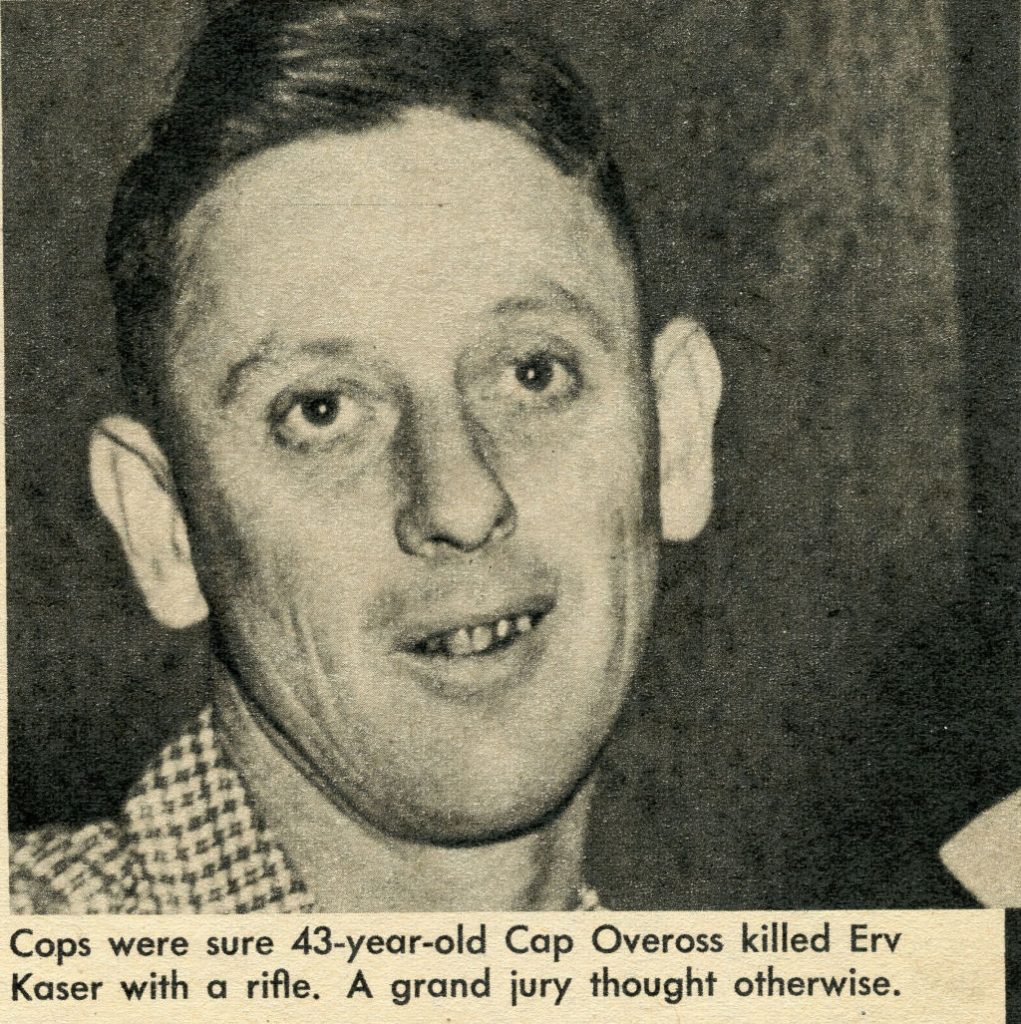
The jury found Cap Oveross “not guilty.” The newspapers and magazines asked when Oregon would capture the ‘real’ killer, said that the killer was still “out there,” waiting to strike again. Was Cap innocent? Did someone else kill Ervin? A number of people pointed their finger at Ervin’s brother Harvey, because Harvey had struck Ervin during a dispute the previous year and made clear that he didn’t like his brother. Then there were the “two mysterious men” in a car parked behind the Evergreen School. What about the other husbands of women Ervin had tried to romance? These are all things the jury may have considered.
But you should consider: 1) The murder weapon was proven to be one of two rifles sold by Ames Hardware in 1949. 2) The other of those two weapons was purchased and still owned by Steve Zolotoff. 3) Ames Hardware had a receipt showing Cap Oveross bought one of those rifles in 1949. 4) Multiple people swore they’d seen, borrowed, or used Cap’s 30-30 rifle between 1949 and Christmas 1954. 4) Dan Gilham placed Cap Oveross at the Gilham house less than 10 minutes after the murder, at which time Cap already knew that Ervin had been shot. 5) Cap later told the police that he had been in taverns the whole evening, had never been in the area of Ervin’s home that evening, and that he had never owned a 30-30 rifle. 6) Multiple people placed Cap or his car in the area of Ervin’s home that night.
Then, we have this: for a while after the trial, Cap said very little about it. But apparently, as some point, he realized that he was safe from “double jeopardy,” the fact that once a person has been accused of a crime, tried and acquitted, they can never be tried again. This protects citizens from being persecuted by the government, something that used to happen with some frequency, causing the framers of the constitution to include protections against that. That meant that Cap could happily go around town admitting, even bragging, that he had killed Ervin Kaser, and he would suffer no (legal) ramifications.
Harvey Kaser’s youngest son told me this story:
In 1975 or ‘76, I had a summer job at Redman, across the street from the Milltown tavern. I went into the tavern with some friends one Friday after work. I elbowed up to the bar next to an old guy sitting on a bar stool. The barkeep asked for my ID, and I happened to plunk down my driver’s license right in front of the old guy. The old guy looked at the license, looked up, and said, “Are you related to Harvey Kaser?” I told him I was his youngest son. The old guy said, “Well, I killed your uncle.” The bartender went pale and told him to shut up. The old guy turned out to be Cap Oveross. I asked my brother Jeff about this once, and he said that in later years Cap would get drunk at the Milltown Tavern and start bragging about killing Ervin.
At the trial, Ted Finlay testified, “I would say it definitely was not” Oveross’s car he saw leave the murder scene a few seconds after hearing four shots. However, Calvin Kaser later recalled:
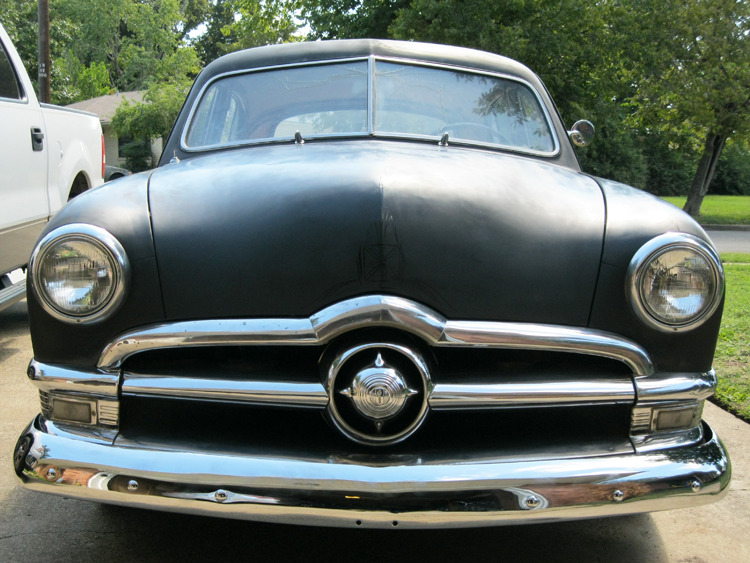
Manny Kellerhals and Ted Finlay were scared shitless that Cap was going to come back and shoot them. I was working at the S&M Truck Line, and Ted Finlay had an electrical shop and would come down there all the time to pick up his freight. He’d say, “I knew who the hell that was, hell, that was Cap, sure as hell. I heard those shots, and I heard that car come off, and I was up in the upstairs window.” Cap drove a Ford, and they had a round deal like this right in the grill, and Ted said, “I can still see that round emblem, and hell, it was Cap’s car. I couldn’t see him, but I’d bet my life that it was Cap’s car.”
1950 Ford grill
When all the evidence is examined with an open and unbiased mind, there can be little doubt that Casper Oveross murdered Ervin Kaser. So how was he found not guilty? The answer to that, of course, is that our “justice system” is not perfect. It was intentionally set up as an ‘adversarial’ system in which the prosecutor must prove their case beyond a reasonable doubt to a jury of 12 citizens. Jurists are supposed to be objective, to judge the case based solely on the evidence presented. But, of course, they can’t. Many of them will have heard of the case ahead of time, and all of them will carry prejudices and beliefs that were shaped by their society and their experiences.
The prosecution seems to have done a poor job of presenting their case to the jury (more below). The job of defense attorneys is not to prove innocence, but rather, in any legal way possible, to prevent the prosecution from doing their job. In the case of the Oveross trial, it seems that the defense did an excellent job of throwing up smoke screens (“look at all these other jealous husbands” and “look at all these mysterious cars and men that were following Ervin Kaser around”), preventing the prosecution from entering crucial items into evidence, and painting the victim as a nasty bad-man and their client as an innocent, simple carpenter who, even if he had killed Ervin, would have been justified because of the way the nasty bad-man had broken up his marriage. You have to keep in mind that this was 1955, the time of Leave It To Beaver and Father Knows Best, of white bread and apple pie, a time when very few marriages ended in divorce, sex outside of marriage was verboten, and an unmarried woman getting pregnant was so shameful that she might as well burn herself at the stake before she was impaled by society’s sharpened, pointing fingers. The jury was made up of nine women and three men, and it wouldn’t take a lot to make them return a not guilty verdict. The newspapers and magazines liked to say that the murder remained unsolved. That’s a poor choice of words. There’s no doubt in my mind that the murder was solved. It’s just that no one was ever convicted.
A lawyer I know, who read a preliminary version of this book, had quite a few thoughts about the trial:
There is a rule of thumb that juries tend to come back fast with a decision if its clearly in favor of the defendant. It looks like this one took a little over a day. I would guess there were enough people on the jury that were not going to vote for conviction, and that after maybe two or three weeks of sitting through a trial, they decided it was time to go home and call it a day. It was hot; they didn’t like camping out.
I can’t tell for sure, but it looks to me like the defense on the gun was this: the Oveross expert soaked a Winchester in Pudding River water for 11 days, and it must have looked like it was in worse shape than the murder weapon, suggesting that the murder weapon was thrown in the river sometime after Oveross departed for Alaska. [EK note: Of course, soaking a gun in shallow, warm water would have a very different result than one where the barrel was buried in cold mud, where the supply of oxygen needed for rusting would be much lower. Also, Cap may have kept his rifle well-oiled, which would have protected it, whereas the test rifle may have been brand new and never oiled. So many variables…]
In the name of establishing that Oveross had left for Alaska, the defense paraded all of his family members in front of the jury, just to give the jury a look at them. The respectable school teacher, the daughters, and everyone else. My guess is that everyone in the family came across as pretty normal, decent people, whereas Ervin Kaser had some baggage.
When Ethel Oveross testified about the mysterious men, and if she was not cross-examined about it, then it casts a lot of doubt about whether it was Oveross or someone else. It looks like she was not cross-examined about it, and I would guess nobody was going to pick on her. That puts the jury in this position: why would she lie about it? Clearly, she didn’t care that much about Oveross because she was running around behind his back. It creates a lot of doubt. I do know this, though: the defense attorneys knew she was going to testify about the mysterious men and what she was going to say about it. I would guess the prosecutors had no idea that she was communicating that to the defense, somehow. Ethel was probably faced with her daughters blaming her for having their Dad put in prison or worse, so may have elaborated on the story about the mysterious men that had followed them.
Ken Brown helps blow the trial by talking about “dry gulching” Ervin, that he was “shot down, shot in the back, dry gulched, shot down like a dog without a chance to turn on his attacker.” He never should have done that.
Hindsight is 20-20, but you can really see how this trial was mishandled. I’ve been through a few of these things and lucky enough to learn a few things from some trial lawyers and judges who have been through a lot of them. After a few days the jury just shuts down and gets tired of it all. Danny Gilham and his stepmother were the strongest witnesses for the prosecution and should have been the first witnesses out of the box, not at the end of 3 weeks. Everything should have centered on the fact that Cap Oveross shows up less than 10 minutes after Ervin Kaser was shot and is talking about it (they lived 5.3 miles away, according to the police). Then, you ask the Kellerhalls to establish the time of the shooting and maybe a couple of others, but not everyone in the neighborhood. And your question to each would be this: “how did you learn about the shooting? Who did you talk to at that time? Did you call Cap Oveross?” And then everything boils down to this argument: it is undisputed that Cap Oveross knew about the shooting less than 10 minutes after it occurred. No one told him about it. The only way he could have known about it that quickly is if he did it himself.
You tend to win or lose these things based on the number of contradictions or inconsistencies the other guy creates. The more witnesses that you have, the more contradictions you will have. Stuff like who said what in taverns, or to the police, or the comings and goings of all the cars, just feeds into that. Never have or allow the same witness to testify three times.
Anyhow, I’d say Ken Brown must have been a pretty young guy at the time and he must have been really inexperienced. You can see they sort of did a methodical, “leave no stone unturned” type of approach, and it just backfired. The one thing I’ve learned about these things is that you don’t do a build up to a crescendo – you put your best witness on first.
According to Edith, for about 30 years after the murder, Harvey wouldn’t allow Ethel or Colleen and Danny into their house because he felt, rightly or wrongly, they’d lied on the stand in a way that might have contributed to Cap getting found not guilty. In order to visit with her twin sister, Edith had to go to where Ethel worked in Stayton. In the early 1980s, probably after Cap had died, the rift between Harvey and Ethel’s family was somewhat healed, but thirty years of anger had caused scars that could never be erased.
It’s hard to read the police reports, newspaper stories, and recollections and not get the impression that Cap Oveross thought he was sharp enough to out-smart the police. He proved rather foolish by going around for six months before the murder threatening to a lot of people that he would kill Ervin, including lying in a field at night with two Silverton police constables watching his (ex-)house to try to catch Ervin visiting Ethel. He tried to set up an alibi that he was in two taverns in town the whole evening, and then drove straight from the murder to the Gilham home and told Danny Gilham that, “Ervin has three slugs in him, and I was with you last night.” But then, when the police question him, he switches back to, “I was in taverns all night and no where near Ervin’s house all evening.” He got incredibly lucky at the trial.
I never knew Cap Oveross, but reading between the lines you can build an image of what his life was like. Edith once said:
Ethel had a hard life during her early marriage. Ethel and Cap lived in an old rundown house at Four Corners (where Abiqua road intersects Hwy 213) when they were first married. Our father [Fred Knight] was concerned and brought chickens, eggs, potatoes and such to Ethel because they didn’t have enough to eat. Cap drank up everything that he made. Colleen had a case of ringworm that was so bad when she was a young girl that she nearly lost all of the hair on top of her head, because they couldn’t afford to go to the doctor.
Calvin said something similar:
Ervin was running around with Ethel, but Ethel and Cap were separated. Cap, he blamed Ervin for their breakup. But, hell, they were having trouble long before that. Cap, he was a damn boozer, he drank up everything he made. Ethel was having to work to support the kids, cause he drank everything. He worked only enough to subsist on.
These memories certainly should be taken with a grain of salt, but there is evidence to back them up. Cap was well known in the taverns at the time of the shooting and was still patronizing them regularly thirty years later. He never remarried. Besides his anger at Ervin, he had also accused his neighbor Wayne Moore of “chasing around” with Ethel. I can imagine asking him shortly before he died, “What would you consider the most important moments of your life?” and I wonder how near the top of the list would be shooting Ervin Kaser. Would that have come to his mind before my two daughters? Before marrying Ethel? Before building a good life with friends and community? From a distance, it seems like a very sad life to have murder be a dominant, central feature. They say that, “Revenge is a dish best served cold.” But I have to believe that, “Revenge is a dish that poisons the server as much as the served.”
I also have to think about the effects murder has on the people around it. I suspect that, in his anger and bitterness, Cap was focused on getting his revenge and didn’t think much about the affect it would have on his family, friends and neighbors. He may even have thought that he’d be viewed as a hero, we don’t know. But we can imagine how this affected the lives of those around him and Ervin.
The divorce of their parents was probably very stressful on the Colleen, 18, and Karen, 14. It’s pretty clear from the police reports that Colleen was very defensive of her father and may well have been ‘informing’ on her mother, telling her father when Ethel would go out and come home, essentially (unwittingly) helping him to learn their habits and patterns, making it easier for him to follow them and set up the murder. It seems that after the murder, Colleen was much more favorable to her father than to her mother. A neighbor girl, Charlotte Moore, told the police:
Colene was very mad and she mentioned something about Mrs. Gilham, the old biddy, being on the side of the law.
Then, the police were suspicious of her boy friend, Danny Gilham, so two of the most important people in her life seemed in danger. Of course she didn’t want to cooperate with the police. Colleen didn’t want Danny to cooperate with the police either, because that would further endanger her father. So, Danny is caught between the police and his girlfriend because his stepmother has already spoken to the police about Cap stopping at their house. He was the perfect example of being between a rock and a hard place. Then, Danny and Colleen got married, and for the rest of their lives, every family get-together that involved either of Colleen’s parents would have had this large shadow looming over all of them, impossible to evict, impossible to forget. There’s little information about how Karen reacted to these events, but one can easily imagine the day-to-day life of a 14-year old girl in a very small community who’s dad has been accused of murder, very publicly in the news and on everyone’s lips for six months.
During the trial, Ethel had to take the stand and testify. If her testimony helped convict Cap and he got sent to prison for life or executed (Oregon had the death penalty at that time), what would that do to her relationship with their daughters? And yet, her lover had been shot dead by her ex-husband. She, too, was between a rock and a hard place.
What about the victim’s family? Ervin’s mother Sarah had lost her husband Fred just a year and a half before, and now her oldest, first-born child is shot to death less than a quarter-mile away from her home. When asked how his mother took the news of the murder, Calvin said: Oh, she was a basket case. She’d want to go over to the cemetery, and you’d no more than drive into the cemetery and she’d start crying, and she’d be crying almost until we got home, unless you could get her talking and get her mind off it. But she had that stroke in the fall of ‘55, not too long after Ervin was shot, along in September, I think. I’m sure she had a pretty good idea why Ervin was shot. She never talked about it much. She never went to the trial. On one trip to the cemetery to visit Ervin’s grave, she said, “I know he wasn’t a perfect boy, but he didn’t deserve a bullet.” My mother, Wilma, said: I think that worked on her so bad, that she got so that she wouldn’t even sit in the living room in the night time. She’d sit in the hallway with just one little light in there. She figured if someone had shot Ervin, someone would come and shoot her, too. When you came in the front door, the dining room was on the right, and the living room was on the left, and right in the middle was where the furnace came up through a grate, and there was a doorway that went into the hallway. Calvin picked up the story: It wasn’t a hallway, it was a cloak room, but we called it the hallway. It had five doors going out of it, one upstairs, one into the kitchen, one into the bathroom, and one into their bedroom. It was just a small, square room. When company came, that’s where we hung their coats. It must have been an eight by ten room, and that’s where she would sit. All she had was a straight-backed chair and a card table. Then, in September, she had that devastating series of three strokes that basically ended her life, although she lay in the nursing home for five years before she died.
Ervin’s brother Harvey, who had also been Cap’s brother-in-law and neighbor, whose kids had played together for years, was also investigated by the police because he’d gotten into a fight with Ervin. People knew that Harvey and Ervin had argued. Calvin remembered it this way:
Sometime after Dad’s hop yard was pulled out, the place was sewed to grain. [Probably 1954, as Calvin’s dad Fred died in August 1953, and the murder was February 1955.] I know that’s what Ervin and Harvey got into a fight about, because they had somebody come harvest Mom’s grain, and Ervin took Mom’s grain down to the Wilco… well, it was Valley Co-op at that time, and the elevator was still there, and he put her grain in his name. That’s what he and Harvey got into it about, and that’s when Harvey poked him. Then Harvey went down and straightened it out and put that grain back in her name. That would’ve had to have been about ’53 or ’54.
So, when Ervin got shot, a number of folks told the police about the two of them getting into a fight. Of course, the police already had good evidence that Cap was the culprit, but they had to investigate and rule out any and all other possible suspects before the case could go to trial. But Harvey and Edith were also caught between a rock and a hard place: the victim was his brother, and the man accused of the murder had been married to her twin sister, up until a few months before, and was the father of their nieces.
When talking to Cleta McMorris about the murder, she said, “Oh, Mary [Ervin’s wife] just made a spectacle of herself at the funeral, she threw herself on the casket, and was hysterical.” When I mentioned this to my dad, Calvin, he said:
The only thing I remember about Mary, we were at the folks’ house after the funeral, a whole bunch of us, and she was standing in the corner over the furnace register. Nobody was saying anything, and she just blurted out, “I don’t care what any of you think, I still loved him!”
What about you? Whoever you are, you have been affected by the murder just by reading about it, whether or not you’re related to the families involved.
Hundreds of peoples’ lives were directly affected by the murder, and its effects still echo today in the lives of people who lived through it and in the lives of their descendants, knowingly or not. No story of a murder has a happy ending. No one is a complete saint, and no one is a complete villain.
By most accounts, Ervin was not the nicest man in the world. He certainly didn’t deserve to be murdered, but it’s clear he was not innocent.
At his trial, Casper Oveross received a verdict of not guilty, but it’s very clear to me that he certainly was not innocent.
And so ends my blogging of the story of the murder of Ervin O. Kaser. I’m well along in the process of completing the book form of this story, which I hope to have finished and “put to bed” by some time in February 2019, almost exactly 64 years after the murder.
This is a preliminary timeline of people and events involved in or surrounding Ervin’s murder. I’m sure I’ll be making some changes to it, but that’s going to require a careful re-reading of all the police reports and newspaper articles.
Nov 16, 1905 — Ervin Oren Kaser born Oct 1, 1911 — Casper Arnold Oveross born Dec 13, 1914 — Ethel & Edith Knight born
Apr 25, 1933 — Ervin O. Kaser & Frances L. Dixon married 1:35pm Vancouver, WA Dec 5, 1934 — Cap A. Oveross & Ethel J. Knight married 1:30pm Vancouver, WA Jan 7, 1936 — Harvey W. Kaser & Edith M. Knight married Marion County, OR Apr 24, 1936 — Colleen Marie Oveross born Oct 21, 1939 — Ervin O. Kaser & Mary L. Calavan Huntley married Salem, OR
Early 1949 — Ames Hardware buys two scarce 30-30 rifles (#1538797 and #1541417) March 5, 1949 — 30-30 rifle #1 sold to Cap Oveross by Marion Zahler at Ames Hardware March 26, 1949 — 30-30 rifle #2 sold to Steven J. Zolotoff at Ames Hardware (#1541417) November 1949 — Noah Wenger borrows Cap’s 30-30 rifle for elk hunting
November 1952 — Everett Kaser born
fall 1953 — Wayne Moore goes hunting with Cap and his 30-30 rifle
sometime 1954 — Jeff Kaser picks up 5 shell casing while Cap is target practicing Aug 6, 1954 — Mary sues Ervin for divorce Aug 20, 1954 — Cap sues Ethel for divorce ~Sep 1, 1954 — Cap, Officers DePeel & Jackson lie in field to watch Ervin at Ethel’s. ~Sep 1, 1954 — Cap states threat to Charles Hopkins that he’ll kill Ervin Mid-Sep 1954 — Cap states threat to Harvey & Edith Kaser that he’ll kill Ervin ~Aug-Oct 1954 — Calvin & Wilma Kaser sees Ervin and Ethel Oveross in Salem ~Oct 1, 1954 — Cap target shoots using 30-30 rifle with Frank Dedrick ~Oct 1, 1954 — Wayne Moore sees Cap’s 30-30 carbine rifle Oct 1954 — Cap & Ethel divorce is final Oct-Dec 1954 — Cap states threat to Robert Barnes that he’ll kill Ervin ~Christmas, 1954 — Dan Gilham sees 30-30 rifle at Cap’s cabin #6
Thurs, Feb 17, 1955 9:30-9:45am — Cap Oveross shoots a rifle at Huddleston lumber yard 12:00pm — Cap Oveross leaves work near Aurora 7:30pm — Ethel Oveross leaves home to meet Ervin 7:40-7:50pm — Cap arrives at Oveross home, visits with Colleen & Dan 7:45pm — Ervin & Ethel Oveross meet at Abiqua covered bridge 8:10pm — Cap leaves Oveross residence — Robert Barnes follows Cap north from Oveross residence — Gerald Hoyd tends bar at Town Tavern, no Cap Oveross 8:15pm — Mary Seward sees Cap at Frank’s Grocery on west Main 8:30pm — Cap buys gas from Dennis Legard, no rifle seen in car 8:40-9:05pm — Car arrives, motor running 5 minutes, at cabin #6 (picking up guns?) 9:00pm — Ray Ruscher at Shorty’s Tavern (Cap is there or arrives) 9:35pm — Rod Oster arrives at Shorty’s Tavern (Cap is there) 9:50-10:00pm — Rod Oster talks with Cap Oveross at Shorty’s Tavern 10:15-10:30pm — Rod Oster leaves Shorty’s (Cap still there) 10:30pm — Ray Ruscher leave’s Shorty’s (Cap already left) — Mannie and Connie Kellerhal go to bed. — Ethel Oveross returns home — Rod Oster arrives at Town House Tavern — Dan Gilham heads home from Colleen’s, sees Cap’s car heading north 10:35pm — Oveross girls return home from Salem skating party 10:45-10:50pm — Waldo Rue passes Ervin’s house on his way home 10:45-10:55pm — Ervin pulls into driveway at Rt 3 Box 115A. — Killer’s dark blue or black Ford sedan stops on road shortly after. — Ervin is shot. — Kellerhals see the last three muzzle flashes and the car. — Killer’s car departs heading south. — Ted Finlay hears shots, sees car pass south on highway — Edith Kaser’s pickup passes by. — Ethel Oveross hears 4 shots, car going south, Edith’s pickup — Kellerhals call Ervin, then Melvin, clock chimes 11:00pm — Melvin goes over, sees Ervin dead, calls Harley DePeel 11:00pm — Rob Riches passes on his way home — Harley DePeel notifies County Sheriff’s Office — Cloreta calls Calvin Kaser (and probably other Kaser family members) — Constable Harley DePeel arrives — Cap arrives in Gilham driveway, covers up something in back seat — Cap tells Dan Gilham Ervin is dead & Dan is his alibi, leaves. 11:05pm — Silverton officer James D. Painter informed of shooting 11:13pm — Painter notifies Sheriff Young & Silverton Chief R. R. Main 11:15pm — James Painter checks taverns for Cap Oveross, not found 11:17pm — James Painter arrives at Holland Auto Court #6 11:23pm — Sheriff Young notified 11:25pm — Deputy Sheriff Richard Boehringer arrives — Calvin and Harvey Kaser arrive at scene 11:40pm — Sheriff Young arrives in Silverton to pick up Chief Main ~11:45pm — Officers check Town House Tavern for Cap Oveross, not there
Fri, Feb 18, 1955 12:10am — Sheriff Young and Chief Main arrive at scene 12:15am — Painter, Bethschieder, Yates enter Holland #6 (no Cap, no guns in sight) 12:35am — State Police Private Robert W Dunn sent to Ervin’s. 12:45am — Gerald Hoyt sees Cap Oveross arrive at Town House Tavern 12:55am — Coroner Leston Howell arrives at scene 1:10am — Pvt Dunn arrives at scene, contacts Sheriff Young 1:20am — Cap Oveross leaves Town House Tavern, goes to cabin #6 1:30am — Rod Oster leaves Town House Tavern (no Cap Oveross) 1:55am — Cap Oveross picked up by Sheriff Young at cabin #6 (shotgun in corner) 3:30am — Cap Oveross is questioned, claims: 1) was in two taverns all evening 2) wasn’t in the area of crime anytime that night 3) never owned a 30-30 rifle 5:30am — Questioning of Oveross ends am — Harvey & Melvin notify mother Sarah Kaser of Ervin’s death 11:00am — Cap Oveross is returned to his cabin in Silverton — Deputy Boehringer takes Ervin’s car to Salem for storage — Dan Gilham takes Cap & Colleen Oveross to attorney ~7:00pm — Cap Oveross moves to brother Henry’s house 315 S Water
Sun, Feb 20, 1955 — Mary Kaser moves back into her & Ervin’s house.
Mon, Feb 21, 1955 2:00pm — Ervin’s funeral in Silverton, buried at Belcrest in Salem
Tue, Feb 22, 1955
8:05pm — Cap Oveross is arrested and his car impounded 10:00pm — Oveross is booked into Marion County Jail
Wed, Feb 23, 1955 10:00am — Oveross is arraigned in District Court
Mon, Feb 28, 1955 9:30am — Grand Jury hears testimony, Oveross released
Thu, Mar 10, 1955 — Ames ledger sheet shows sale of 30-30 to Oveross Mar 5, 1949
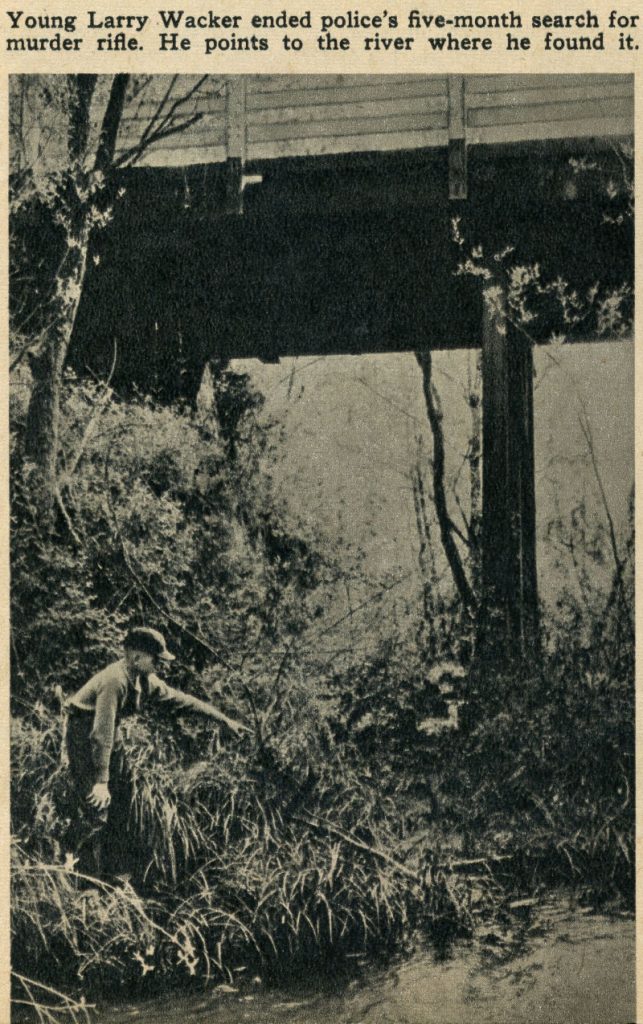
Sun, May 8, 1955 3:00pm — Larry Wacker pulls 30-30 rifle #1538797 from Pudding River
Tue, May 10, 1955 — Confirmed: 4 of casings from Jeff Kaser (1954) fired by murder weapon
Fri, May 13, 1955 — Confirmed: Rifle #1538797 fired the murder bullets
Mon, May 16, 1955 — Grand Jury indicts Casper Arnold Oveross for murder
Mon, May 16, 1955 5:20pm — Call from Colleen Oveross residence 468 N Winter Street phone# 38146 to Lloyd Oveross at Happy Camp, CA, finally
put through at 7:20pm on May 17th.
Fri, May 20, 1955 — Oveross located in Fairbanks, Alaska
Wed, May 26, 1955 — Sheriff Young and Deputy Hoffman leave for Fairbanks
Sun, May 29, 1955 — Young, Hoffman and Oveross return to Salem
Tue, June 1, 1955 — Oveross pleads not guilty, trial date set for June 21st
June 21, 1955 10:00am — Trial begins
July 14, 1955 5:26pm — Oveross found not guilty, released
sometime-1955 — Dan Gilham & Colleen Oveross marry
1958-1960 — Wilma & Everett Kaser encountered Cap on Silverton street corner
~1975-1976 — Cap bragged to Harvey Kaser’s youngest son that he killed Ervin
Jan 24, 1981 — Casper Oveross died (buried Valley View Cemetery, Silverton OR)
1988 — Mary (Calavan Huntley Kaser) marries Albert Cianni
Sep 30, 1998 — Ethel Jane Oveross died
Apr 4, 1999 — Mary Calavan Huntley Kaser Cianni died
Oct 5, 2013 — Colleen Oveross Gilham died (buried at Mt. Hope Cemetery)
And that’s it for a while. Now, I have to assemble, compose, write, edit and polish “the final chapter.” It will contain a few later events, thoughts by myself and others about all of this, speculation about the trial and juries and social standards, and dwell a bit upon how one action in selfish anger can have very significant effects upon the lives of hundreds of people over decades and generations to come.
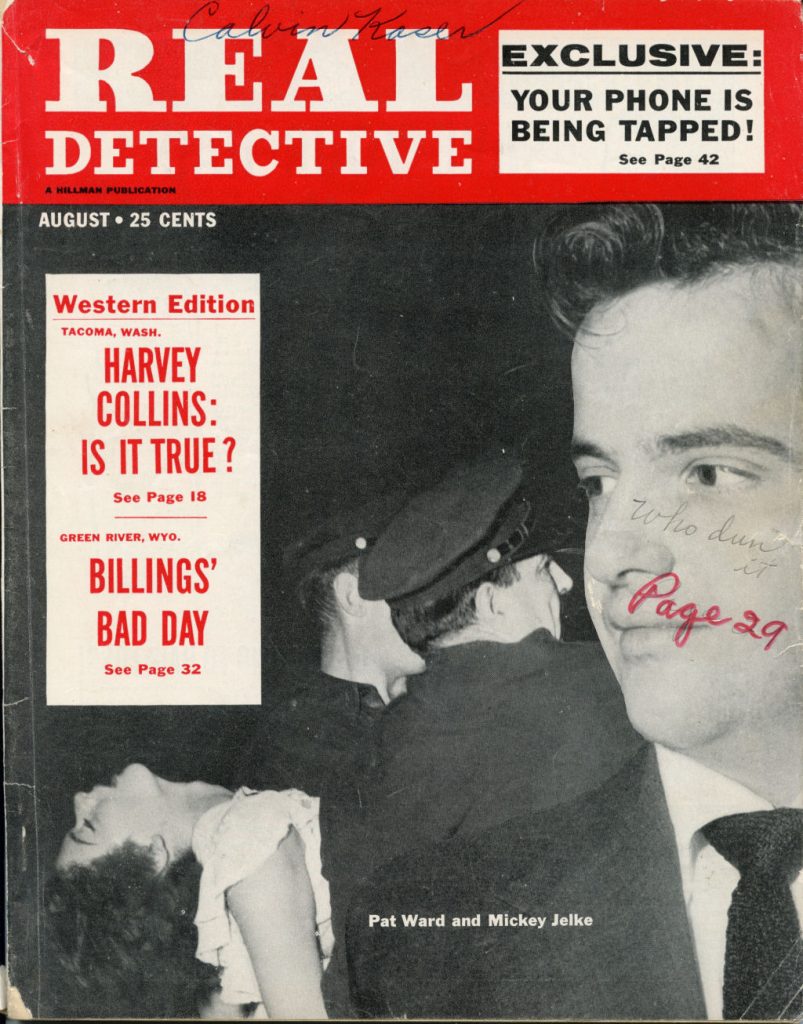
…And here’s the final magazine story about the murder. As the author says near the beginning of the article, “It’s been nearly six weeks…” So, this article was written around the end of March, before the rifle was found and before Cap Oveross was arrested the second time and indicted.
Real Detective – August 1955
WHODUNIT?
By Steve Clay
Silverton, Oregon has 3164 residents and one corpse. But if you ask who the killer was, Silverton’ll shrug its shoulders.
SILVERTON’S LOOKING for a murderer.
And it doesn’t look like it’ll find him.
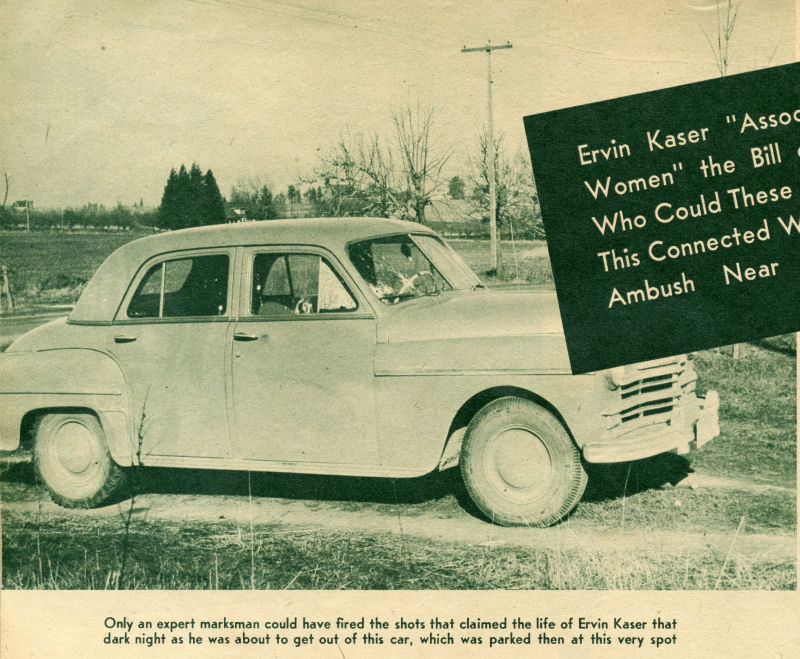
It’s been nearly six weeks since the cops found 49-year-old Erv Kaser dead in his own driveway, slumped against the dashboard of his bullet-riddled Plymouth with a.30-caliber slug lodged near his heart.
It’s been five weeks since they tried to pin the rap on a local carpenter.
And it’s been only a little less than that since they admitted they were stymied.
One cop says they’re caught in an endless circle. Everything they check seems to run back to something they’ve checked before.
District Attorney Ken Brown says the town’s full of rumors. There are plenty of things the cops could investigate.
A newspaper reporter in nearby Salem, the state capital, says something could break any time. It always can.
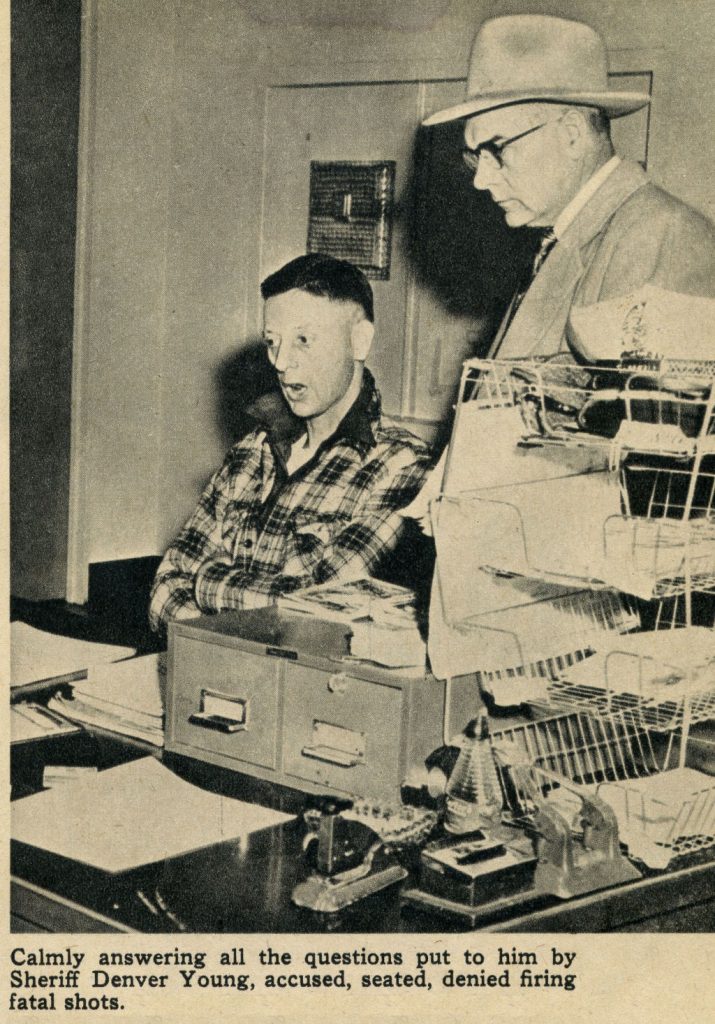
But most of the cops aren’t saying much of anything. Sheriff Denver Young and the state troopers just tell everyone they’re continuing their investigation and have lots of evidence. They’re keeping it secret until the right moment.
They thought they had lots of evidence five weeks ago, too, a few days after the murder. They thought they had the killer.
They must have kept a lot of their evidence secret then, too, because a grand jury didn’t agree with them. And now all Silverton’s wondering who Erv Kaser’s killer really is.
And it looks like it’ll keep on wondering, unless and until a shadowy, sharpshooting killer comes out of the tall, green Oregon firs to kill again. Because he’s still free and, the way things are going, he may stay free forever….
It was Em Kellerhals who saw Erv Kaser die. He was lying in bed the windblown night of February 17, when he heard Erv pull into the driveway of his pleasant-looking white frame house across the way. He looked at the hands on his luminous watch and noticed it was a few minutes to eleven.
As he remembers it now, he heard Erv slam the door to his car and, within a matter of three seconds, the quick whine of a single bullet. By the time he’d gotten out of bed and to his front window, he found he was just in time to see three quick white flashes and watch the slugs crunch into the windshield of Erv’s car.
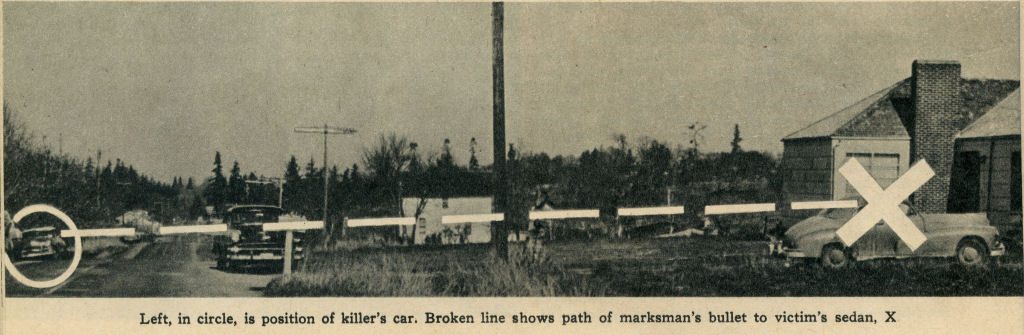
They came from a dark-looking sedan parked a few feet from Em’s own driveway and about 75 feet from Erv’s car. As soon as the fourth bullet had been fired, the sedan sped off down the black-topped road toward Stayton, hurtling forward into the wind. Em said it sounded like a Ford.
Silverton Constable Harley DePeal was the first cop to get to the murder scene. He was followed by Sheriff Denver Young and other officers from the Marion County sheriff’s office. Then came the state police.
What they found out about Erv Kaser in the next 24 hours was enough to show that several people might have wanted to kill him. Em Kellerhals said Erv was a good neighbor, but a lot of people around Silverton didn’t like him. They said he’d caused a lot of family arguments and broken up several marriages around the countryside.
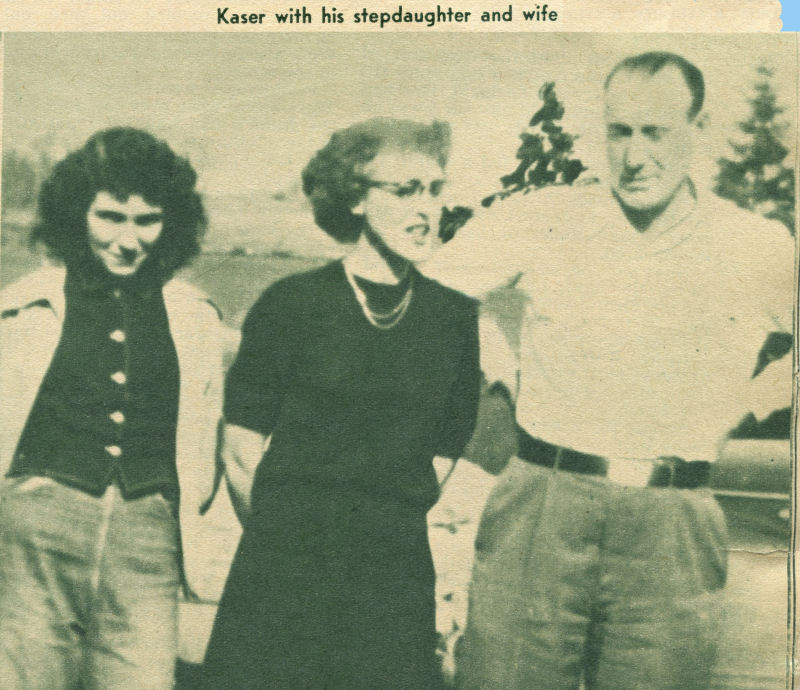
And Erv Kaser had been in the process of getting a divorce himself. In August, 1954, his wife, Mary, had filed suit against him, charging him with associating with other women, staying out all night and striking and beating her. When she filed it, she moved into an apartment in Salem, 15 miles away.
Erv hadn’t wasted any time. He’d turned right around and filed suit against her. He denied all her charges and thought up some of his own. He said he’d be glad when the case came to trial March 17.
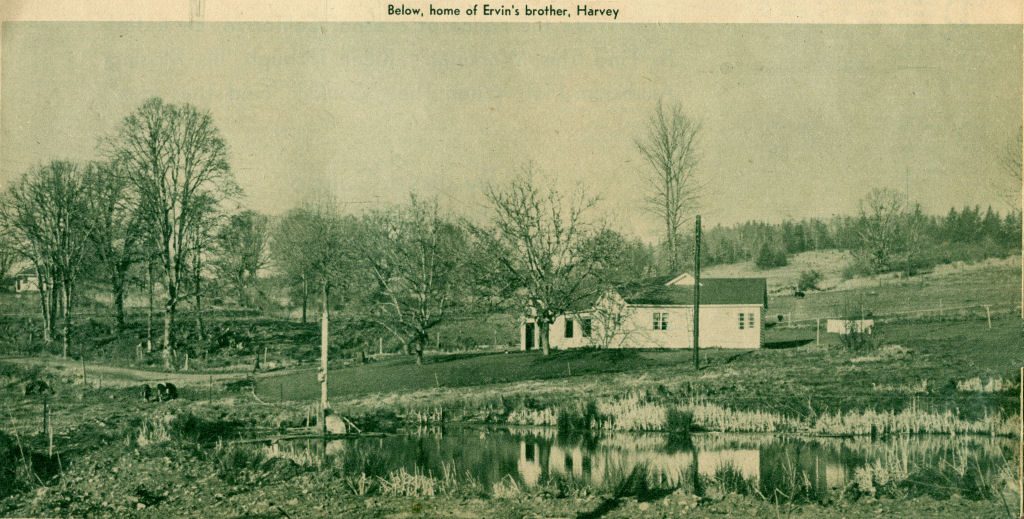
The cops talked with Mary Kaser about the victim, but they were more interested in what Erv’s younger brother, Mel Kaser, had to say about him. He described Erv as a lone wolf, said he always concealed his affairs, his friends and his goings and comings.
And Mel also said he and his friends thought Erv’s death had been carefully planned. And he didn’t think February 17 was the first time that Erv’s killer had tried to do him in. He said it was unusual for Erv to park just where he did and that it was a million-to-one shot that the killing had gone off just the way it had. He figured the murderer must have known Erv and his habits pretty well.
It was as plain to the cops as a big piece of lumber that Erv Kaser had been a trouble maker and a lone wolf, a man whom few people knew well and some people thought they knew too damn well, a man whom many residents might have liked to see out of the way.
They thought there was one man in particular, however, who might have liked to kill Erv Kaser. His name was Cap Oveross. His age was 44. His occupation, carpentry.
Like Erv, Cap had been separated from his wife. Two weeks after Mary Kaser filed suit against Erv, Cap had asked his wife for a divorce. He’d gotten it in October.
And, just as Mary Kaser had accused Erv of associating with other women, Cap Oveross had accused his wife of associating with other men and one in particular. He didn’t name him in the divorce suit, but he told plenty of people around Silverton who he considered responsible for the breakup of his marriage. A man named Erv Kaser.
LIVED NEAR KASER
There were a couple of other things about Cap Oveross that interested Denver Young and the state troopers. He’d lived for 20 years only one half mile east of Erv Kaser. He had a car, a dark 1950 Ford tudor sedan. And he was a crack shot with a rifle and had had a target range on the little farm where he’d lived before his divorce.
Within 24 hours of the death of Erv Kaser, police had long and extensive talks with Cap Oveross. Cap was nonchalant enough. He just told them he’d spent Thursday evening, February 17, in two taverns and thought he’d been in one of them both before and during the approximate hour of the killing.
The cops didn’t like his story. They said it was too hazy.
And they didn’t like the facts that he had a motive, had a Ford and had a gun.
But they let him go because they didn’t have enough evidence to hold him. And they talked with even more people who might have wanted to kill Erv Kaser and started investigating the murder scene.
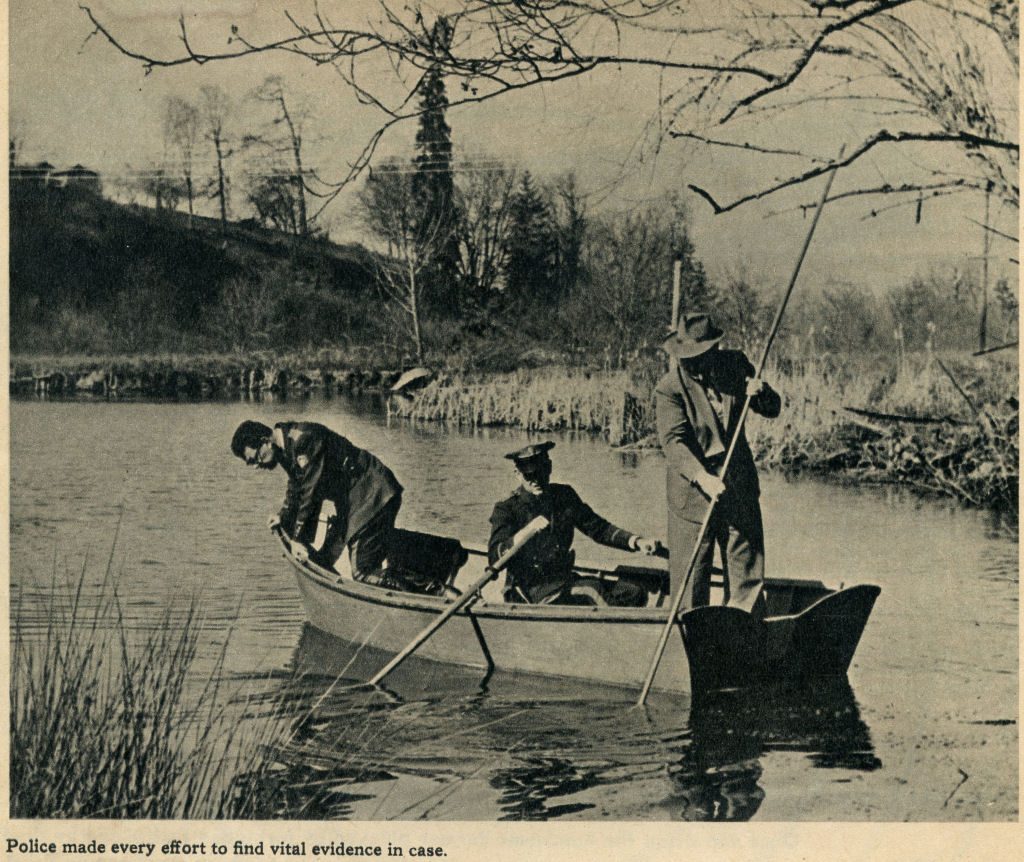
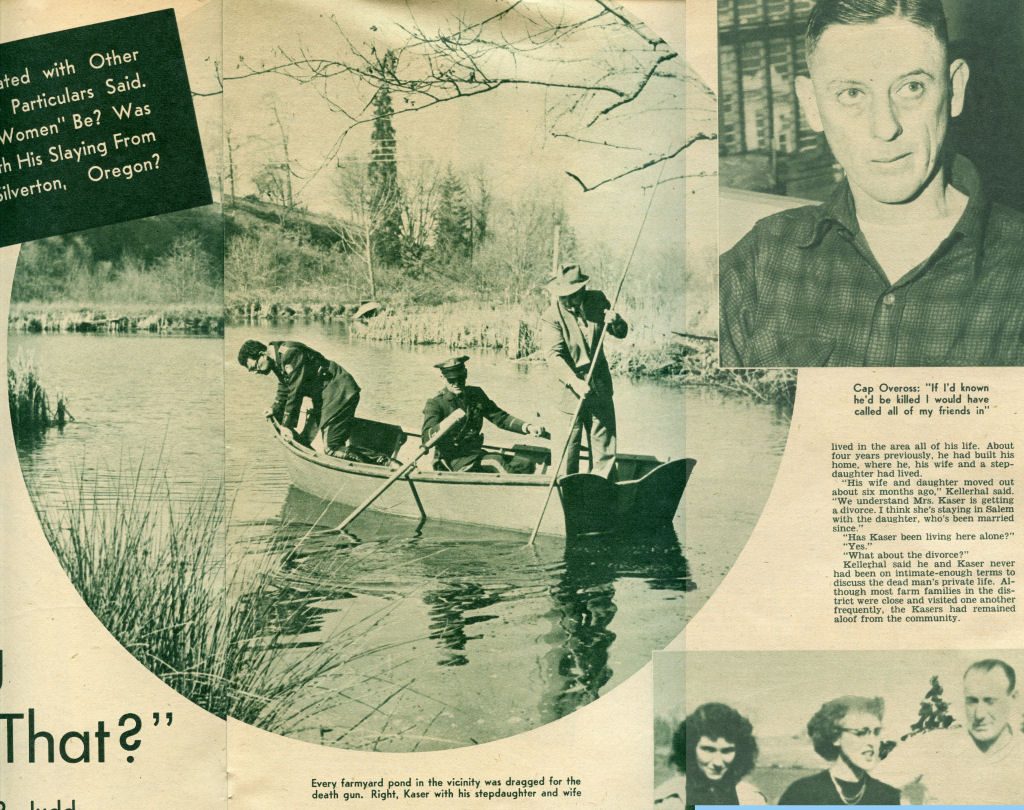
Saturday, both sheriff’s deputies and state troopers scoured the entire Silverton neighborhood for the murder weapon. Streams were dragged. Abandoned wells were searched. Woods were probed.
Sunday, two ponds were dragged, one within a half mile of the victim’s home, three miles south of Silverton. No weapon was found.
But three rifles to which Cap Oveross had access were impounded and sent to the state police crime laboratory for inspection. Cap’s own hunting rifle was not found.
His car was found though, and they impounded it, too, and sent it to the crime laboratory for inspection. Because one thing seemed sure – the four shots that had slammed into Erv Kaser’s car had been fired from inside the killer’s car. Em Kellerhals said it had looked like that to him, and he said the car had started up immediately after the last quick, white flash.
CONTINUED INVESTIGATION
Monday and Tuesday, the cops continued their investigation, comparing bullets found at the murder scene with slugs in the possession of various suspects, working quietly and secretly, telling as little to the newspaper reporters as they could. But, by Tuesday afternoon, word had gotten around Silverton that Denver Young and the state troopers had made little progress.
The word was wrong. Because, early Tuesday evening, Cap Oveross was arrested in his niece’s home in Silverton, and Cap didn’t like it one bit. He refused to accept the arrest warrant.
The cops made him accept it though and took him to state police headquarters in Salem, but that didn’t change Cap’s attitude at all. All he would say was that his name was spelled with a ‘C’ instead of a ‘K,’ as the warrant had it, and that he wanted his lawyer, Bruce Williams.
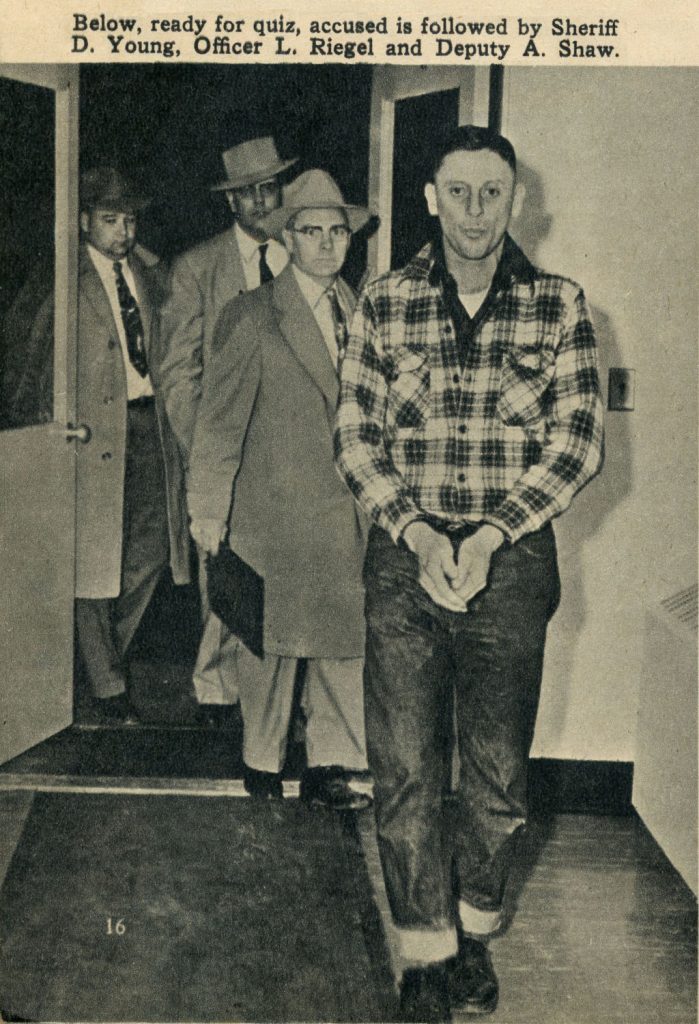
When the cops tried to find out more, the lean, laconic carpenter scratched at his bright plaid shirt, hitched at the belt on his blue jeans, looked down at his rolled-up cuffs – and turned toward the wall.
When his neighbors heard about it, most of them didn’t blame him. The news of what had happened started coming over the telephone wires strung through the big Oregon firs within an hour of his arrest, and they couldn’t believe it.
Some of them slipped into their fur-lined windbreakers or big red-plaided lumber jackets and drove into town to talk it over. A lot of them had known Cap all his life, still thought of him as a kid.
He looked like a kid anyway – only weighed about 155, wore his hair cut close to his head, had a big, friendly smile. They didn’t think he’d do a thing like kill Erv Kaser.
Some of them said that, even if he had, he’d been justified. Everyone knew about his divorce, and everyone knew he was a quiet, levelheaded guy who wouldn’t take the law into his own hands without good reason.
And a couple of them suggested that, if he had fired the bullets, maybe he’d just done it to scare Erv. Em Kellerhals had said the last three had come pretty fast – too fast for the killer to have taken dead aim. And a lot of people knew Erv Kaser had visited Ethel Oveross the night he died.
The next morning, a lot of Cap’s neighbors drove over to Salem and jammed into the spectator’s section of the Marion County District Court to watch Cap’s arraignment before Judge Ed Stadter.
They’d hardly gotten settled before Cap’s lawyer, Bruce Williams, asked the judge for a quick preliminary hearing so Cap could be set free. He said there was no evidence against him.
And Bruce Williams got what he wanted, partly because the cops refused to say just what the evidence against Cap was. Ed Stadter set preliminary hearing for a week later and told the cops they’d have to present sufficient evidence for him to turn the case over to a grand jury. Otherwise, he’d dismiss the charges.
Cap Oveross was very pleased. He’d sat calmly and impassively in the prisoner’s dock throughout the hearing, chewing on a wad of gum. But when Bruce Williams obtained an early hearing, he walked smiling out of the courtroom and waved to the friends and neighbors who’d come over from Silverton to see how things went.
He didn’t pay any attention when the cops returned him to the fourth cell in cellblock A of the Marion County jail, and he didn’t even look at them when they told him he could get the gas chamber in the Oregon State Penitentiary if he was convicted of killing Erv Kaser.
If Cap had known what was coming, he’d have been even more relaxed. He never even got a preliminary hearing.
District Attorney Ken Brown asked Judge Stadter if he wouldn’t send the case right to the grand jury, and the judge said yes, despite the protests of Bruce Williams.
WHAT DID JURY LEARN?
On February 28, the grand jury met in secret session at 9:30 in the morning. It didn’t finish its hearing until four in the afternoon.
And what did it learn?
It learned that Cap Oveross had refused to take a lie detector test. He said he didn’t need to, he was innocent.
According to Denver Young, it listened to several witnesses who claimed they heard him threaten Erv Kaser’s life.
It learned that some people thought he’d been at his old farmhouse the night of the killing. The cops said that was close enough to Erv Kaser’s place for Cap to have gone there and returned without any trouble.
But it didn’t learn anything about the murder weapon because it hadn’t been found after the shooting of Erv.
It didn’t learn aything about the three rifles Cap Oveross had access to because state troopers were still making tests on them in Portland.
And it didn’t learn anything about Cap’s 1950 tudor sedan because there hadn’t been much, if any, evidence in it linking him to the murder.
Seventeen witnesses were paraded in front of the grand jurors. Some were favorable to Cap Oveross, some unfavorable.
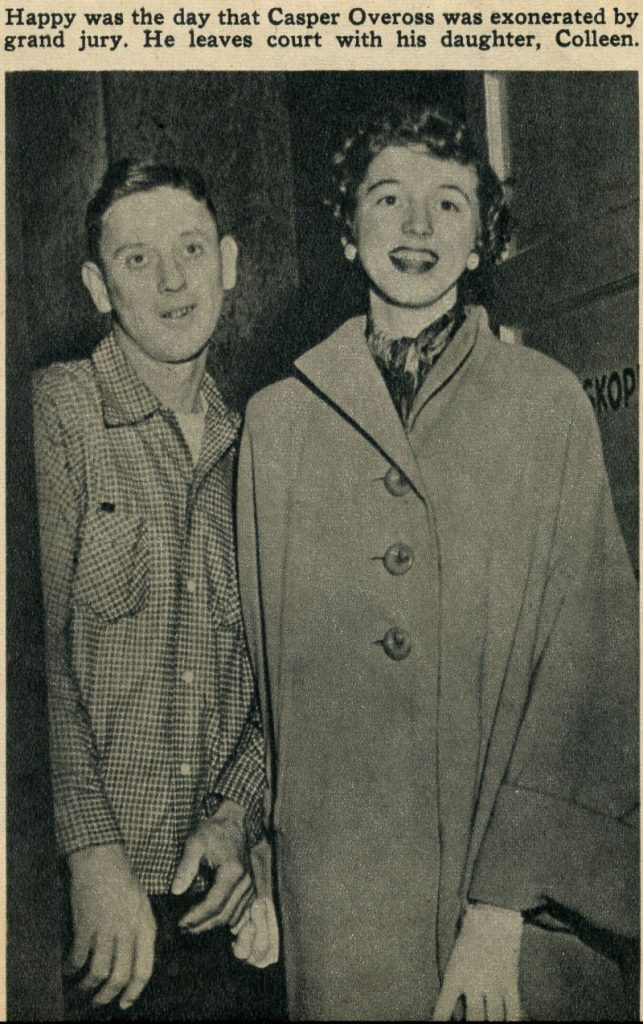
Early in the afternoon, the jurors retired to consider the evidence against the slim, boyish-looking carpenter. At four o’clock they returned and told Ken Brown and the cops there wasn’t a ghost of a case against Cap Oveross. They didn’t believe he’d killed Erv Kaser and, even if he had, there just wasn’t enough evidence to indict him.
When they brought Cap into the sheriff’s office, he was as quiet as ever. He just turned and asked Bruce Williams if it were true.
He was just as calm in front of Judge Stadter. He listened intently to the brief proceedings that resulted in his freedom and then said, “Thank you, judge” and walked out of the courtroom.
From the police, he picked up some extra clothing he’d worn when he was first arrested, four one dollar bills and his 1950 Ford. He was a free man.
Cap went back to his home and his work. He refused to say anything about his arrest or what had followed, except to repeat that he wasn’t guilty. As far as anyone could tell, even he wasn’t sure of what allthe evidence against him was.
Two days after Cap was freed, Sheriff Denver Young announced the investigation would continue. Privately, some cops admitted they didn’t know where their next clue was coming from.
More than a month after Erv Kaser died in his own blood and his own car, rumors began circulating through Silverton that the sheriff’s office had given a secret lie detector test to a suspect.
Denver Young and his aides refused to identify the suspect. As a matter of fact, they refused to admit a lie detector test had been given to anyone. They refused to deny it, too. They said they weren’t saying anything one way or the other.
Neither was the killer saying anything. But, whoever he is, he’s waiting somewhere – in the big fir country around Silverton or in Salem or in Portland or in some other state – waiting, perhaps, to strike again.
When’s Oregon going to catch him?
I’ve never heard of a “tudor sedan.” At first, I thought the author was mistaking “two-door” for “tudor.” But apparently that was actually a term that Ford once thought was cute:
“Those terms were more common in the 1939 to 1948 vehicles where they actually made a coupe, a tudor sedan, and a fordor sedan. The 1949 was the first year where they called a tudor a coupe. Ford cars continued with the business coupe in the 49 to 51 years but not for the Merc.”
Those marketing types are always pushing the envelope…
Next, I’ll be working on a time-line of events surrounding the murder. Stay tuned.
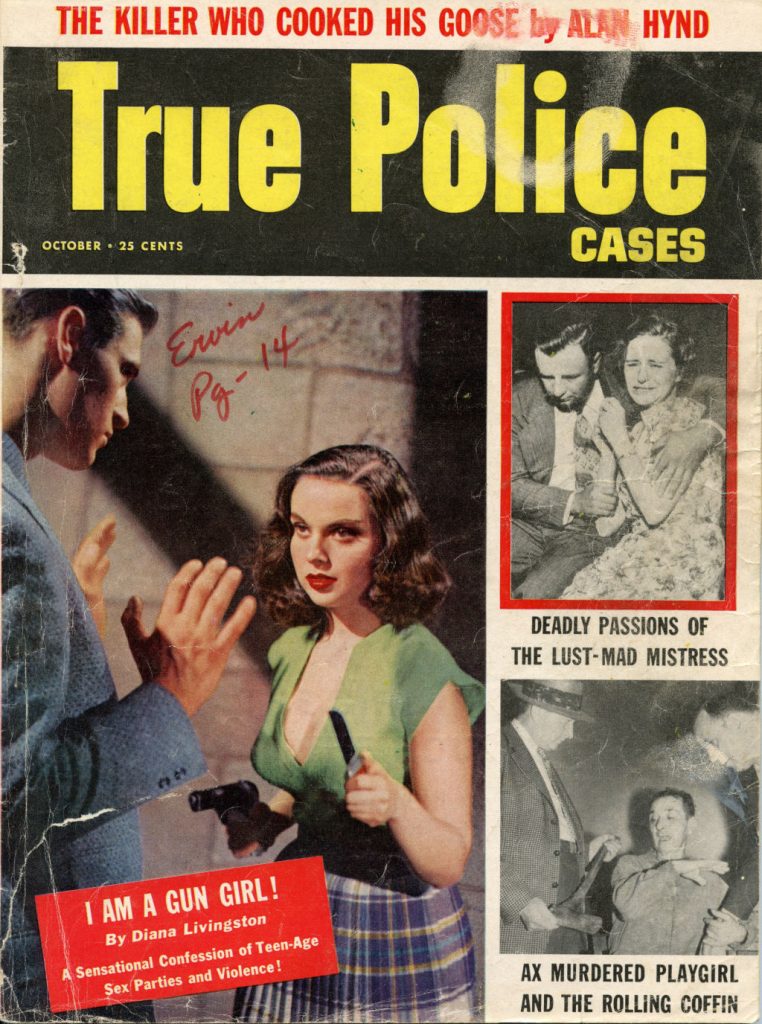
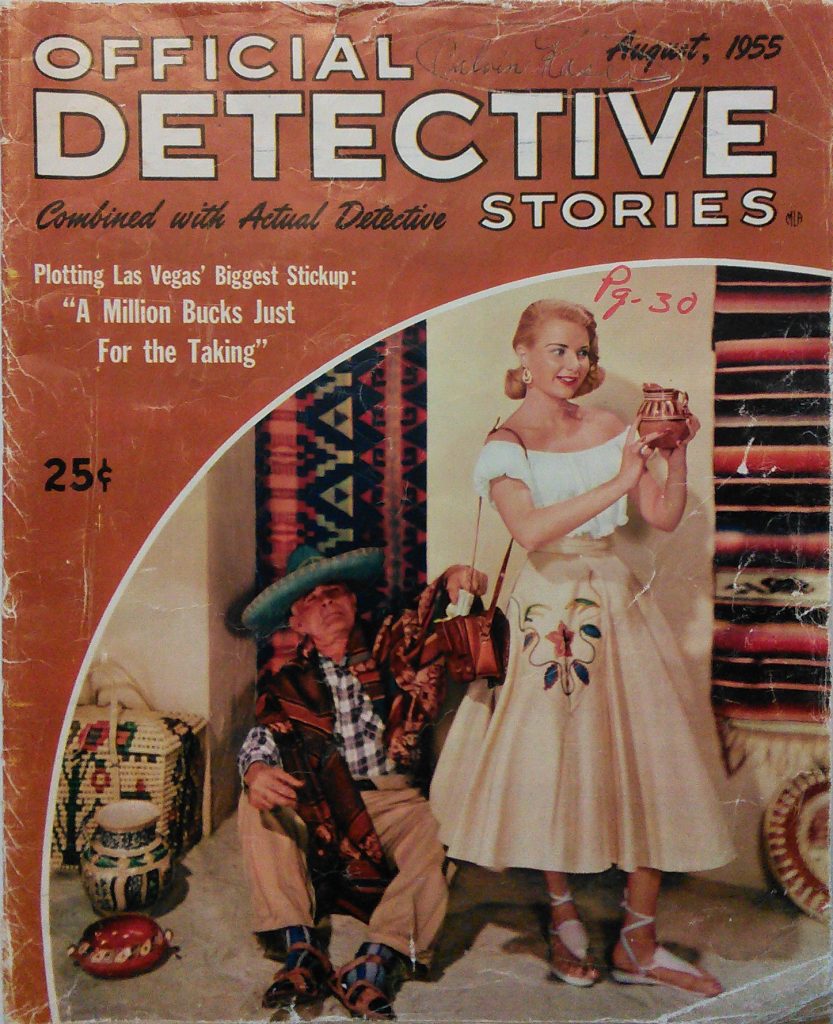
Here’s the second of the magazine stories about the murder, this one with a more typically lurid cover. Sex and violence are always successful salesmen…
True
Police Cases – October 1955
To
Love, To Die!
By Louis Adams
The quickest way for a man to make enemies is to cheat at the game of love.
Once too often the handsome farmer plucked at forbidden fruit – and he died.
Frost was just beginning to sparkle in the fields two miles south of Silverton, Oregon, as Emanuel Kellerhals Jr. burrowed deeper under the comforting warmth of the bedcovers to shut out the chill of the night on February 17,1955.
He was tired from his day’s work and as he closed his eyes he was momentarily annoyed by the slam of a car door. The sound came from the direction of his neighbor’s driveway across the road. “Erv Kaser’s home early tonight,” he muttered to his wife.
Suddenly the tiny bedroom reverberated to the shattering roar of a shot close by. “What was that?” Mrs. Kellerhals asked in alarm, rising to a sitting position. Kellerhals jumped from bed and rushed to the window.
From where he stood, the now thoroughly awakened man could see his neighbor’s sprawling hop farm. Parked in the driveway by the house was Ervin Kaser’s sedan.The dome light was burning. Near the front of his own driveway, Kellerhals observed the shadowy outlines of another car. It appeared to be dark in color.
As he watched, three more shots punctuated the night air and Kellerhals saw vivid flashes corresponding to the sounds. They seemed to come from the strange car in his driveway and, adding force to his visual observations, the motor of the automobile roared into life. The vehicle leaped ahead, and soon its taillights were fading toward Stayton on the Silverton-Stayton highway.
“What’s wrong? What’s going on?” Mrs. Kellerhals inquired anxiously. “Tell me what’s happening out there!”
“I don’t know,” her husband replied, “but it looks as if someone just shot Kaser!”
Kellerhals started to dress, intent on going across the road to see what happened; but then he recalled that there were people better equipped than he to handle such matters. He telephoned Constable Harley DePeal in Silverton.
DePeal contacted Police Chief Raoul Main, and the two men wasted no time in getting to Kaser’s farm. As they pulled to a stop, they noticed the dome light burning in Kaser’s 1949 Plymouth sedan.
The officers rushed up to the car. One glance was all that was required to convince them they needed help beyond that which their own meager departments could give. Constable DePeal called the Marion County sheriff’s office and soon Sheriff Denver Young was on his way from the state capital and county seat at Salem, 13 miles away. As Young left his office he told a deputy to relay the alarm to the Oregon State Police. At the police barracks, Private John Mekkers dispatched State Officer Robert Dunn to the scene.
When the lawmen were assembled, the wheels of a full-scale murder investigation were set in motion.
Ervin Kaser was lying on his right side on the front seat of his car, his feet on the brake pedal and the accelerator. Blood from a wound beneath the victim’s read-and-black plaid jacket was congealing in a pool that had formed on the car seat. The initials E. O. K. on the man’s belt buckle reflected the light from the dome of the car.
“From the looks of things, the poor devil never knew what hit him,” Sheriff Young muttered to Officer Dunn.
The state officer nodded, then suggested that this was a job calling for the talents of Dr. Homer Harris of the state crime laboratory.
“Good idea,” Young agreed. “Get him on his way down here from Portland while I call the coroner.”
Dunn radioed to his dispatcher, with instructions to contact Dr. Harris and have him and a fingerprint technician come down. At the same time, he asked for more help and State Officer Lloyd T. Riegel was dispatched.
Meanwhile, Young, Main and DePeal went across the street to talk to the Kellerhalses.
“It’s all so horrible,” said Mrs. Kellerhals. “Why would anybody do such a thing?”
“That’s what we aim to find out,” Sheriff Young said grimly. “But tell us all you know about it.”
Em Kellerhals described what he had seen and heard when he looked out of his bedroom window.
“What do you know about Kaser?” Young asked when the other finished talking. “Perhaps if we know something about him, it will help establish a motive.”
“Afraid there isn’t much I can tell you,” Kellerhals said. “He was always a pretty good neighbor. Kept to himself though. Maybe someone tried to rob him. He was supposed to be pretty well off.”
“How about visitors? Did he have many?”
“Not many – and what few there were, usually came at night. I think they were men he worked with, but I couldn’t recognize any of them,” Kellerhals declared.
The sheriff asked about the car that had been seen pulling away after the shooting.
“It looked like a Ford. Yes, I’m pretty sure it was a Ford. It sounded like one when it started up,” Kellerhals replied. “It was dark colored, maybe black. It looked like a sedan or coach. I couldn’t tell very well. All there was to see by was starlight.
The officers soon perceived that the Kellerhalses could offer little, if anything, more in the way of information. As they started to leave, Police Chief Main asked if he could use the telephone. He said he hated to do it, but someone had to notify Kaser’s relatives about the murder.
“Oh, I’ve already done that,” Kellerhals interrupted. “I called his brother, Melvin. He should be getting here soon.”
The officers thanked him and started to leave, but as they were on their way out the front door, Sheriff Young turned back and asked, “How do you account for the sequence of sounds, Mr. Kellerhals? The door slamming and then the shots?”
“Gosh, I don’t know,” Kellerhals answerd. “Looks to me as if Kaser maybe got out of his car and started for the house, then something warned him so he got back into his car.”
“That’s about the way it looks to me, too,” Young commented. “He probably intended to drive out of there and never had a chance.”
The coroner and Officer Riegel had arrived by the time the lawmen returned to Kaser’s car. State Officer Dunn quickly filled them in on what he had determined. Kaser’s wallet had not been disturbed and everything seemed in order in the house.
“Doesn’t look as if the motive was robbery,” Dunn concluded. Officer Riegel, meanwhile, had his notebook out, jotting down a physical description of Kaser and making a rough diagram which showed the location of the murder car and the approximate position of the slayer’s automobile before it fled.
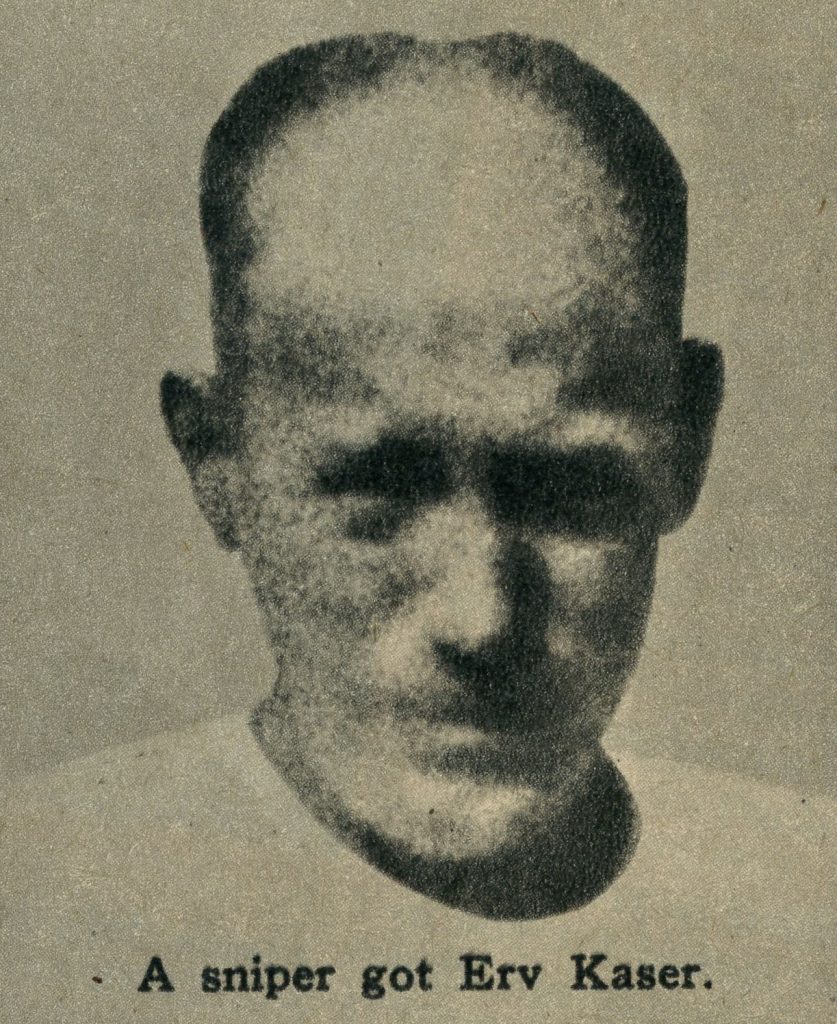
Ervin Kaser, 49, was of medium weight and about five feet ten inches. His brown hair receded in front, but he had been a comparatively handsome man. In addition to the plaid jacket, he wore a gray shirt, dark twill trousers and tan loafers. A gray felt hat was crushed beneath his head.
A sack of groceries in the back
seat indicated that the victim had just returned from shopping.
“Have you searched the area where the killer’s car was parked?” asked Young.
“Yes, but we’ll probably have to wait until daylight if we’re going to find anything that might give us a lead,” Dunn replied.
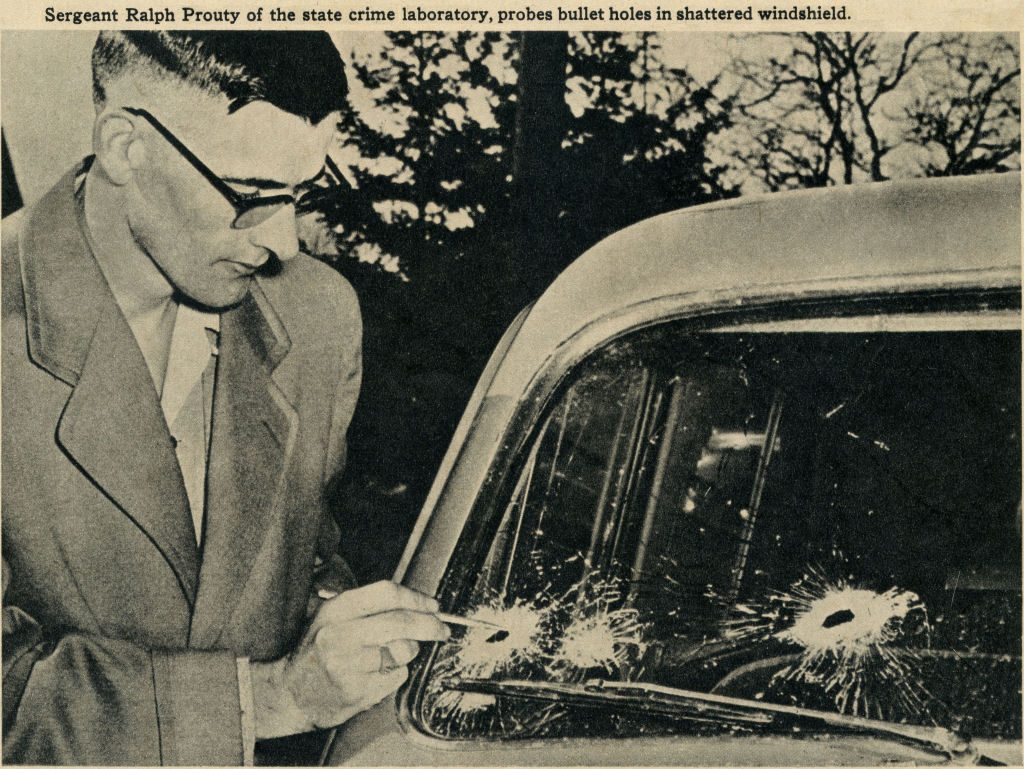
Dr. Harris and Sergeant Ralph Prouty of the state crime laboratory pulled up just then and they immediately got to work. Prouty began shooting pictures of the scene, after which Dr. Harris accompanied the coroner to the morgue where a preliminary autopsy would be performed.
Meanwhile, an examination of Kaser’s sedan revealed that three bullets grouped close together had plowed through the left doorpost; a fourth had gone through an open window and out the windshield. Two of the bullets that had penetrated the doorpost also had gone through the windshield, while the fourth was lodged in Kaser’s body. It struck Kaser in the left shoulder, but did not emerge.
The Kellerhalses had placed the murder car between 50 and 75 yards away from Kaser’s sedan. When Sergeant Prouty learned this he was amazed.
“Whoever did this was a whale of a good shot. Look how closely grouped those shots are on the doorpost,” he said. “Accomplishing that at night is really something.”
Sheriff Young nodded assent. “Of course the killer was helped by the fact that with the dome light on, Kaser made a clear target; but still the sniper is a deadly marksman. We’d better warn the cars that are out hunting him to be careful.” Earlier the sheriff had broadcast a description of the killer’s car and he now issued a warning.
At this point, Constable DePeal introduced Melvin Kaser, brother of the slain man. DePeal stated that Melvin lived just down the road from his brother’s farm and might know something.
Young and Riegel, mindful of the younger brother’s grief over the killing, nevertheless decided to question him immediately rather than wait until later.
“I don’t know what’s behind my brother’s murder,” Melvin Kaser began, “but I can tell you one thing. It definitely was planned. It looks to me as if there must have been other attempts, maybe several times.”
“Why do you think that?” Dunn asked.
“Because the chances are about a million to one for Erv to be parked right where he was shot and for him to have his dome light on to make it easy for the killer.”
“Isn’t there some other reason, too, why you think the murder was planned?” Sheriff Young pressed. “Did your brother have any enemies?”
Melvin Kaser’s brow furrowed in deep thought. He was silent several moments as though weighing something in his mind, then he said:
“Erv was always somewhat of a lone wolf. Sure, he lived next door to me and all of that, but he never told me any of his affairs. He never discussed his friends or where he went. Far as I know, he never had much to do with anybody. Afraid I can’t help you much that way.”
The Silverton police chief, who had been listening, spoke up:
“There’s a lot of talk going around Silverton that Erv was quite a lady’s man. Some say he’s broken up some marriages around here. His wife sued him for divorce not long ago, claiming he was messing around with other women and staying out all night with them. There’s probably several people who won’t be sorry about his death.”
The younger Kaser admitted that he, too, had heard the rumors, but he didn’t know how true they were.
“Well, we’re getting somewhere, at least,” Sheriff Young interrupted. “if we can find out who Ervin Kaser has been dating, we’ll probably find a clue to the killer. This job begins to look like the work of some jealous husband.”
Chief Main nodded agreement. “There’s a carpenter, named Oveross, who lives up the road a way, and I’ve heard that Kaser has been seen with this man’s wife. He might be a good place to start,” the chief suggested.
Sheriff Young thanked Melvin Kaser for his help, conferred briefly with Sergeant Prouty and Officer Riegel, then ordered the carpenter picked up for questioning. “Bring him to my office, and while you’re getting him I’ll talk to District Attorney Kenneth Brown,” the sheriff said.
Casper (Cap) Oveross had lived in the Silverton area all his life. Unlike Kaser, the thin, gum-chewing carpenter was generally well liked by his neighbors. His habitually friendly grin and youthful ways belied his 44 years.
As he entered Sheriff Young’s office and was introduced to District Attorney Brown and State Officer Dunn, Oveross appeared only mildly concerned over being taken from his home in the middle of the night and hustled to the county seat.
The officers wasted little time in obtaining preliminary information from their plaid-shirted subject. He had been born near Rocky Four Corners on Abiqua Creek north of Salem, had graduated from Silverton High School as had his wife, Ethel, and, for 20 years, had lived less than a quarter mile from the murder scene in the Evergreen community.
Did he like Erv Kaser? No. He blamed Kaser for breaking up his marriage. Yes, he had sued his wife for divorce last fall, just a couple of weeks after Mary Kaser filed for divorce from Erv.
Was he glad Kaser was dead? No more so than probably a lot of other husbands in Silverton.
“Where were you when Kaser was killed?” Sheriff Young asked.
“What time did it happen?” Oveross countered.
The sheriff estimated Kaser died about 10:55 p.m.
“I was probably in a tavern over in Silverton about then,” Oveross said, taking a hitch in his blue jeans. “I was in a couple of them during the evening. I hadn’t even got home when your men came to my place.
“Can you fix the exact time when you were in those taverns?” Brown asked.
“Nope, don’t think I can,” the carpenter replied. “Never looked at the clock.”
“You own a gun, don’t you?” Dunn interrupted.
“Not now,” Oveross replied.
The questioning continued several hours, but Casper Oveross stuck to his story concerning his whereabouts during the evening. He steadfastly denied any part in the killing of Kaser.
At midmorning, weary and disgruntled, Young and Brown retired to another room to talk over what had transpired. They agreed that they were getting nowhere; that Oveross should be set free. Certainly he had a motive, but apparently dozens of others in Silverton also had a motive.
“Let him go,” Brown ordered, “but better check on his wife and Kaser’s wife. Maybe they can offer some hint as to who might want Kaser dead.”
“That’s right,” Young agreed. “From what Oveross tells us, Mrs. Kaser divorced Erv because he was chasing around. She just might know of any threats made against her husband.”
“Yes, and if Oveross is right in thinking his wife was going with Kaser, she might be able to suggest a possible suspect,” Brown commented. “Also, maybe Kaser wasn’t romantically interested in Mrs. Oveross but in some other woman.”
The two lawmen returned to the interrogation room and told Oveross he was clear of suspicion; they suggested, however, that he not leave Silverton for the time being.
“It would help us,” said District Attorney Brown, “if you could fix the time more exactly when you were in those taverns.”
“Sure,” the carpenter replied as he took his departure.
With Oveross tentatively cleared, the officers turned their attention toward other suspects. They also decided to check the divorce complaints in the Kaser and Oveross cases.
On August 6, 1954, they learned, Mary Louisa Kaser, wife of the Silverton hop grower, had filed suit. She charged, among other things, that the “defendant does associate with and keep company with another woman or women from time to time.” Unfortunately she didn’t name names.
On August 20, Oveross sued his wife, Ethel, for divorce, alleging that “for the period of several years, the defendant has associated herself with other men, and particularly one other man to such an extent that such association has become public scandal and gossip in the community in which the plaintiff and defendant live.” Neither did he list names, but Oveross had told police he referred to Kaser.
The Kaser divorce trial had been set for March 17, but the murder changed the situation. Defendants in both actions had entered general denials of the allegations in the complaints.
It was evident the women had to be talked to, so interviews were set up.
Mrs. Kaser was contacted at her Salem apartment where she had moved pending settlement of the divorce action. The trim, 40ish blonde told her interrogators that she had no reason to kill Erv. Certainly she was unhappy about his associations with other women, but she had already handled that matter by filing suit for divorce. She indignantly asserted she would never stoop to murder. Before the officers left, Mrs. Kaser had convinced them she knew nothing of real value to aid their search for the killer.
No better luck was encountered in the questioning of the ex-Mrs. Oveross. Obviously overwrought by all that had happened, she nevertheless tried to be cooperative.
The slender divorcée insisted she knew nothing about the killing; she also didn’t think her ex-husband would have done it even in a moment of jealousy. She startled her interrogators by stating that her twin sister was married to Harvey Kaser, a brother of the slain man.
Saturday afternoon, February 19, nearly 40 hours after the killing, District Attorney Brown announced, “This thing is beginning to go around in circles. We’re getting nowhere. Possibly we’ve been concentrating too much on the Kaser-Oveross situation and the real killer is somewhere laughing at us.”
Arrangements were made with state police headquarters to assign Sergeant Wayne Huffman and Officer Lloyd Riegel to work with Sheriff Young and Deputy Amos Shaw until the case was solved, no matter how long it took.
The authorities went into a huddle and sifted through the information already at hand: Kaser was killed at 10:55 p.m., and a dark car had fled from the scene. So far as was known, only Emanuel Kellerhals and his wife had seen that car, and their look at it had been hindered by darkness. Perhaps someone else had seen it under better conditions.
With the help of Silverton officials, a map was drawn which listed every house in a five-mile radius of the Kaser home, particularly those along the Silverton-Stayton highway. Huffman and Riegel were assigned to check each of the houses to determine whether anyone else had seen the murder car. They also decided, for a few nights at least, to stop every car on the highway on the theory that people have pretty definite habits, and some motorist who normally traveled between Silverton and Stayton at that time would have seen something significant.
Sheriff Young and Deputy Shaw, meanwhile, agreed to check other possible suspects. They already had learned that the shot which killed Kaser was fired from a .30-caliber rifle and that the fatal bullet had been either a “lucky” shot or aimed by a perfect marksman.
The rifle slug had punctured the left lung and the arch of the aorta, the great trunk artery from the heart.
“Let’s go over to Silverton and see what we can learn about marksmen,” Young said to his deputy.
Several hours later the two teams met over a cup of coffee to compare progress.
Huffman and Riegel so far had found no one other than the Kellerhalses who had seen the killer’s car, but they had some other interesting information.
“We kept getting the story that Kaser was involved with other men’s wives,” Sergeant Huffman reported. “He also had money problems. He was a hard bargainer with people who worked for him in his hop yard, and there’re stories going around that he didn’t pay some of them.”
“Say, that’s worth checking further,” the sheriff interrupted. “Maybe he fought with one of those workers and the fellow he fought with went for him with a gun.”
“We’re way ahead of you there,” Riegel said. “We’ve been busy compiling a list of former employes and have talked to some of them. Haven’t come up with anything definite yet. However, it should be pointed out that we’re checking stories circulated by people who don’t like Kaser. We’ve heard some good things about him, too, that indicated some of the stories might be distorted.”
Young and Shaw had something to report, too. They had learned that Kaser received a telephone call from eastern Oregon the day before the shooting.
“The phone company is looking that up for me now, and when we’ve got the information, I think someone had better go over to eastern Oregon to see what it’s all about,” the sheriff said. “That call may tie in with the murder.”
The teams separated again, Huffman and Riegel to continue looking up former employes of Kaser; Young and Shaw to make a round of taverns where Oveross said he had been at the time of the murder.
The latter team ran into something at the first tavern they visited. James Lowrie, bartender, said Cap Oveross was an excellent shot – one of the best in the area. He didn’t believe the carpenter had killed Kaser, however –“even though he had good reason” – because Cap was too easy-going to be a murderer. Further, he had been in the tavern the night of the shooting.
“Why do you say he had good reason to kill Kaser?” Shaw asked.
“Because everyone knows Kaser was making a play for Mrs. Oveross. Why, they were together just before the shooting,” Lowrie retorted.
“How do you know that?” Young shot back.
“One of my customers saw them in Kaser’s car driving along the road to Silver Creek Falls State Park,” the bartender replied.
Young and Shaw questioned Lowrie further, learning that he could not definitely fix the time Oveross had been in the tavern. Thanking the bartender for his help, the officers proceeded toward the state park. En route they called for Huffman and Riegel to join them.
Arrived at the popular park grounds, the officers again compared notes and then set about checking nearby houses to determine if anyone had seen the dark sedan that had been at Kaser’s farm. The theory had been suggested that the killer was trailing Kaser on the fatal night. Nothing significant was turned up, so back to Silverton the lawmen went. There questioning of townspeople disclosed that, on the night of the shooting, Mrs. Oveross had been at a lodge meeting, had left for a time, presumably to meet Kaser, and then had returned to the lodge.
“This thing keeps leading right back to the Overosses,” Sergeant Huffman told his fellow officers. “I’ll bet Cap Oveross heard about them meeting Thursday night and trailed Kaser home and killed him.”
“We found out he was a crack shot, too,” Sheriff Young added, “and he’s wrong when he said he had no gun. He’s said to have several. Let’s go talk to him again!”
This time Casper Oveross was not so friendly when police arrived at his home. He grudgingly admitted he had access to some rifles, but said, “You’re mistaken if you think I told you before that I don’t have a gun.”
“Why don’t you tell us about killing Kaser?” Young demanded.
“Listen,” Oveross retorted indignantly, “I’m getting tired of all this monkey business. We went all through it the other night. Now you birds lay off or I’m calling in my attorney.”
“If you’re innocent, then let’s run a lie detector test and prove it once and for all,” Shaw suggested.
“Why should I? It’s just more of the same old malarky. I’m not having any part of it,” the carpenter lashed back.
Basically, the interview produced no more results than the first one, but three rifles Oveross had access to were rounded up for examination by ballistics experts at the crime laboratory.
That night in Salem the officers related their findings of the day to District Attorney Brown.
“It’s getting more complicated all the time. Looks as if a batch of people, not only Oveross, had motives,” Brown commented when they were through.
“You know, I think the key to this whole thing is the murder gun. We’ve got to find it, then we’ll know who the killer really is,” Young said.
“What about the guns you got from Oveross?” Brown asked.
“They’re being checked, but we don’t think any of them is the right one,” Huffman informed the DA.
Before the meeting broke up, it was decided to pick up every .30-caliber weapon in the area for checking by ballistics experts and to drag every stream and pond in case the killer had disposed of the gun.
Sunday, February 20, 1955, saw policemen knocking at every door asking for guns. Residents were surprisingly cooperative and soon a sizable arsenal was on its way to Portland to the crime lab.
Other officers in boats probed all local bodies of water. Dragging operations on two ponds within earshot of the death scene were discontinued when a farmer reported no cars had used the road on Thursday night.
Meanwhile, State Officer Dunn, who had been sent to Madras in eastern Oregon to investigate the Kaser telephone call, returned to report it had no connection with the murder.
Late Sunday, Sheriff Young learned that Oveross had a target range behind his home where he test fired rifles for several of his friends. The sheriff directed that bullets be dug from the range and compared with the one taken from Kaser’s body.
Monday the search for the gun continued, and again on Tuesday morning.
It was late Tuesday afternoon that District Attorney Brown received a call which set him wondering about Paul Hatfield, a friend of Oversoss’ pretty 17-year-old daughter, Colleen. The person who called said the youth knew something.
Young Hatfield was extremely nervous and reticent when police started talking to him. He denied having had anything to do with the murder, but when the questioning swung to Oveross, he became agitated.
“I guess I’d better tell you,” the youth is alleged to have answered. “Cap came to my place a few minutes after the shooting. He said, ‘Kaser’s got three slugs in him and you’ve got to be my alibi. If anybody asks, I was with you last night.’”
Brown jerked his head for Young and Huffman to follow him into another room.
“If what the boy says is true, it looks as if we’ve hit pay dirt,” he said. “Bring Oveross in.”
A short time later, armed with a Marion County District Court warrant charging first-degree murder, Deptuy Sheriff Amos Shaw and State Patrolman Lloyd T. Riegel located Casper Oveross at the home of his niece in Silverton.
Oveross indignantly refused to accept his copy of the warrant, but he offered no resistance as he was taken back to Salem and booked into jail. The officers also impounded his 1950 black Ford coach and stored it in a Silverton garage.
All the way to Salem, the rough-clad carpenter refused to answer questions, and when he arrived at the sheriff’s office all he had to say was: “I’m waiting for my attorney.”
It wasn’t long before Defense Attorney Bruce Williams appeared and, after a brief conference with his client, told newspaper reporters there was no evidence whatsoever against Oveross and he would demand the earliest possible preliminary hearing or, failing that, a writ of habeas corpus to free his client from custody.
The next morning, Oveross was arraigned before District Judge Edward O. Stadter Jr., and was granted a March 2, 1955 preliminary hearing. He displayed the same unruffled composure as had marked his behavior almost from the beginning.
That same day, in Marion County Probate Court, Kaser’s widow, Mary Louisa Kaser, was appointed administratrix of her dead husband’s estate. Probable valuation was listed as $10,000 in real property and $1,000 in personal property.
Later, District Attorney Brown called the officers together. “Just because that boy claims Oveross wanted him to serve as an alibi doesn’t mean that Oveross is guilty. Oveross could have heard of the shooting and have known he would be the logical suspect,” the DA said to the gathered men.
When Huffman and Riegel returned to Silverton they found the town buzzing. Some people refused to believe that likable, easygoing Casper Oveross could have had anything to do with the crime. They said they would never believe it until the sheriff’s office proved it beyond a doubt.
Others said that if Oveross did fire the fatal shots, he only did it to scare Kaser – not to kill him. “Why, those shots came so fast that it should prove the rifleman had no intention to hit anyone,” a service station attendant said. “Anybody who deliberately was trying to kill a man under starlight would take a long time between shots.”
Thursday, February 24, 1955, one week after the murder, Dr. Harris and his assistant, Sergeant Prouty, returned to Silverton from Portland to pick up clothing found in Oveross’ car and to examine the interiors of both the Oveross and the Kaser cars.
The next day, District Attorney Brown again conferred with his officers, reviewing all of the evidence that had been collected. There still were some unanswered angles and the murder weapon still had not been discovered, but the DA decided to take the case to the grand jury on the following Monday.
Defense Attorney Williams objected bitterly when he heard the news, then said he would not permit his client to appear before the jury.
A parade of 17 witnesses started going into the grand jury rooms at 9:30 a.m. It included Sheriff Young and Dr. Harris, plus relatives of both Kaser and Oveross. At 4 p.m., the jury made its report to Circuit Judge George R. Duncan.
The jury failed to find the evidence sufficient to support an indictment. Oveross was released, completely exonerated.
District Attorney Brown summoned the police authorities to his office. “We’ve got to start all over again. The murder of Ervin Kaser has got to be solved.”
The Officers reviewed again the facts and rumors they had gathered. Finally Riegel spoke up:
“It still goes back to that missing gun. We’ll have to find it.”
“There’s more to it than that,” the DA said. “Since Oversoss isn’t the guilty party, then it means there’s a killer loose somewhere around here. We still don’t definitely know he’s a jealous husband. He could well be a trigger-happy madman and he may strike again.
“I suggest we call for public help in locating that gun. Maybe the American Legion or the Boy Scouts or some similar group can help search.”
“We’ll keep on looking,” Sheriff Young promised grimly. “We’ll check every hardware store from here to Portland if we have to, and find out who bought 30-30 shells. Then we’ll go to their homes and look at those rifles. We’ll find that rifle and we’ll get the killer!”
The days changed to weeks and the weeks to months, and still the search went on. By the first of May, 1955, more than 100 persons had been talked to. Dozens of ponds were dragged. Dozens of hardware stores were checked. Still no luck.
Then Sunday afternoon, May 8, Larry Wacker, 12, of Salem, was playing along the banks of the Pudding River near the small community of Pratum. The spot was five miles by road from Kaser’s farm. Suddenly the boy pulled what he thought was an iron rod from the river. It was a .30-30 rifle.
The boy excitedly turned to his companions, Neil Beutler, 11, and Roger Beutler, 8, and said, “Look what I’ve found!”
The gun was crusted with rust, but young Wacker managed to work the lever. The gun ejected an empty cartridge. A live cartridge still was in the chamber.
The boys rushed to the John Ross home where their parents were visiting. When the fathers examined the gun, they immediately notified the authorities.
Sheriff Young examined the rifle, and was elated. “There is a good possibility this is the murder weapon,” he declared.
The gun and cartridge were immediately sent to the crime laboratory and now the officers redoubled their efforts, this time to determine whether anyone had seen the dark-colored murder car in the vicinity of the Pudding River bridge at any time after the shooting.
On May 12, Sheriff Young received a telephone call from the crime laboratory. When he hung up the phone, he turned to his co-workers and said:
“That’s the death weapon. We’ve got the gun now, the right one. Now all we’ve got to do is prove ownership.”
When District Attorney Brown was informed, he said, “I don’t think we’ll have any trouble showing that Oveross had that gun. I’ll call the grand jury into session again.”
He was even more certain later that afternoon when the sheriff called him to report that a witness had been found who claimed he had seen Oveross near the Pudding River bridge the night of the murder.
On Monday, May 16, 1955, a new grand jury heard the now mountainous pile of evidence in the case. This time police were able to produce a murder weapon. Because of their exhaustive canvass of hardware and sporting-goods stores, they had reason to believe that Oveross had bought one like it; the district attorney was able to present ballistics findings that were not available for the first grand jury.
The jury did not take long to indict Cap Oveross with first-degree murder.
Then the officers got a shock. Oveross was not in Silverton. He reportedly was somewhere in northern California visiting relatives. Defense Attorney Williams, however, was unconcerned. He told police he was certain his client would return home as soon as he heard of the indictment.
The attorney was correct. A few days later, at Fairbanks, Alaska, where he had been working on a construction job, Oveross walked into the office of the U. S. Attorney and identified himself. He had just learned of the indictment and was anxious to prove his innocence. Sheriff Young and Sergeant Huffman soon went to Alaska to accompany the carpenter back to Silverton.
Oveross still maintained the same calm as before when he was returned to Salem. He still declares he is innocent and is ready to clear himself of the murder charge in court.
NOTE: The names James Lowrie and Paul Hatfield, as used in the foregoing account are fictitious to protect the identities of the persons innocently involved in the investigation.
NOTE: Obviously, Paul Hatfield was really Dan Gilham.
And that’s it for the second magazine. Next up, the third magazine, Real Detective.
In every era, there is always some form of mass entertainment masquerading as news or true stories. Today we have reality TV and endless forms on the internet. In the 1950s, there were at least three “true crime” magazines that carried the ‘story’ of Ervin’s murder. Each of them sensationalized the story to a certain degree, some more than others. They all re-arranged the sequence of exactly what happened (in order to make a better story for their readers), made up dialog they couldn’t possibly have known (as if they had been in the room while the police were interrogating people), and sometimes just got the facts wrong. So, the stories in these magazines should be read with that in mind. These should be the last resort for information about the murder and thrown out entirely when they contradict the police reports.
With that said, here’s the first of them: Official Detective Stories from the August 1955 issue. This would have been written in early June of 1955, as Cap Oveross was returned from Alaska in the very last days of May, and the trial started just over three weeks later, June 21, and this magazine story ends with Oveross awaiting trial. Magazines are generally “post-dated” by about 2-3 months in an effort to keep them on the newsstands longer, so this issue would have appeared in either June or very early July 1955.
The cover is apparently the east-coast publisher’s idea of what shoplifting in Mexico looked like: let’s throw in a few pots and baskets, a few seemingly Mexican wraps or blankets, what looks like a businessman in a poor-man’s Halloween costume, and what appears to be a Doris Day want-to-be as a southern senorita. I guess they didn’t have much of a budget for their cover art…
Cover of August 1955 Official Detective Stories
Official
Detective Stories – August 1955
“Me, I Shoot. Anything Wrong With That?”
Ervin Kaser “Associated with Other Women” the Bill of Particulars Said. Who Could These “Women” Be? Was This Connected With His Slaying From Ambush Near Silverton, Oregon?
The first shot brought Emanuel Kellerhal upright in his bed. He and his wife had retired at 10:30 Thursday evening, February 17, 1955. It was now 25 minutes later.
The second shot took him to the window, where he could see across the highway to the ranch home of his neighbor, Ervin O. Kaser.
A pair of headlights illuminated the driveway, garage and front of the Kaser house.
The third and fourth shots exploded and Kellerhal could see the dirty orange flame of the blasts, for they were fired just beyond his window from a car parked in his own driveway.
A car motor roared. Tires whined and there was a hailstone sound of gravel being thrown by the spinning wheels. And then the silence of night that comes to those who enjoy the seclusion of country living.
The Kellerhal and Kaser hop-growing ranches are in the rural district of Evergreen, three miles south of Silverton, Oregon.
“What is it?” Mrs. Kellerhal asked.
“I don’t know,” her husband answered, still peering out of the window. “I can see Kaser’s car in his driveway. Somebody must have been shooting at him.”
“Shooting at Mr. Kaser? Why?”
Kellerhal turned away from the window and picked up his trousers.
“What are you going to do?” his wife demanded.
“I’d better get over there and see what’s the matter. Nobody’s moving around. Maybe Kaser was hit.”
“Please don’t,” Mrs.
Kellerhal said. “Call the police.”
“You call them.”
“No, you call. It’s their business. Please stay here until they arrive. If some fool is shooting out there –”
“They’ve gone. I saw them leave.”
“It makes no difference. Call the police and we’ll wait.”
Silverton Marshal Harley DePeel was the first to arrive. He was followed shortly by Marion County Deputy Sheriff R. C. Boehringer. Within a few minutes more sheriff’scars and State Police rushed into the area.
The Plymouth sedan owned by Kaser was parked almost beside the front door of his neat, nearly new white frame cottage. Its motor was stopped but the headlights and the dome light inside the car were burning.
Kaser was slumped on the right side of the front seat. Blood had spilled onto the floor mat.
A hole was drilled through the glass of the front door on the left side of the car. It probably had been made by a shot that had struck Kaser in the shoulder and penetrated his heart, killing him instantly.
Three other holes made a tight pattern in the frame of the front door, the post and the forward edge of the rear door.
Boehringer eyed the 75-yard distance across the front yard and the highway to the spot where Kellerhal said he had seen the other car. “Whoever he was, he was a marksman,” the deputy said. “That kind of shooting would win a medal on a target range.”
Kellerhal was questioned. He could not name the make of the car he had seen. “All I can be sure of is that it was a dark color. Maybe it was a Ford, but I couldn’t be certain.”
And he had not seen the killer, nor anyone else in the automobile. “Its lights were off and I didn’t notice it until I heard the third and fourth shots. I was looking over at Kaser’s place. Then this other car sped away.”
“How long after the shots?”
“Right away.”
“There wasn’t any pause?”
State Police Patrolman Robert Dunn was trying to determine if enough time had elapsed for the person who fired the shot to put down the gun and then start the car.
“It didn’t seem like any time at all.”
“Then two persons must have been in the car,” Dunn surmised. He radioed State PoliceHeadquarters and asked for a road block around the area. All cars would be stopped and their occupants questioned. The officers would search each automobile for the gun that had been used in the slaying.
Why had Kaser been ambushed?
The police officers readily realized that the killing had not been motivated by robbery. This was something personal between the victim and his slayer.
No attempt had been made to burglarize Kaser’s house or rob his person. The killer had fired the shots with the sole purpose of getting Kaser.
Kellerhal could tell the officers little about his neighbor, although Kaser had lived in the area all of his life. About four years previously, he had built his home, where he, his wife and a step-daughter had lived.
“His wife and daughter moved out about six months ago,” Kellerhal said. “We understand Mrs. Kaser is getting a divorce. I think she’s staying in Salem with the daughter who’s been married since.”
“Has Kaser been living here alone?”
“Yes.”
“What about the divorce?”
Kellerhal said he and Kaser never had been on intimate-enough terms to discuss the dead man’s private life. Although most farm families in the district were close and visited one another frequently, the Kasers had remained aloof from the community.
“Since his wife’s been gone,we’ve seen some men there at nights. We guessed maybe they were having a poker party. I’ve heard talk that Kaser liked to gamble.”
This could be a motive. The officers quickly seized upon it to ask more questions. They wanted to know if Kellerhal had recognized any of the men who had come to the house in the evening.
Kellerhal said that while he had paid no particular attention to the visitors at Kaser’s house and the men usually arrived after dark, he was almost certain they were not residents of the community. “Otherwise, we’d have heard talk.”
“How about the cars? Do you recall any in particular?”
Kellerhal could give no help on this point either.
About this time, Sheriff Denver Young and State Police Sergeant Wayne Huffman arrived on the scene. They examined Kaser’s car without disturbing the interior for Doctor Homer Harris, a pathologist, and Ralph Prouty, a criminologist with the State Police Crime Laboratory, were on their way.
Of the four shots that had entered the side of the car, two had gone out through the front windshield. One had struck the windshield and lay spent on the floor. The fourth was in Kaser’s body.
Sheriff Young directed a search for the two slugs that had gone through the windshield. A second search was started for any shell casings at the place where Kellerhal had seen the bullets fired.
However, no casings were found. Either the slayer had used a gun that did not eject its empty shells or he had fired from inside a car and the ejected shell casings were still in his auto.
Inside Kaser’s car was a sack of groceries on the back seat and the dead man clutched a carton of cigarets in one hand.
Apparently Kaser had turned on the dome light of his car and slid over to the right side of the front seat, preparatory to lifting the sack of groceries, when he was shot. The light inside the car had given the slayer an illuminated target.
Sheriff Young wanted the answer to one question right away. Had the killer been waiting in ambush for Kaser to return home, or had he followed Kaser’s car?
To the Sheriff, the answer meant a difference in the theories that could be formed for a motive.
Anyone planning the crime in advance, which would indicate a motive of long standing like a grudge, would have known where Kaser lived and his habits. He could have waited for Kaser to come home.
But if Kaser had been followed, then the motive might be a spur-of-the-moment decision, based on something that had happened during the evening. The slayer could have followed him from wherever he had been during the evening and used the first opportunity to send home the lethal slug.
Kellerhal had said that he heard Kaser’s car turn into the driveway across the highway and had heard the second car follow it within a few moments.
“I though the people in the second car also had gone into Kaser’s place,” Kellerhal said. “I remember thinking at the moment that Kaser probably was going to have another of his poker parties.”
Doctor Harris and Prouty arrived during this questioning. They recovered the spent slug inside the car and Prouty examined it carefully.
“I’d guess it to be about a thirty-caliber rifle slug,” he said. “It’s pretty badly mushroomed, but we may find enough land and groove marks on it to identify the gun if it can be located. We’ll also have a chance from the slug in the body.”
Photographs were made of the scene. The officers went over the area where the killer’s car had been parked in hopes of obtaining imprints of the tires but the graveled surface foiled this attempt.
A few minutes later Marshal DePeel came up to Sheriff Young and Huffman with some information. “I’ve been canvassing at the edge of town,” he said, “and I heard that two fellows who live out on this road left town at about the time that would bring them past here when the shooting took place. They are Ray Jackson and Fred Barto.”
“Do you know anything about either of them? Anything that might connect them to a feud with Kaser?”
“I know both of them. They’re nice fellows with families. We can go out and talk to them and then, on the way back, I guess we’d better notify Kaser’s relatives, his brother and his mother.”
Kaser’s brother, Harvey, had a ranch about a half mile down the road. His mother also lived near by on the old family farm. Kaser’s father, who had passed away, had been one of the pioneers in the section. Two other brothers also lived in the area; a fourth brother lived in Bay City and a sister in Salem.
“The Kasers are a fine old family in this section,” DePeel said. “Folks aren’t going to take it kindly that Ervin has been killed.”
“It’s a break that he’s an old-timer,” Huffman said. “Maybe from all the friends and relatives we can come up with a motive.”
The officers went to see Ray Jackson first. The young farmer was already in bed. Barefooted and in his nightshirt, he invited the officers inside, expressing shock at the news that Kaser had been slain.
“What time did you get home?” Huffman asked.
“Ten fifty-five exactly,” Jackson declared.
Huffman’s eyes narrowed at the answer. Kaser had been killed at exactly 10:55, according to Kellerhal.
“How are you so sure of the exact time?”
“I looked at the clock when I came in.”
“Where were you tonight?”
“At the wrestling matches.”
DePeel said: “They weren’t over by that time. I was at the matches when I got the call Kaser had been shot.”
“I know. But I promised my wife I’d be home by eleven and I left before they were finished.”
Jackson claimed that he had seen nothing unusual along the highway on this way home and had not noticed any cars parked at Kaser’s place as he went by. If his story were true – and the officers had nothing to disprove it –he must have passed before Kaser and his slayer had arrived.
At the Fred Barto ranch, Barto told the officers that he had seen Kaser’s car parked in the driveway at the time he had gone past.
“I saw the headlights and slowed down, thinking he might be backing out,” Barto declared. “But the car was standing still so I went on by.”
Kellerhal had told the officers that he had not heard any other cars come down the highway after the slayer’s machine had left. But he might have been telephoning at the time Barto had passed, or Barto might have scooted by before the shooting.
Someone already had telephoned Harvey Kaser with the news that his brother had been killed when the officers reached his home and Harvey was getting ready to leave.
He drove to the scene with the officers while Huffman and Young questioned him. He claimed he knew of no reason for anyone to kill his brother.
Questioned about the divorce, Harvey said the only dispute still involved in the separation of his brother and sister-in-law was over a property settlement.
“Their marriage just didn’t work out,” Harvey declared.
Pressed for any other possible motives, Harvey recalled that his brother had been involved in a dispute with a bulldozer operator who had done some work on the ranch.
“This man didn’t do the job the way Ervin wanted it done and Ervin said he wouldn’t pay him unless he did it over. The guy refused and threatened to sue Ervin,”Harvey said. “I heard he threatened to punch in Ervin’s head.”
The man was Sam Lord, a contractor of Salem, the state capital, only fifteen miles from Silverton.
Huffman radioed State Patrol Headquarters in Salem to have Sam Lord questioned at once to determine the man’s movements during the evening.
Harvey was asked about the poker parties at his brother’s home.
“Ervin liked to play cards, but the stakes weren’t big,” he replied. “I doubt if that could have anything to do with this. All the fellows he played with were his friends.”
Harvey gave the officers the names of a number of the players. They would be questioned later to determine if any quarrel had developed as the result of the card games.
Back at the scene, Docter Harris and Prouty had concluded their investigation of the physical evidence and had the victim removed from the car. With Harvey’s permission,the body was taken to a mortuary in Salem where an autopsy would be performed in the morning.
The road blocks around the Evergreen area were maintained throughout the night and although several hundred cars were stopped and searched and the occupants questioned, no one was found who could be considered a suspect in the slaying.
One lead was reported by a motorist who said he had seen a dark Ford sedan speed through a stop sign at the Paradise Alley intersection on the way to Silverton at about ten minutes after the slaying. It might have been the fleeing killer but the motorist had been unable to get the license number and no further trace of the car could be found.
At a conference in the morning, after working through the entire night, Sheriff Young, Deputy Amos Shaw, Sergeant Huffman, Patrolmen Lloyd Riegel, Stan Barron and Robert Dunn, and District Attorney Kenneth E. Brown formed plans for continuing the investigation.
“The case amounts to this,” Huffman declared. “Kaser was killed by somebody who had a pretty strong motive. You don’t follow a man and mow him down with a rifle unless you’ve worked up a big hate.”
The others agreed. But how find the motive? How solve the killings?
“There are enough riflings on the slugs to identify the death weapon,” Prouty said. “Find the motive and that will give you the killer. The gun will be the evidence to convict him.”
It was that simple.
But where to start?
The report from Salem on Sam Lord was negative to the extent that police had been unable to find the man. He had left on a job three days previously. Friends thought he had taken his equipment to The Dalles area but did not know the exact location.
A rumor came in to the officers that despite Fred Barto’s statement that he and Kaser had been on friendly terms, the men had quarreled over marketing their crop the previous Fall.
Barto had no alibi from the time he had left Silverton until he had reached his ranch. By his own admission, he must have passed Kaser’s house around the time of the slaying.
Deputies were assigned to investigate further on the rumor. Two rifles owned by Barto were brought in to be tested by ballistics experts at the State Crime Laboratory.
The pending divorce between the slain man and his wife was examined to determine if it could hold a clue to the motive. The charges and counter-charges were examined.
They found the complaint by Mrs.Mary Louisa Kaser charged her husband with cruel and inhuman treatment, staying out all night on occasions and sometimes remaining away from home for days without explanation. She further charged that he had failed to support her, refused to buy food or clothing for her, refused to associate with her friends and locked her and her daughter out of their home.
The charges also declared that Kaser had associated with other women and had refused to speak to her, refused to share information about family finances and had struck and beat her.
Mrs. Kaser requested an undivided half interest in his property or a cash settlement of $15,000.
In his answer to the suit, Kaser had denied all of his wife’s charges.
The action had been started on August 6, 1954, and was scheduled to be heard in court on March 17,1955.
The officers drove to Salem, where Mrs. Kaser was living with her daughter and son-in-law, Mr. and Mrs. Virgil Boyd.
She was asked about the charges she had made in her divorce complaint, particularly those stating that Kaser often had stayed away from home overnight and had associated with other women.
The widow, an extremely attractive woman with close-cropped curly hair, wearing ornamented glasses and dangling earrings, declared that all the charges she had made were true.
“Who were the women he assocaited with?” Sheriff Young asked. “you did not name them in the complaint.”
“I don’t know. That’s why they weren’t named.”
“But if you don’t know, how can you be sure that he ever saw any other women?”
“I know.”
“How?”
Mrs. Kaser hestitated a moment. “You ask his brother, Harvey,” she said. “He knows. Or Cap Oveross. I haven’t any proof but I’m sure of it.”
Huffman told Mrs. Kaser, “You don’t have to give us proof. But you can tell us whom you suspect. It could be a motive for the killing.”
As Mrs. Kaser hestitated again, Young pressed: “Why would his brother Harvey know about it?”
“Because Harvey is married to Edith Knight, and she has a twin sister Ethel, who was married to Casper Oveross. They all went to school together, the Kaser boys, the Knight girls and Casper Oveross.”
But who is the other woman?”
Mrs. Kaser shrugged. “When Ethel and Cap – that’s what they call Casper – were divorced last year, Ethel got the family ranch and custody of their two children. They lived just a quarter of a mile down the road from us. Ethel has been living there with the children ever since while Cap moved in to Silverton.”
That was all she would say except, “Ask Harvey or Cap Oveross.”
Harvey Kaser home and pond
The officers drove back to Evergreen to talk with Harvey Kaser. On the drive, they discussed possible angles.
“It sounds interesting, but when you analyze it, we don’t have much there,” Huffman pointed out. “The Overosses are divorced and everything is final. The only one with a motive from this would be Casper Oveross. And since everything is settled, his motive isn’t very strong.”
Harvey Kaser and his wife, Edith, were questioned about the possibility of a triangle existing between his brother and the Overosses.
“I think both Mary and Cap had some ideas about that,” Harvey declared. “I’m sure it wasn’t true, but Cap kept saying it until he got Mary to believing it.”
“Did your brother go to see Mrs. Oveross frequently?”
“We’ve all grown up together,” Harvey explained. “We’ve been friends since we were little kids. Ethel is my wife’s twin sister. We all live right here near each other and we’re bound to be good friends.”
“Whether there was any truth in it or not, could Casper Oveross have believed your brother was responsible for breaking up his marriage?” Huffman asked bluntly. “The truth would make no difference to a man blinded by jealousy.”
“Yes,” Harvey answered. “Cap blamed Ervin. I even heard that he threatened Ervin. But Cap was born right down at Rocky Four Corners on Abiqua Creek. We’ve all been like one big family since we were kids.”
Phyllis Boyd and Mary Kaser
The officers next stopped to see Mrs. Oveross. She repeated what they had heard from Harvey Kaser. The suspicions concerning herself and Ervin Kaser, she declared, were unfounded.
But she did admit that the suspicions were held by both her former husband and Mary Kaser.
“I don’t see any reason, though, why Cap would still have it in for Ervin,” Mrs. Oveross declared. “our troubles have all been settled.”
Casper Oveross was found in a small cabin in Silverton, where he lived alone. The former farmer, who has a local reputation as a hunter and woodsman, had turned to carpentry after his divorce.
“I filed the divorce and I got it,” the slender, gum-chewing man told the officers. “But the judge gave her the kids and our home out at Evergreen. I got twenty acres near Abiqua Creek.”
“You were sore at Ervin Kaser,” Young said flatly.
“I’m not denying it,” Oveross replied. “I said he broke up my marriage. And I’ll say it now. He used to be my best friend. We’ve gone hunting and camping together and we were neighbors for about twenty years. But just because he’s dead is no reason for me to change my mind. I think he was a dirty skunk while he was acting like my friend.”
“We also heard you’re an excellent marksman,” Huffman said. “And I see you have a number of rifles.”
Cap Oveross tucked his plaid shirt tighter into the beltless top of his blue jeans and smiled. “I guess it’s natural I’d be suspected.”
“Where were you last night?”
“Right here.”
“Was anyone with you?”
“Nope. If I’d known somebody was going to kill Ervin, I’d have invited half the town in so’s I could have had a good alibi. But I didn’t know it.”
Oveross gave the officer the three hunting rifles that he owned so they could be test fired at the Crime Laboratory. “These are all my guns,” he said. “I never owned a thirty.”
“Who do you think killed Ervin?” Young asked Oveross. “You knew him well. Maybe you can help us.”
Cap chomped on his gum for several seconds. Looking squarely at the Sheriff, he said: “Let me put it this way. I don’t know who killed Ervin, but to be truthful with you, even if I did I reckon I wouldn’t tell you. In my book,he got what was coming to him.”
Meanwhile, additional patrolmen brought into the area by Huffman were aiding the Sheriff’s deputies in searching the entire area around the Evergreen district on the theory that the slayer might have disposed of the death weapon in one of the many ponds, creeks and wells in the district.
Dredging the Harvey Kaser pond
Ponds had been dredged on almost every farm to collect the Winter rain and hold it to water the cattle in Summertime. Rowboats, carrying officers with grappling hooks and magnets, covered all the ponds along the road from Silverton to Stayton, in the direction Kellerhal had seen the killer’s car take from the slaying scene.
The poker-playing pals of Kaser were questioned. No game had been planned for the night Kaser was slain. All denied that any arguments had cropped up during the card games that would provide a motive for the killing.
At the request of Sheriff Young, those who had been at the poker parties surrendered their rifles for ballistics examination.
Numerous other acquaintances of Kaser were asked to turn in their guns for the ballistics test.
Sam Lord was located at The Dalles. He readily admitted that he and Kaser had had violent differences concerning the job and payment for the work Kaser had hired him to do. But Lord had an airtight alibi of being in The Dalles at the time Kaser was killed.
The rural community seethed with excitement over the first slaying that ever had been committed in that area. Rumors kept the officers busy investigating leads that all eventually petered out to be only gossip.
On Sunday afternoon, Mrs. MaryLouisa Kaser moved into the farmhouse where her husband had been slain. This started more rumors, but the widow explained that she was the sole heir of her husband’s estate and she intended to live at the farm.
Funeral services were conducted for Ervin Kaser in Silverton at two o’clock on Monday afternoon. The town was jammed with ranchers who put aside their farm tasks and came dressed in their Sunday best to pay their last respects. So many persons attended the services at the funeral home that a loudspeaker was placed outside the chapel so the huge crowd gathered on the lawn and in the street could hear.
But no arrest had been made.
The newspapers from Salem, which carried daily headlines on the slaying, had been hounding Sheriff Young, District Attorney Brown and Sergeant Huffman for facts on the progress of the case.
Young gave out a statement that made new headlines on Monday afternoon. The story quoted him as saying the officers had a suspect and as soon as a certain piece of evidence was uncovered, an arrest would be made.
When the other officers questioned Young about the story, he told them: “It’s half true. The piece of evidence we’re looking for is the gun.”
“How about the suspect?”
“I’m hoping the killer will see that and run. We’ll keep our eyes open. If anyone leaves the area in a hurry it could be the slayer thinking we are getting close to him.”
But no one ran.
Search for the rifle used to kill Kaser continued, for both Young and Huffman felt certain the slayer would attempt to get rid of the damning evidence.
“Whoever it is, he knows we have the slugs that can prove it’s the death weapon,” Huffman reasoned. “And he’s smart enough to conceal it because he took pains to make sure the cartridge casings couldn’t be found.”
“And the the chances are he got rid of it shortly after he killed Kaser,” Young added. “He’d know we’d put up road blocks. The logical place would be in one of the ponds or creeks near the Kaser farm.”
Deputy Shaw said: “We’ve just about covered all of them. But if he took time out to bury it, he may have us whipped. We’ll only get it if somebody should stumble onto it.”
One strong clue to the slayer was the tight grouping of the rifle shots into the car. Only an expert marksman could make a pattern so small. Oveross was an expert marksman: the officers investigated him as closely as they could Tuesday morning. A neighbor near the farm Oveross owned at Abiqua Creek reported that Oveross had a rifle range on his property.
“I’ve seen Cap out there practicing the past few weeks,” this neighbor said. “He’s been using up a lot of ammunition and it’s a long way until hunting time. Maybe you’d better ask him about it.”
Before requestioning Oveross, the officers went out to the farm to look over the rifle range. It had a number of old logs as backstop for the bullets.
Criminologist Prouty carefully dug some of the spent slugs from the logs. He came up with several he identified as .30 caliber.
“Cap told us he didn’t own a thirty-caliber rifle,” Young said. “those three guns he gave us were of a different size than this.”
The slugs from the rifle range were rushed to the State Crime Laboratory where they were put under a comparison microscope with the spent bullet found in Kaser’s car and the one removed from the body. Enlarged photographs were made so that every mark on the lead could be examined closely.
“I have found enough similarity in the samples to indicate that the bullets taken from the rifle range might have been fired from the same gun used in the killing,”an expert declared.
Was it enough to charge Oveross
with the slaying?
“We have a motive,” Young explained to District Attorney Brown. “Cap thought Ervin had broken up his marriage. We have the evidence of the slugs.”
“I’ll issue a warrant,” Brown said. “we can bring him in and see what he says about it. But, of course, we can’t prove yet that Oveross owned such a gun. Anybody could have used his range.”
Oveross was arrested at the home of a relative.
“You guys are nuts,” Oveross told the officers. “I didn’t kill Ervin. I’ll admit I think he deserved killing, but I didn’t do it.”
Told about the slugs found at the rifle range on his farm, Oveross said: “I don’t know nothing about ballistics. Maybe you can tell if a gun shot a certain bullet.But it don’t mean it was my gun, or I did the shooting.”
“You were seen out there practicing.”
Calmly chewing gum, Oveross shrugged. “Sure, I shoot all the time. It’s my sport. Some men play golf. Some men bowl. Me, I shoot. Anything wrong with that?”
“You are going to be charged with killing Kaser.”
“In that case, I guess I’d better keep my mouth shut,” Oveross said. “I know you got good reason to suspect me, so it’s no use me helping you any. All I’m going to tell you is I didn’t do it.”
District Attorney Brown announced that Oveross refused to take a lie-detector test and quoted him as saying: “I’m just going to sit tight. You can’t prove a thing.”
Brown filed a charge of murder against Oveross in the court of District Judge Edward O. Stadter,Jr., and called a special session of the Marion County grand jury to hear the evidence that had been collected.
On Monday, February 28, he summoned seventeen witnesses before the jury.
At the end of an all-day session, the jury ruled that Brown did not have sufficient evidence to indicate Oveross should be held to answer the charge in court. Brown withdrew the charge before the district court and Oveross was released.
Brown announced immediately, “If I get additional evidence later, I’ll call the grand jury into session again.”
Pressed by reporters for a further statement, he said: “We have no other suspects at this time. All I can say is that the Sheriff and the State Police will continue to work on the case until it is solved.”
What could be done?
“Find the gun,” Brown said.“Find the gun and we’ve got a case. It may not be against Oveross, but if you can find the gun, I can make a case against whoever owns it.”
In a rural district like Evergreen, nearly every farmer has several hunting rifles. The .30-caliber gun is a favorite for hunting.
A tedious canvass began of all sporting-goods stores in the area to find out if anyone had purchased a .30-caliber rifle recently. It was a nearly hopeless task, but no other leads were open.
The gun might have been bought locally, or it could have come from Portland or some other big city. It might have come from a mail-order house or even have been bought secondhand.
Weeks went by and the excitement in the rural community that had experienced its first slaying failed to subside. It was the prime topic of conversation at every gathering.
The curious still drove out on the the highway and paused to look at the house where the widow of Kaser was living and to examine with interest the spot where the slayer had waited in ambush to slay Kaser.
Rumors grew rather than died as time lapsed. Sheriff Young and Sergeant Huffman constantly were investigating some new angle that was brought to them because of talk in the area.
Then, on Sunday, May 8, Larry Wacker, a Parrish Junior High School student, and two chums, Neil and Roger Beutler, were fishing in the Pudding River not far from the junction of the Pratum-Silverton-Sublimity roads, about five milesfrom Ervin Kaser’s farm.
Larry found a rifle in the river. An empty shell was in the chamber and a live shell in the magazine. The boys took the gun to the home of John Ross, where their parents were visiting. The Sheriff was notified.
Young asked the boys and their parents to make no mention of the rifle until he was ready to release the news.
The gun was rushed to the State Crime Laboratory. Ballistics tests, according to the police, gave definite proof it was the rifle that had fired the slug that killed Kaser.
Next came the serial numbers on the gun. Could it be traced to the last owner – the person who had used it for a killing?
The factory was called. Records there supplied the name of the wholesaler in Portland who had received it, way back in 1948.
The wholesaler had a record of the dealer to whom it had been shipped.
The hardware store dealer did not have a record of the purchaser of the serial number of the gun. (Records are required only on handguns.) But the owner of the store recalled that he had received only two guns of this caliber and model during that entire year, since the wartime shortage of sporting guns still existed then.
He had sold both of these guns shortly after he had received them in Jarnuary of 1949. One of the purchasers, according to the police, had been Casper Oveross.
Young first questioned the man who had purchased the second rifle. This man still had his gun.
Casper Oveross had disappeared from Silverton. After being freed from the murder charge by the grand jury, he had announced he was going to Southern California to work. He was believed to be in Santa Barbara.
District Attorney Brown once again called a session of the grand jury. He presented the evidence including the new facts about the gun and this time the jury, on May 16, returned an indictment charging Oveross with the murder of Kaser.
An all-out search was started for him. On May 21, the Territorial Police in Fairbanks, Alaska, located Oveross working as a carpenter on a construction job. He was arrested on a bench warrant issued from Salem, Oregon, charging him with first-degree murder and unlawful flight to avoid prosecution.
“I didn’t even know they wanted me again,” Oveross said. “I wasn’t running away, I just happened to land a good job in Alaska. I told them once I wasn’t guilty, but I guess they won’t be satisfied until I go to trial and prove it.”
At the present time, Oveross has been returned to Salem from Alaska and is being held in custody pending further legal action. Watch the department entitled “Up to the Minute” in a future issue for the results of this action.
The names of Ray Jackson, FredBarto and Sam Lord in this story are fictitious.
And here’s the conclusion of the trial, though not (entirely) the conclusion of the story.
The Statesman morning newspaper, Salem, Tuesday, July 12, 1955
Chemist Declares Murder Rifle Not In River 80 Days
A Portland chemist testified Monday that in his opinion the rifle which the state claims killed Ervin Kaser couldn’t have been in the Pudding River for some 80 days as attorneys opened their fight in defense of Casper Oveross, on trial here for the murder. A rusty rifle of the same type as the 30-30 Winchester carbine pulled from the river last May 8 was admitted as evidence for the defense after the chemist, E. Nealley Wood, testified that he had conducted tests on it to see how fast it would corrode. Defense questioning of Wood and of Sheriff Denver Young who followed him to the witness chair set off some of the hottest debates of the trial thus far. Judge Duncan at one point threatened to clear the courtroom of spectators after they had vocally sounded opinions against the merits of prosecution objections and the judge’s rulings on them. Wood, qualified as a chemical and metallurgical expert, was a surprise witness Monday afternoon when the defense began its presentation.
Capital Journal photograph — Dr. Homer H. Harris of the state crime laboratory, on the stand as he testified briefly. He said Ralph Prouty, ballistic expert of the crime laboratory would not be able to make further testimony in the case. Prouty was injured when he apparently went to sleep while driving from Portland to Salem last week.
The state rested its case Monday morning after Dr. Homer Harris, director of the state crime laboratory, appeared to report that Ralph Prouty, state ballistics expert, was still in no condition to testify as the result of a Friday motor mishap. Harris said he doubted Prouty would be able to testify before trial’s end, ruling out the possibility of the state having entered as evidence the results of tests conducted last Thursday in the chambers of Circuit Judge George R. Duncan. End of the state’s direct presentation came at 9:39 a.m. Monday after 12 days of testimony from 54 witnesses. At that time Defense attorneys Bruce Williams and Otto R. Skopil Jr. made a motion for a directed verdict of acquittal and for dismissal of the first degree murder indictment against the 43-year-old Silverton carpenter stating the prosecution had failed to prove the allegations of its opening statement. The motion was denied by Judge Duncan who granted the defense until 1:30 p.m. to begin its own presentation.
Members of the Oveross family were first to take the stand as the defense sought to emphasize that Oveross had apparently left this area about the middle of April and had gone to Alaska by way of Tacoma. This line of testimony, Williams asserted, was intended to link with the testimony of Wood to show that it could not have been Oveross who tossed the murder gun into the Pudding River near Pratum. During the first day, the defense aimed all its questioning at this contention and it raised numerous objections from Special Prosecutor Charles Raymond and District Attorney Kenneth O. Brown. The defense will continue its case at 9:15 a.m. today.
[page 2]
Defense Witnesses Tell of 2 Men ‘Shadowing’ Ervin Kaser in Car
Reference to an old car occupied by two men who had reportedly “shadowed” Ervin Kaser before his murder was brought out again Monday in testimony of witnesses for the defense of Casper Oveross. Oveross, whose ex-wife Ethel Oveross has admitted going with Kaser for some three years, is on trial in Marion County Circuit Court here for the slaying.
Mrs. Oveross was one of those testifying to the presence of the old car as defense counsel Bruce Williams and Otto R. Skopil opened their defense presentation Monday afternoon. Kaser was considerably excited about being followed, Mrs. Oveross said. She told of seeing the old car in the cutoff road north of Silverton where she had parked her car to meet Kaser. She said she had seen it again last January and last October. On the October occasion she said she was driving in her car, followed by Kaser when she had noticed the third car following. She said she pulled off the highway near the Evergreen School and watched Kaser drive into his driveway and to the rear of his house. The old car went on by and then returned, she said, and when Kaser drove back along the road looking fro her she could see that two men were in it. Mrs. Oveross also told of seeing her former husband follow when she was out with kaser on one occasion.
Efforts of two school teachers at the Evergreen School, just a few hundred yards from the Ervin Kaser home where he was shot, to testify that they had seen an old car parked near the scene on the day before the slaying were beaten down by prosecution objections. The teachers were Mrs. Emma Wolfard, Silverton, sister of the defendant, and Mrs. Gertrude E. Twohy, now of Clackamas.
Testifying to the date Oveross was last seen in the Silverton area last April were his niece, Mrs. Jean Moon, her husband Robert Moon, Ruth M. Schubert, another sister of Oveross, Ed W. Schubert, her busband, Karen J. Oveross, the defendant’s 14-year-old daughter, Colleen Oveross, 19, another daughter, Henry Anunson, Oveross’ brother-in-law, and Mrs. Wolfard. All had indicated the defendant had left about April 17 to find work and they did not see him again until he was returned from Alaska in custody.
Karen and Ila May Moore, 17, daughter of Wayne Moore who lives next door to the Oveross home south of Silverton, testified they had been to Salem rollerskating on Feb. 17, the night Kaser was shot in the driveway of his home. They both told of returning home about 10:40 p.m. past the Kaser home and said they couldn’t recall seeing any cars along the way.
Defense witnesses up to its metallurgical expert were called in rapid fire order by the two attorneys. Beginning with Mrs. Moon the average stay of witnesses was something slightly over three minutes as the prosecution limited cross examination. The trail of witnesses slowed when Mrs. Wolfard took the stand, opening a bitter fight between the defense and prosecution over admissibility of evidence concerning the old car. Testimony on this count was interrupted by Special Prosecutor Charles Raymond who cited cases stating defense attempts to prove someone else committed the crime invalid. Defense Attorney Skopil countered with several other cases which he said showed testimony which might show someone else guilty should be admissible. Raymond’s objection was sustained and subsequent questions by Attorney Williams on the same point brought a request from District Attorney Kenneth O. Brown that he be admonished for the tactics. That began a series of maneuvers which saw the jury in and out of the jury box with almost comic regularity or trips to the judge’s chambers by counsel for the defense and prosecution during the rest of the afternoon so the two sides could argue the merits of their positions.
Portland Chemist E. Nealley Wood examines rust on the barrel of a Winchester rifle which he testified Monday was the result of an 11-day test in water taken from the Pudding River. Wood’s testimony was part of the defnese effort to show that a rifle taken from the river May 8 could not be linked to Casper Oveross who they claim left the area April 17.
A roof-top rust test on a model 94 Winchester 30-30 carbine provided the most interest of the day. Portland Chemist E. Nealley Wood testified he purchased such a gun, the same type the state says is the murder weapon and which it says Oveross owned, for the test. Wood told of drawing five gallons of water from the Pudding river near the point where the murder gun was found and of placing the gun in some of the water and some soil July 1 for the test. He said the test was conducted on the roof of the Charlton Laboratories in Portland where he works. The rusty rifle, which Woods testified was taken from the water at 1 p.m. Monday, was presented as evidence by the defense. He said he had fired three or four rounds through the gun to try and duplicate the condition of the murder rifle. Prosecution offered no objections to admitting the test rifle as evidence, but immediately rose to protest defense questions concerning which rifle had been in the river longer. Raymond’s objection was sustained.
On cross examination Raymond asked these questions: How much are you being paid to testify? Wood answered that his standard fee was $50 a day. What was the consistency of water of the river when you took the water for the test? Amber but not muddy. Wood answered “no” to Raymond’s questions of whether he knew what weather and water conditions were in the river between Feb. 17 and May 8, whether he had positive knowledge of the gun’s position in water, whether the two guns were manufactured from the same steel, how much mud was on the murder gun when found and what the gun’s condition was when put in river. His closing question of “You don’t know much about it then?” brought an objection from Williams and the question was stricken from the record.
Some of the spectators who had been making their defense sympathies known vocally throughout the afternoon questioning became abusive to the court during the examination of the final witness of the day Sheriff Denver Young. At that point Judge Duncan threatened to have the court cleared and later voiced his impatience by ordering the bailiff to keep the spectators in the courtroom and in their seats until all members of the jury had cleared the room. After Sheriff Young had testified that he had not determined the exact date of Oveross’ arrival in Alaska, Attorney Williams requested the right to recall Young today. In the meantime, Williams said an effort would be made to subpoena records of the Canadian customs authorities and border officials at the Alask line who had checked Oveross through on his way to Fairbanks.
This picture of Casper Oveross talking with his attorneys Bruce Williams, left, and Otto Skopil, Jr., was taken just before the three went into Judge George Duncan’s chambers to argue on the defnse motion of a directed verdict of acquital. The motion was denied by the judge and the trial of Oveross for first degree murder of Ervin Kaser continues with the defense beginning its case.
Williams motion for a directed verdict of acquittal at the morning session was denied by Judge Duncan after both defense and prosecution had cited numerous cases for and against. Duncan stated that the rule in Oregon is that a motion for directed verdict is not proper at this time without the defense resting. Then Williams went on to assert that the state had failed to prove the indictment and the allegations in the opening statement by Special Prosecutor Raymond. He stated that four witnesses for the state placed Oveross at four different places at the same time. Reports of threats were too remote to have bearing in this case, Williams said. Allegations that Oveross was at his old home looking for his ex-wife the night of slaying, that he had laid in wait for Kaser once before, that the death car had laid in wait for Kaser and Oveross’ arrival at the Gilham home just after crime also were not substantiated, Williams claimed.
Attorney Skopil took up the argument to attack the inferences brought in by the state, asserting they were not consistent with each other. He said the state had failed to link the defendant with the car at the scene, failed to connect up the murder gun, and failed to place Oveross at the scene at the time of the slaying. After Judge Duncan denied the motion, Williams indicated it would take the defense only about one day to present its case. When the defense began its presentation Monday afternoon, Williams filed a motion to strike all testimony by Ralph Prouty from the record on the grounds he was not available for adequate cross examination. Judge Duncan took the motion under advisement after hearing Attorney Raymond state that the defense had had opportunity to cross examine Prouty on every phase to which he had testified so far. Raymond said the state had reserved the right to recall Prouty to testify solely to the results of the Thursday comparison tests with the murder gun.
The Statesman morning newspaper, Salem, Wednesday, July 13, 1955
Jurors Bed Down at County Courthouse
Twelve jury members and two alternates hearing the first degree murder charge against Casper Oveross were bedded down in Marion County Courthouse for the first time Tuesday night. The jury is housed on the mezzanine floor which contains dormitory space for men and women. Efforts to get facilities ready were not without pitfalls. The women’s dormitory will hold only nine bedgs; one alternate, a woman, will therefore sleep just inside the entrance to the dormitory. This move meant Oliver Rickman, building superintendent, had to change a lock on the entrance door so that the door would not open form the outside. Only one bailiff, Mrs. Ervin Ward, will stay with the jury at night. She will sleep in the hallway which separates the two dormitories.
The usual tomb-like quiet of the mezzanine floor was replaced Tuesday afternoon by hurried and harried activity as building employes made up beds, provided soap, face and bath towels for jurors, and installed a telephone on the mezzanine floor. Families of the jury were also busy bringing suitcases of clothing and other necessary items to them.
The jury was taken to dinner at the Marion Hotel “so they could get a little more fresh air and exercise,” according to Mrs. Rose Howard, head bailiff. The evening was to be spent either in dormitory rooms or in the court room. Both dormitories are on the west side of the building and were “warm” from afternoon sun. The jury quarters are equipped with rest rooms, including shower stalls, but otherwise contain only beds and a small chest. No reading material will be provided.
Oveross Case May Go to Jury Today; Testimony Completed
After 13 days of testimony both the prosecution and defense rested Tuesday in the first degree murder trial of Casper Oveross, and it appeared that the jury would begin deliberation late today on whether or not he shot and killed Ervin Kaser last Feb. 17. At 10:22 a.m. Tuesday, after recalling only one of 13 witnesses, Defense Attorney Bruce Williams announced with dramatic suddenness: “Your honor, the defense rests.”
Apparently caught by surprise by the short defense presentation, Special Prosecutor Charles Raymond and District Attorney Kenneth E. Brown asked for a recess until 1:30 p.m. before making their rebuttal. At that time they called to the witness stand Joseph Schulein, an associate professor in chemical engineering from Oregon State College who testified there was no way to determine how long a gun had been exposed to the water short of exhaustive tests. The testimony was aimed at refuting that of defense witness E. Nealley Wood, a Portland industrial chemist, who told Monday of taking water from the Pudding River to make an 11-day corrosion test on a Winchester 30-30 carbine. Wood had stated in his opinion a gun which the state claims belonged to Oveross and killed Kaser could not have remained in the Pudding River from the time of the crime until it was found May 8. Schulein was the final witness of 68 called to testify in the 16-day-old trial.
After that testimony the state rested and Defense Attorneys Williams and Otto R. Skopil Jr. motioned again for a directed verdict of not guilty. The motion was denied by Circuit Judge George R. Duncan who announced that final arguments would be heard beginning at 9:30 a.m. today. Defense arguments will be presented first, and following prosecution arguments, Judge Duncan will give his general and special instructions to the jury. It seemed likely that the jury, which was kept in the courthouse overnight would begin its deliberation sometime this afternoon. Included in its instructions from Judge Duncan will be the five possible verdicts it may return. The jury may find Oveross guilty of murder in the first degree as charged, guilty in first degree with recommendation for life imprisonment, guilty in second degree, guilty of manslaughter, or acquit him.
[page 2]
Defense Rests Case in Trial Of Oveross in Surprise Move
In a move which apparently took the prosecution and spectators by complete surprise, counsel for Casper Oveross rested their defense Tuesday after only 2 hours and 29 minutes of testimony. Fate of the 43-year-old Silverton carpenter, charged with shooting his one-time neighbor Ervin Kaser with a high-powered rifle last February, will probably pass to the Marion County Circuit Court jury late today.
Almost as much a surprise as the shortness of the direct presentation by the defense was the decision by Defense Attorneys Bruce Williams and Otto R. Skopil Jr. not to put the defendant on the witness stand in his own behalf. By law, however, this decision cannot be legally held as evidence against him.
Burden of the defense testimony, given by 13 witnesses of which 9 were members of Oveross’ family, was aimed at two positions maintained by the defense. One of these was that testimony by several persons indicated that Kaser had been followed and shadowed on several occasions by two men in an old model car variously described as a coupe and a sedan. The second is that condition of the murder weapon at the time it was found in the Pudding River near Pratum May 8 was such that it could not have been placed there by the defendant before he left for Alaska about April 17.
Only defense testimony offered Tuesday centered on the reported presence of the old car near the Evergreen School the day before the crime. Again efforts to have the testimony of Mrs. Emma Wolfard, sister of the defendant, convering the car admitted as evidence were beaten down by prosecution objections. Attorney Williams succeeded, however, in getting into the record just before the defnse rested the testimony of Mrs. Wolfard that Mrs. Edith Kaser had told of stopping at the crime scene before police arrived and of continuing on home. During cross examination, Mrs. Kaser, wife of Harvey Kaser who is a brother of the murdered man, denied making the statement or of having stopped. Williams asked Mrs. Wolfard if Mrs. Kaser hadn’t told her on Feb. 23 that she had seen the lights on the Kaser car, stopped her pickup at the scene, walked over to the car, seen Kaser slumped in the seat, returned to her truck and continued on home. Mrs. Wolfard answered with a firm “yes.” Williams then asked the judge if it was the ruling he could not pursue the testimony concerning the old car further. When Judge Duncan reaffirmed his earlier ruling concerning the matter, Williams stated, “Your honor, the defense rests.”
At that point Williams asked that all final arguments be held to a single day. Special Prosecutor Charles Raymond arose to express surprise at the early completion of the defense presentation and to announce that the state had one rebuttal witness to call, but that he was not then available. Then the jurors, who through the 22 days since the trial stared had been permitted to go home at nights, were advised by the judge that from now on they would be kept together until they had reached a verdict. He reminded them not to read newspaper accounts of the trial or to discuss the case with anyone. After the jury has heard the final arguments and the judge’s instructions today it will begin its deliberation. If not needed at that time the two alternate jurors, Mrs. Pearl Gwynn of Salem Route 6 and Walter Oldenberg, Clear Lake farmer, will be excused. Only the 12 original jurors will deliberate.
The regular jury consists of nine women and three men. They are Mrs. Louise Franzen and Perry Baker, both of Turner, Mrs. Myrtle Rogers, Mrs. Delores Throneberry, Mrs. Doris McMullen, Mrs. Bessie Edwards, Mrs. Helen Taylor and Mrs. Norma Lawless, all of Salem, Mrs. Evelyn Beard, Aurora, Mrs. Margaret Edgell, Woodburn, David H. Barnhardt, Gates, and Harry Oldenberg, Jefferson.
The state’s rebuttal testimony was also brief, taking about 20 minutes. Prof. Joseph Schulein who said he had been in the chemical engineering profession since 1928 and had testified as an expert witness several times before was the only rebuttal witness. Shown the 30-30 Winchester rifle which the state says is the murder gun, he said, “I’m sure I’ve nver seen it before.” Prof. Schulein said it was his opinion that the gun had been subjected to moisture, but that he wouldn’t have any idea how long. He explained that to tell how long would require knowledge of the nature of the water, temperature, acidity, concentration of oxygen, volume, motion and other materials in contact. “Even then I would hesitate to make an opinion without making tests.” Under cross examination by Attorney Skopil, Schulein stated he would probably need hundreds of like pieces in similar situations to make a specifical analysis of the length of time the gun had been exposed.
Spectators, jammed into the courtroom for the brief morning and afternoon sessions Tudesday, got another lecture on decorum from Judge Duncan, this one preventative. Before the jury was brought in for the morning session, Judge Duncan reminded the spectators that the relations for most of the trial had been good despite the intense feeling in the case. But he stated that any repetition of Monday’s actions by a few spectators would lead to removal by the bailiff if it could be determined who the individuals were. If this could not be determined he said the courtroom would be cleared of all spectators for the balance of the trial. Tuesday’s audience, largest of the trial, was extremely quiet throughout the sessions.
A witness-by-witness and point-by-point attack on the evidence presented by the state is expected in the defense final arguments beginning this morning. This was indicated in the arguments of the two defense attorneys for acquittal Monday and Tuesday. At that time Williams stated the state had presented “not an iota of evidence” to link this weapon to Oveross. Williams moved again Tuesday to have the testimony of Ralph Prouty stricken from the records on the grounds the state’s ballistics expert was not available for adequate cross-examination by the defense. Judge Duncan denied this motion stating that Prouty had been cross examined on every phase of his testimony.
In Tuesday’s arguments for a directed verdict Williams asked “brevity of remarks not to be taken as retreating from our position” of the “absolute insufficiency of the state’s evidence.” Voluminous special instructions for the jury, requested by both sides in the case, were presented to the judge Tuesday afternoon. They will be presented along with general instructions required by law.
The Statesman morning newspaper, Salem, Thursday, July 14, 1955
Oveross Jury Quits for Night After Deliberating 3 Hours
Final Pleas of Prosecution, Defense Heard
A jury of nine women and three men retired for the night late Wednesday after failing in the first few hours of deliberation to reach a verdict in the first degree murder case against Casper A. Oveross. Circuit Judge George R. Duncan ordered the jurors to their dormitory rooms at 11:22 p.m. after they had deliberated a total of three hours and 16 minutes. There was little indication of votes or progress by the jury. When Judge Duncan sent the order for them to cease deliberation until 9:30 a.m. today Mrs. Bessie Edwards, who has apparently been chosen foreman, was overheard to say, “We’re not getting anywhere.”
Only members of the Oveross family, newsmen, counsel for the defense and a half dozen other spectators were still in the courtroom when the jury retired for the night. The jury received the case at 5:56 p.m. after hearing final arguments of defense and prosecution throughout the hot, humid day. Temperatures, like the voices of pleading counsel, had risen in the courtroom far beyond the 91 degrees registered as Salem’s official reading.
Despite the heat which prompted a number of improvised fans among spectators and members of the jury, defendant Oveross remained apparently calm and impassive during the final hours of the trial. Oveross, 43-year-old Silverton carpenter and father of two daughters who were in the courtroom Wednesday, is charged with shooting Ervin Kaser to death in the driveway of Kaser’s home last Feb. 17.
Capital Journal–The Oveross jury is shown here listening to an argument by District Attorney Kenneth Brown, standing at right. Front row, left to right: Mrs. Bessie Edwards, Salem; Mrs. Norma Lawless Salem, Mrs. Evely Beard, Aurora; Harry Oldenberg, Jefferson, Mrs. Helen Taylor, Salem; Mrs. Margaret Edgell, Woodburn rural. Back row: David H. Barnhardt, Gates; Mrs. Doris McMullen, Salem; Mrs. Delores Thorneberry, Salem; Myrtle Rogers, Salem; Perry Baker Turner, Mrs. Louise Franzen, Turner. (Alternates seated out of box are Walter Oldenberg, Clear Lake, and Mrs. Pearl Gwynn, Route 2, Salem).
Recounting of the state’s case against Oveross was District Attorney Kenneth E. Brown who was first to speak for the prosecution. The evidence shows, Brown said, that Ervin Kaser was “shot down, shot in the back, dry gulched, shot down like a dog without a chance to turn on his attacker.” Then he recounted the testimony offered by state’s witnesses — the bullet which killed Kaser, testimony of the Kerllerhals, the Gilhams and the Barnes relating to threats by and location of the defendant. Oveross’ activities of the murder night, traced in testimony of witnesses, was reconstructed by Brown. He said he was first at Shorty’s Tavern, then at his former home about 8 o’clock, then driving slowly past Kaser’s place, at Frank’s Grocery store, at LeGard’s service station, at his own cabin for a few moments at 8:30 p.m., back at Shorty’s which he left again after 10, then near the scene again about 10:30 p.m., about 10:45 to 10:50 to do the killing and about 11 p.m. at Gilham’s calling to Danny.
Brown hit the defense failure to explain where Oveross’ gun was. “Where is his gun?” he asked. Then pointing to the state’s exhibit No. 21, “It’s obvious, that’s his gun.” He emphasized the motive, that Kaser had been going out with his wife. “Consider the implications of the statement about three slugs,” Brown told the jury. “Why three, not four? Because his first shot missed. Nobody but the man who killed Ervin Kaser would have said, ‘Ervin’s got three slugs in him.’ That man is this man,” Brown said, pointing his finger at Oveross across the counsel table.
Defense Attorney Otto R. Skopil Jr. opened final arguments for the defense. Referring to “red herrings” which Brown had accused the defense of throwing into the case, Skopil said, “I’m not going to talk about 17 red herrings, I’m not even going to talk about pink elephants. I’m going to talk about facts.” Skopil charged that the prosecution had failed to prove its allegation that the defendant had “laid in wait,” had come “looking for his ex-wife.” There was no evidence to show that Oveross was at the scene Skopil asserted. “He would have to be there in order to shoot someone,” he said. “How could he shoot the deceased Ervin Kaser when he was not there.”
Attorney Bruce Williams took up the defense argument from Skopil, making an impassioned plea for acquittal of Oveross. “This is no Sunday school picnic, a man’s life is at stake,” he stated. He rapped hard at the presence of Special Prosecutor Charles Raymond in the case, and at the actions of police officers both at work and as witnesses. Williams pointed to Oveross and said, “I think he still loves Ethel Oveross. He’s been stripped of everything; all he has is the love of his two daughters.” “I think he was a lonely little guy. I know I’m a better man for having known Cap, and Karen.” As he closed his arguments he approached the bar between him and the spectator seats where Oveross’ family sat in the front row. “We know, each and everyone of us, that Cap is not guilty,” he concluded. A short burst of applause shocked the courtroom. One man who had apparently begun the clapping was escorted from the courtroom by the bailiff at the direction of Circuit Judge George Duncan. He was identified as a Mr. Sleighter.
[page 2]
Trial Evidence Taken To Deliberation Room By Oveross’s Jurors
Statesman–Camera Catches Glimpse of Jury Deliberation. Casper A. Oveross, on trial for murder, spent Wednesday night in Marion County jail while three floors below these juurors debated the firsdt degree murder charge against him. Taken with the aid of a telephoto lens from the Grand Hotel building, this photo looks through windows in the jury room which are normally curtained. Extreme heat in the courthouse Wednesday night probably caused jurors to open them. The jury of nine women and three men retired late Wednesday night without reaching a verdict.
Some 44 separate items of evidence, including the 30-30 Winchester rifle which the state claims is the murder weapon, were taken into the jury room with the jury considering the case against Casper Oveross. During the state’s case, which took 13 days to present, a total of 53 separate items of evidence were offered and 41 of them admitted as evidence. Three exhibits of defense evidence were admitted.
Going into the jury room along with the material evidence were the detailed instructions of Circuit Judge George R. Duncan. He told the jury they could return one of five verdicts. They are first degree murder with no recommendation, first degree with a recommendation for life in prison, second degree, manslaughter or acquittal. Judge Duncan instructed the jury that to return a first degree verdict the decision must be the decision of all the jurors. For any of the other verdicts 10 of 12 jurors must concur in the decision.
All members of counsel participated in the closing arguments which took all the day Wednesday. Defense Attorneys Bruce Williams and Otto R. Skopil Jr. teamed in a scathing attack on the state’s case. Special Prosecutor Charles Raymond and District Attorney Kenneth E. Brown teamed in a broad review of the case and in criticism of the defense for failure to explain away evidence. District Attorney Brown, who had generally taken a secondary role during the rest of the trial, took the major role in the final arguments. However, Raymond carried the burden of final summing up for the prosecution and the final refuting of defense statements.
Defense arguments centered on the testimony of Ralph Prouty, the state’s ballistic expert, who appeared as a witness three times during the course of the trial. Pointing to Oveross, Skopil stated, “If you send this man to the gas chamber it will be on the basis of Officer Prouty’s testimony.”
The Statesman morning newspaper, Salem, Friday, July 15, 1955
Jury Frees Oveross of Murder Charge
Jurors Consider Case 24 Hours Prior to Verdict
Cap Oveross, the man almost no one wanted to see convicted, went free Thursday night. It was the second time the lean-faced Silverton carpenter had been cleared of a murder charge since Ervin Kaser was found shot to death in his car last Feb. 17, but this time it was by the conclusive, unanimous vote of a hot, tired and solemn-faced jury.
Jury Foreman Mrs. Bessie Edwards read the verdict at exactly 5:26 p.m., just 30 minutes short of 24 hours after the Marion County Circuit Court jury of nine women and three men began deliberation. Oveross heard the verdict “Not Guilty” with little outward emotion, but tears moistened the eyes of many of the 44 spectators, most of them members of his family who were on hand for the jury decision. Defense Attorney Bruce Williams hugged Oveross’s shoulder at the verdict, almost it seemed to keep him from sliding back into the chair he had occupied during the 18 days of the trial.
Statesman–Family Rushes to Congratulate ‘Cap’ on ‘Not Guilty’ Verdict. A relieved family, led by his two daughters, surrounded Casper Oveross Thursday evening when a jury returned a verdict of not guilty in his trial for the murder of Ervin Kaser, a one-time neighbor. Here left to right in the courtroom a few seconds after the jury decision was read are Oveross, his brother-in-law, Henry Anunson, daughters Colleen, and Karen, siter-in-law Mrs. Henry Oveross, and sisters Mrs. Lillian Anunson and Mrs. Ruth Schubert.
When Circuit Judge George R. Duncan told Oveross he was released, he walked back to the second row of spectator seats and sat down with his relieved family. Then they all filed quietly out of the courtroom. Some five minutes after the verdict Oveross, with daughter Colleen on one arm and daughter Karen on the other, walked out of the courthouse, presumably to a family reunion at the home of one of his sisters or his brother. All had kept an unbroken vigil outside the courtroom while the jury was deliberating.
Oveross, forever free of the charge of slaying Kaser, plans to stay a few weeks in the Silverton area with his family. Then he intends to find a job to prove himself to his daughters, his family and to the 12 jurors who acquitted him. he says he wants to work to provide a college education for Colleen and Karen. He didn’t say whether his plans would take him back to Alaska where his car and his carpenter tools are.
Statesman–Oveross Daughters Grip Freed Father. Colleen Oveross had a proud grip on one arm and Karen had a firm hold to one hand as they escorted their dad Casper Oveross from the Marion County Courthouse Thursday. A few minutes before the poicture was taken Oveross was freed of a first degree murder charge by a tired jury of nine women and three men. Oveross said he planned to go to work to provide a college education for the two daughters, who stayed by him faithfully through two arrests and a long trial for the shooting of Ervin Kaser.
Judge Duncan thanked the jury for its public service. “No other jury will be called on probably for many years to come to hear such a difficult case,” he said. Then the judge excused the jurors, Mrs. Edwards, Mrs. Louise Franzen and Perry Baker, both of Turner, Harry Oldenberg of Jefferson, Mrs. Myrtle Rogers, Mrs. Delores Throneberry, Mrs. Doris McMullen, Mrs. Helen Taylor and Mrs. Norma Lawless, all of Salem. Mrs. Evelyn Beard of Aurora and Mrs. Margaret Edgell of Woodburn.
Defense attorneys Williams and Otto R. Skopil Jr. were jubilant over the verdict. District Attorney Kenneth E. Brown appeared satisfied that the long deliberation of the jury was indicative of careful consideration of all the evidence. Special Prosecutor Charles Raymond, contacted in Portland, said, “The jury has spoken. We presented all the evidence available. Judge Duncan gave us a very fair trial.” At 5:28 p.m., only four minutes after the jury had filed back into the jury box, Judge Duncan recessed the court in the case of State vs. Casper Arnold Oveross.
[page 2]
Acquittal of Oveross Adds Kaser’s Death To Unsolved Crimes
Acquittal of Casper Oveross Thursday of the charge that he killed Ervin O. Kaser adds the Silverton area shooting to the list of unsolved mysteries. Oveross, himself, by law can never be retried for the crime. The kaser murder case, which since the first areest of Oveross had become the Oveross case, has commanded the highest interest of any criminal case in recent Marion County history. The quiet little Evergreen Community some two miles south of Silverton was torn in two by the rifle shots that ripped through the frosty, starlit night last Feb. 17.
One of the four slugs tore through the doorpost of Ervin Kaser’s Plymouth sedan, tore a gaping wound in Kaser’s back and killed him instantly. Across the Silverton-Stayton Highway from the white frame house where Kaser lived alone, Mr. and Mrs. Emmanuel Kellerhals had just retired for the night. They told of hearing the first shot, of rushing to their bedroom window, of seeing the last three flashes, and of seeing a dark sedan speed off south into the night. It was only a matter of minutes before police, called first by Kaser’s brother Melvin, began the search for “Cap” Oveross, who many knew had blamed Kaser for breaking up his home. Cap, a slender, taciturn carpenter, had lived alone in a small cabin apartment in Silverton since he moved out of his Evergreen home last August. There, about three hours after the slaying, police found him and began a night-long interrogation which became a temper point in the investigation and trial to follow.
Evergreen community was made up for the most part by residents who had lived all their lives in the area. Melvin and Harvey Kaser, both brothers of the slain man, lived within a short distance of the murder scene, Melvin just next door to the south. Ethel and Cap Oveross, both born within a few miles of Silverton, had lived there for many years. Both their pretty young daughters, Colleen 19, and Karen 14, had attended the two-room Evergreen school where Ethel was the clerk of the school board. Mrs. Oveross had been Ethel Knight before her marriage to Cap twenty years ago. She was a twin sister of Edith Knight who married Harvey Kaser. The Kellerhals, the Wayne Moores, the Barnes families–all of them were long-time residents of the community, all of them were to play roles in the tragedy.
Sympathies of the community mostly went to Cap Oveross. Ervin Kaser, described as a “lone wolf” was not on speaking terms with his two nearby brothers, hadn’t been for over a year. He was described as a man who feared for his life, careful of his actions, driving behind his home so he could enter the house from the rear. Since 1952 he had been seeing Ethel Oveross. She said they had met frequently at a trysting place north of Silverton. Last year Kaser’s wife Mary moved out and started a suit for divorce. Earlier Cap had taken steps to divorce Ethel, blaming her associations with Kaser in the complaint. Their divorce, result of a countersuit by Ethel, was granted in October.
Oveross made damning denials during that night and morning of questioning, police said. Sheriff Denver Young, who direct the investigation, testified Oveross had denied owning a rifle, denied being south of Silverton that night, told of spending the evening between two Silverton taverns. After some 10 hours, during which time he was questioned at his cabin, enroute to the sheriff’s office, back to the scene and in Silverton, Oveross was taken back to his cabin. The 10 hours, because of the testimony and through accusations of defense counsel, played a heavy part in the trial. Oveross’ attorneys Bruce Williams and Otto R. Skopil Jr., who he had retained shortly after his release, accused police of gestapo tactics, of denying constitutional rights to a free American. They said his cabin was entered and searched without benefit of a search warrant in violation of the bill of rights. They said he was held through those hours without a warrant being issued for his arrest, without being able to contact an attorney. They fought the admission of evidence based on that period.
For five days the Silverton seethed with rumors, of a rendezvous near Silver Falls, of two men in an old car, of the unexpected death of one of Kaser’s one-tim friends. Ponds and streams, wells and brush in the vicinity of the crime were searched for the murder weapon. Then, after a long session with an unnamed witness, a deputy sheriff and a state policeman went to Oveross’ niece’s home with a warrant for his arrest on a charge of first degree murder. A week later, after 17 witnesses had testified, a Marion County Grand Jury declined to indict him and Oveross walked unbelievingly and happily from the jail a free man. Police went back to work investigating. Oveross went back to work as a carpenter.
Then after about six weeks he paid up his bills, said goobye to his daughters, his sisters, his brother and his friends and drove his 1950 Ford to Alaska where he got a job carpentering. In the meantime voices of complaints were heard that District Attorney Kenneth E. Brown, himself a Silverton resident, hadn’t called all his witnesses for the grand jury. possibility of a special prosecutor was raised. And police kept looking for the murder gun, the one piece of evidence they felt they needed to break the case. That break came on May 8. It was Sunday, Mother’s Day, and Larry Wacker, aged 12, was down on the Pudding River near Pratum looking for crawdads. He spotted the butt end of a .30-.30 Winchester carbine sticking out of the muck and the water, so he pulled it out and carried it up on the bridge to show his two young friends Neil and Ralph Beutler. They carried the rifle home and the sheriff’s office was notified. Next day the gun was at the State Crime Detection Laboratory where Ralph Prouty conducted some tests and said it fired the bullet which killed Ervin Kaser.
Police had already checked through Silverton hardware and sporting goods store records. They knew Cap Oveross had bought a gun from the Ames Hardware Co. in 1949 about the time the store got a shipment of two .30-.30 Winchesters. One of those guns had the same serial number as the murder gun. WIth this new evidence District Attorney Brown took the case to the grand jury again and came away with a first degree murder indictment against Oveross. Police began a widening search for the defendant. So did his attorneys who found him first through a letter he sent Colleen from Alaska. Oveross, notified of the indictment, turned himself in to authorities at Fairbanks, Alaska, and a week later was returned to Marion County by Sheriff Denver Young and Sgt. Wayne Huffman of state police to stand trial.
The trial began on June 21, 24 days ago. It took three days and 123 prospective jurors to get a jury. It took 13 days for the state to present its case. It took 13 witnesses and 2 hours and 29 minutes for the defense. It took 23 hours and 30 minutes for the jury to deliver a verdict.
[undated, unattributed newspaper article, from June/July 1957]
Gun Presented in Murder Trial Now Used by Deputies
A 30-30 rifle which played a major role in the Kaser murder trial here two years ago this month was released by court order Tuesday to the Marion County sheriff’s office for use in the sheriff’s official business.
The Winchester carbine, which allegedly was the weapon used to slay Ervin Kaser, had been held by the Marion County clerk’s office since the conclusion of the trial in which Casper Oveross was acquitted in June, 1955.
Release of the gun was ordered on a motion by the district attorney’s office pointing out that the weapon had never been claimed by its rightful owner.
And that concludes the trial. Next up: The Idiot Magazines