Unknown's avatar

About Everett

Being the reincarnation of Leonardo da Vinci, Everett is primarily and foremost a modest man, his single tiny fault being the habit of speaking about himself in the second person. His life is an open book. Everything else is as private as a politician's sex scandal in the hands of an investigative reporter.

Not Innocent: The Idiot Magazines (Part 2) – True Police Cases

Here’s the second of the magazine stories about the murder, this one with a more typically lurid cover. Sex and violence are always successful salesmen…
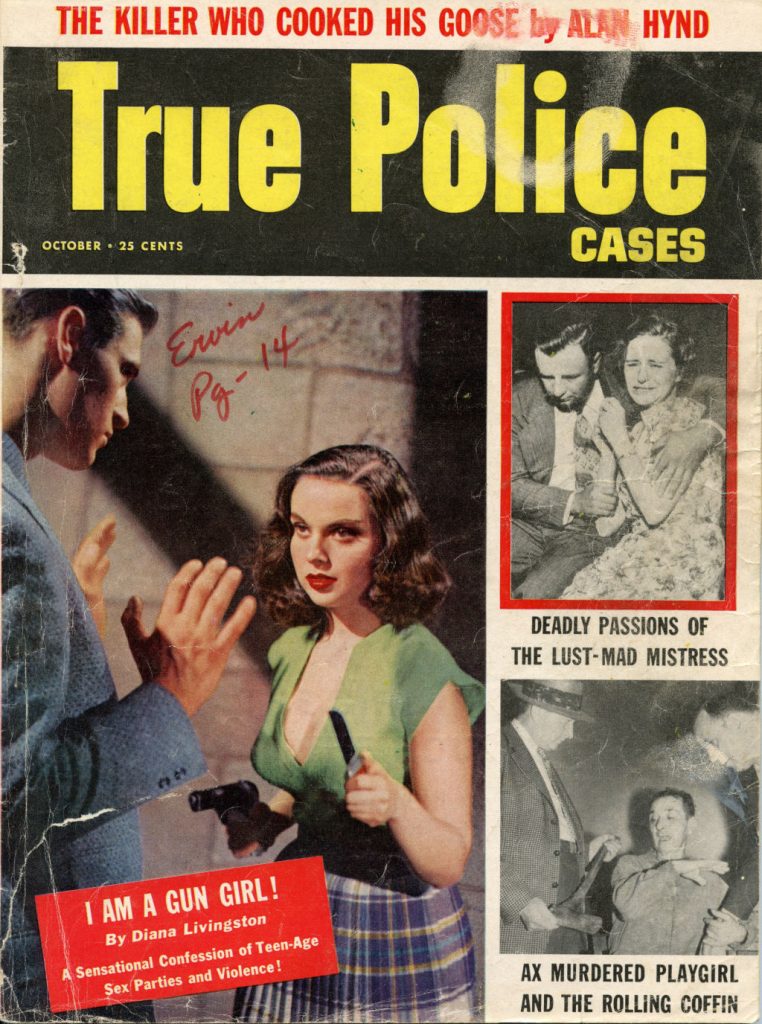
True Police Cases – October 1955

To Love, To Die!

By Louis Adams

The quickest way for a man to make enemies is to cheat at the game of love.

Once too often the handsome farmer plucked at forbidden fruit – and he died.

Frost was just beginning to sparkle in the fields two miles south of Silverton, Oregon, as Emanuel Kellerhals Jr. burrowed deeper under the comforting warmth of the bedcovers to shut out the chill of the night on February 17,1955.

He was tired from his day’s work and as he closed his eyes he was momentarily annoyed by the slam of a car door. The sound came from the direction of his neighbor’s driveway across the road. “Erv Kaser’s home early tonight,” he muttered to his wife.

Suddenly the tiny bedroom reverberated to the shattering roar of a shot close by. “What was that?” Mrs. Kellerhals asked in alarm, rising to a sitting position. Kellerhals jumped from bed and rushed to the window.

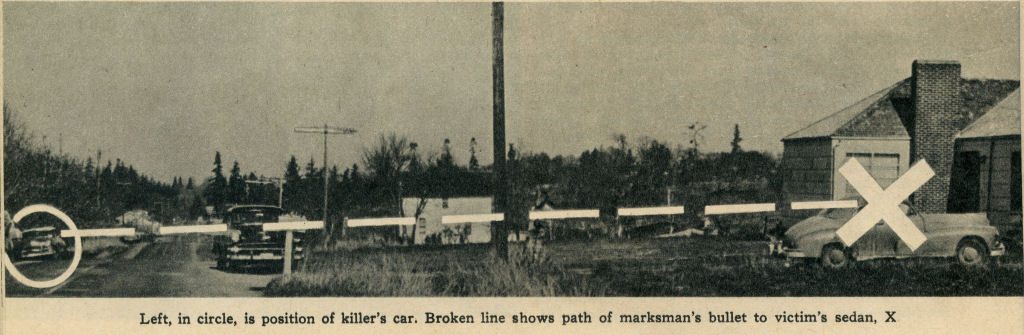
From where he stood, the now thoroughly awakened man could see his neighbor’s sprawling hop farm. Parked in the driveway by the house was Ervin Kaser’s sedan.The dome light was burning. Near the front of his own driveway, Kellerhals observed the shadowy outlines of another car. It appeared to be dark in color.

As he watched, three more shots punctuated the night air and Kellerhals saw vivid flashes corresponding to the sounds. They seemed to come from the strange car in his driveway and, adding force to his visual observations, the motor of the automobile roared into life. The vehicle leaped ahead, and soon its taillights were fading toward Stayton on the Silverton-Stayton highway.

“What’s wrong? What’s going on?” Mrs. Kellerhals inquired anxiously. “Tell me what’s happening out there!”

“I don’t know,” her husband replied, “but it looks as if someone just shot Kaser!”

Kellerhals started to dress, intent on going across the road to see what happened; but then he recalled that there were people better equipped than he to handle such matters. He telephoned Constable Harley DePeal in Silverton.

DePeal contacted Police Chief Raoul Main, and the two men wasted no time in getting to Kaser’s farm. As they pulled to a stop, they noticed the dome light burning in Kaser’s 1949 Plymouth sedan.
The officers rushed up to the car. One glance was all that was required to convince them they needed help beyond that which their own meager departments could give. Constable DePeal called the Marion County sheriff’s office and soon Sheriff Denver Young was on his way from the state capital and county seat at Salem, 13 miles away. As Young left his office he told a deputy to relay the alarm to the Oregon State Police. At the police barracks, Private John Mekkers dispatched State Officer Robert Dunn to the scene.

When the lawmen were assembled, the wheels of a full-scale murder investigation were set in motion.

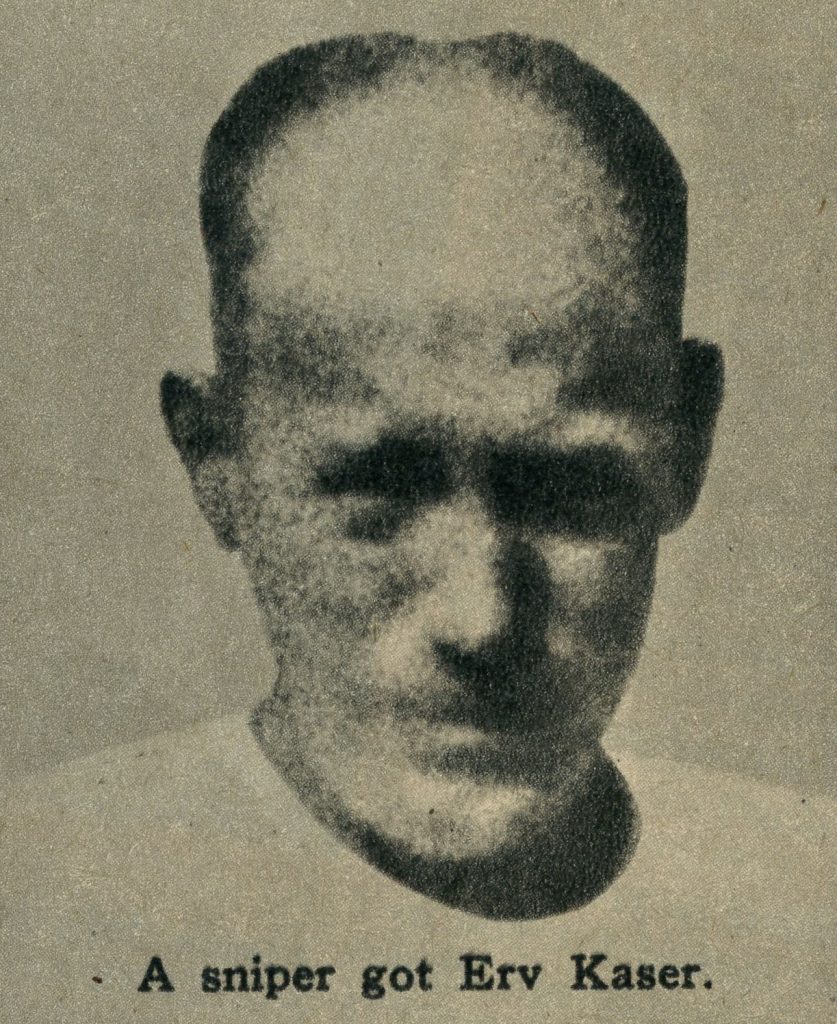
Ervin Kaser was lying on his right side on the front seat of his car, his feet on the brake pedal and the accelerator. Blood from a wound beneath the victim’s read-and-black plaid jacket was congealing in a pool that had formed on the car seat. The initials E. O. K. on the man’s belt buckle reflected the light from the dome of the car.

“From the looks of things, the poor devil never knew what hit him,” Sheriff Young muttered to Officer Dunn.

The state officer nodded, then suggested that this was a job calling for the talents of Dr. Homer Harris of the state crime laboratory.

“Good idea,” Young agreed. “Get him on his way down here from Portland while I call the coroner.”

Dunn radioed to his dispatcher, with instructions to contact Dr. Harris and have him and a fingerprint technician come down. At the same time, he asked for more help and State Officer Lloyd T. Riegel was dispatched.

Meanwhile, Young, Main and DePeal went across the street to talk to the Kellerhalses.

“It’s all so horrible,” said Mrs. Kellerhals. “Why would anybody do such a thing?”

“That’s what we aim to find out,” Sheriff Young said grimly. “But tell us all you know about it.”

Em Kellerhals described what he had seen and heard when he looked out of his bedroom window.

“What do you know about Kaser?” Young asked when the other finished talking. “Perhaps if we know something about him, it will help establish a motive.”

“Afraid there isn’t much I can tell you,” Kellerhals said. “He was always a pretty good neighbor. Kept to himself though. Maybe someone tried to rob him. He was supposed to be pretty well off.”

“How about visitors? Did he have many?”

“Not many – and what few there were, usually came at night. I think they were men he worked with, but I couldn’t recognize any of them,” Kellerhals declared.

The sheriff asked about the car that had been seen pulling away after the shooting.

“It looked like a Ford. Yes, I’m pretty sure it was a Ford. It sounded like one when it started up,” Kellerhals replied. “It was dark colored, maybe black. It looked like a sedan or coach. I couldn’t tell very well. All there was to see by was starlight.
The officers soon perceived that the Kellerhalses could offer little, if anything, more in the way of information. As they started to leave, Police Chief Main asked if he could use the telephone. He said he hated to do it, but someone had to notify Kaser’s relatives about the murder.

“Oh, I’ve already done that,” Kellerhals interrupted. “I called his brother, Melvin. He should be getting here soon.”

The officers thanked him and started to leave, but as they were on their way out the front door, Sheriff Young turned back and asked, “How do you account for the sequence of sounds, Mr. Kellerhals? The door slamming and then the shots?”

“Gosh, I don’t know,” Kellerhals answerd. “Looks to me as if Kaser maybe got out of his car and started for the house, then something warned him so he got back into his car.”

“That’s about the way it looks to me, too,” Young commented. “He probably intended to drive out of there and never had a chance.”

The coroner and Officer Riegel had arrived by the time the lawmen returned to Kaser’s car. State Officer Dunn quickly filled them in on what he had determined. Kaser’s wallet had not been disturbed and everything seemed in order in the house.

“Doesn’t look as if the motive was robbery,” Dunn concluded. Officer Riegel, meanwhile, had his notebook out, jotting down a physical description of Kaser and making a rough diagram which showed the location of the murder car and the approximate position of the slayer’s automobile before it fled.

Ervin Kaser, 49, was of medium weight and about five feet ten inches. His brown hair receded in front, but he had been a comparatively handsome man. In addition to the plaid jacket, he wore a gray shirt, dark twill trousers and tan loafers. A gray felt hat was crushed beneath his head.

A sack of groceries in the back seat indicated that the victim had just returned from shopping.

“Have you searched the area where the killer’s car was parked?” asked Young.

“Yes, but we’ll probably have to wait until daylight if we’re going to find anything that might give us a lead,” Dunn replied.

Dr. Harris and Sergeant Ralph Prouty of the state crime laboratory pulled up just then and they immediately got to work. Prouty began shooting pictures of the scene, after which Dr. Harris accompanied the coroner to the morgue where a preliminary autopsy would be performed.
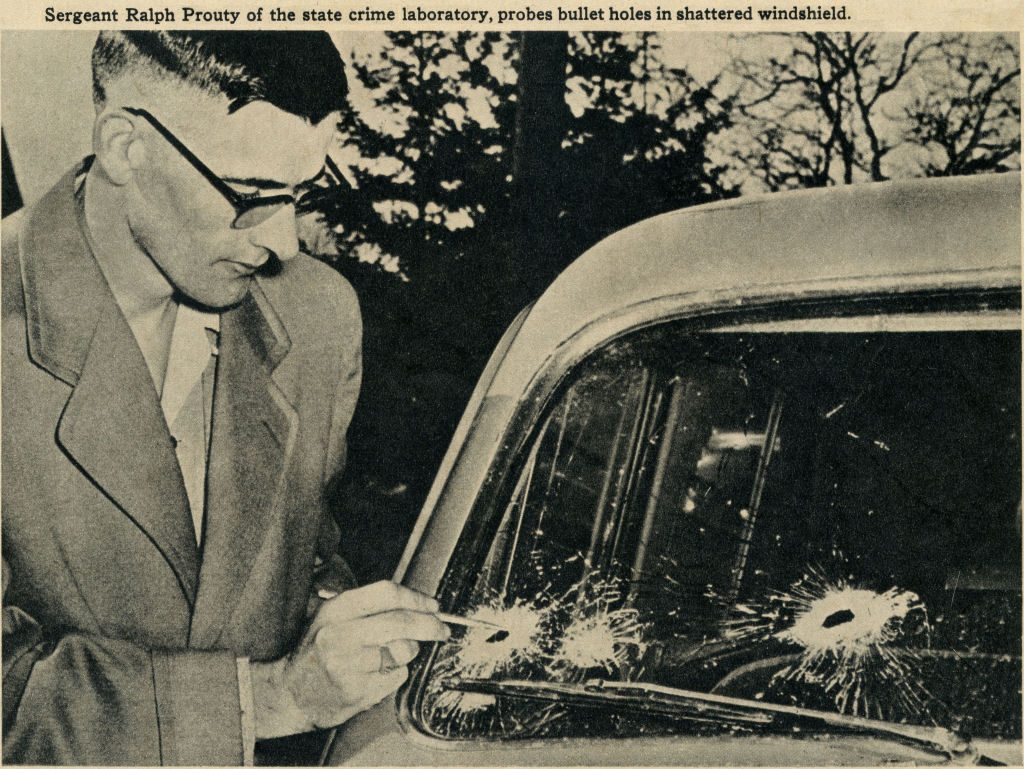
Meanwhile, an examination of Kaser’s sedan revealed that three bullets grouped close together had plowed through the left doorpost; a fourth had gone through an open window and out the windshield. Two of the bullets that had penetrated the doorpost also had gone through the windshield, while the fourth was lodged in Kaser’s body. It struck Kaser in the left shoulder, but did not emerge.

The Kellerhalses had placed the murder car between 50 and 75 yards away from Kaser’s sedan. When Sergeant Prouty learned this he was amazed.

“Whoever did this was a whale of a good shot. Look how closely grouped those shots are on the doorpost,” he said. “Accomplishing that at night is really something.”

Sheriff Young nodded assent. “Of course the killer was helped by the fact that with the dome light on, Kaser made a clear target; but still the sniper is a deadly marksman. We’d better warn the cars that are out hunting him to be careful.” Earlier the sheriff had broadcast a description of the killer’s car and he now issued a warning.

At this point, Constable DePeal introduced Melvin Kaser, brother of the slain man. DePeal stated that Melvin lived just down the road from his brother’s farm and might know something.

Young and Riegel, mindful of the younger brother’s grief over the killing, nevertheless decided to question him immediately rather than wait until later.

“I don’t know what’s behind my brother’s murder,” Melvin Kaser began, “but I can tell you one thing. It definitely was planned. It looks to me as if there must have been other attempts, maybe several times.”

“Why do you think that?” Dunn asked.

“Because the chances are about a million to one for Erv to be parked right where he was shot and for him to have his dome light on to make it easy for the killer.”

“Isn’t there some other reason, too, why you think the murder was planned?” Sheriff Young pressed. “Did your brother have any enemies?”

Melvin Kaser’s brow furrowed in deep thought. He was silent several moments as though weighing something in his mind, then he said:

“Erv was always somewhat of a lone wolf. Sure, he lived next door to me and all of that, but he never told me any of his affairs. He never discussed his friends or where he went. Far as I know, he never had much to do with anybody. Afraid I can’t help you much that way.”

The Silverton police chief, who had been listening, spoke up:

“There’s a lot of talk going around Silverton that Erv was quite a lady’s man. Some say he’s broken up some marriages around here. His wife sued him for divorce not long ago, claiming he was messing around with other women and staying out all night with them. There’s probably several people who won’t be sorry about his death.”

The younger Kaser admitted that he, too, had heard the rumors, but he didn’t know how true they were.

“Well, we’re getting somewhere, at least,” Sheriff Young interrupted. “if we can find out who Ervin Kaser has been dating, we’ll probably find a clue to the killer. This job begins to look like the work of some jealous husband.”

Chief Main nodded agreement. “There’s a carpenter, named Oveross, who lives up the road a way, and I’ve heard that Kaser has been seen with this man’s wife. He might be a good place to start,” the chief suggested.

Sheriff Young thanked Melvin Kaser for his help, conferred briefly with Sergeant Prouty and Officer Riegel, then ordered the carpenter picked up for questioning. “Bring him to my office, and while you’re getting him I’ll talk to District Attorney Kenneth Brown,” the sheriff said.

Casper (Cap) Oveross had lived in the Silverton area all his life. Unlike Kaser, the thin, gum-chewing carpenter was generally well liked by his neighbors. His habitually friendly grin and youthful ways belied his 44 years.
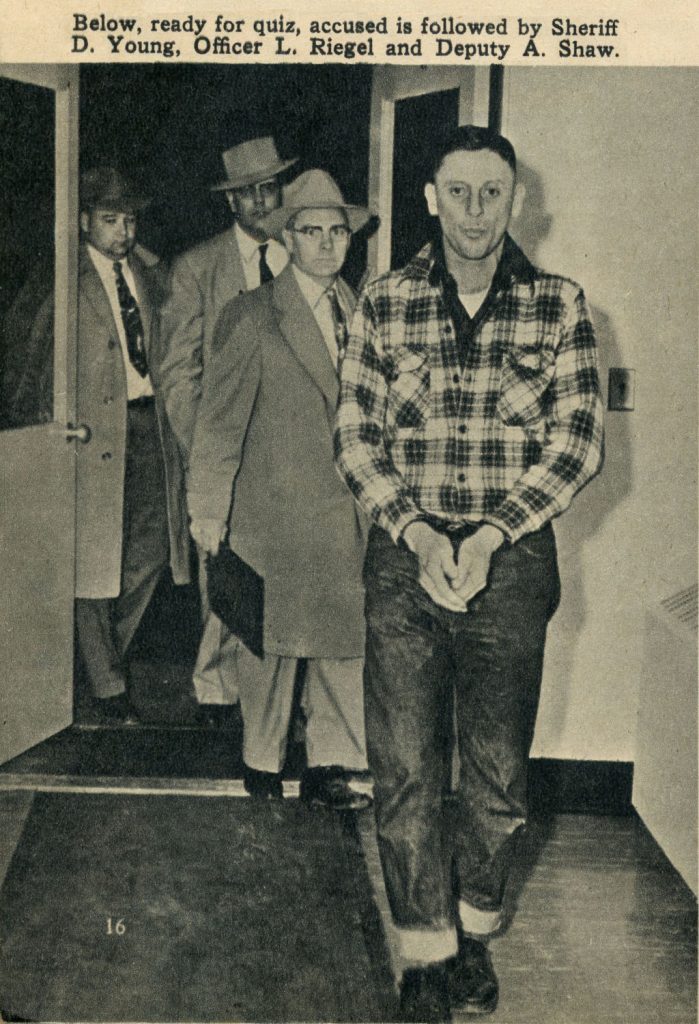
As he entered Sheriff Young’s office and was introduced to District Attorney Brown and State Officer Dunn, Oveross appeared only mildly concerned over being taken from his home in the middle of the night and hustled to the county seat.
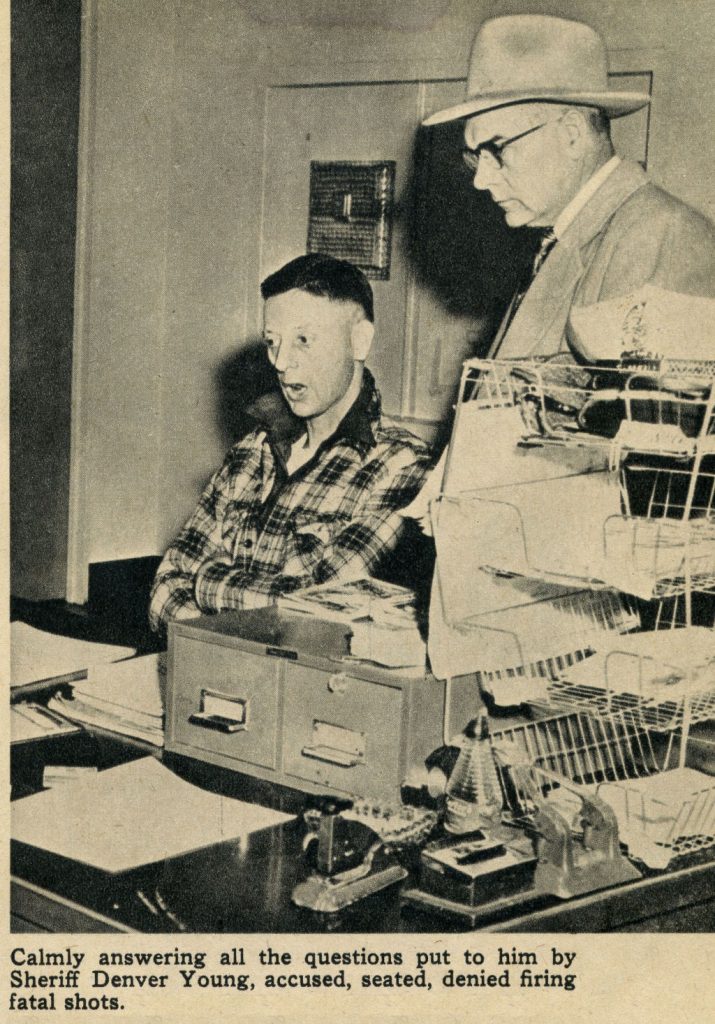
The officers wasted little time in obtaining preliminary information from their plaid-shirted subject. He had been born near Rocky Four Corners on Abiqua Creek north of Salem, had graduated from Silverton High School as had his wife, Ethel, and, for 20 years, had lived less than a quarter mile from the murder scene in the Evergreen community.

Did he like Erv Kaser? No. He blamed Kaser for breaking up his marriage. Yes, he had sued his wife for divorce last fall, just a couple of weeks after Mary Kaser filed for divorce from Erv.

Was he glad Kaser was dead? No more so than probably a lot of other husbands in Silverton.

“Where were you when Kaser was killed?” Sheriff Young asked.

“What time did it happen?” Oveross countered.

The sheriff estimated Kaser died about 10:55 p.m.

“I was probably in a tavern over in Silverton about then,” Oveross said, taking a hitch in his blue jeans. “I was in a couple of them during the evening. I hadn’t even got home when your men came to my place.

“Can you fix the exact time when you were in those taverns?” Brown asked.

“Nope, don’t think I can,” the carpenter replied. “Never looked at the clock.”

“You own a gun, don’t you?” Dunn interrupted.

“Not now,” Oveross replied.

The questioning continued several hours, but Casper Oveross stuck to his story concerning his whereabouts during the evening. He steadfastly denied any part in the killing of Kaser.

At midmorning, weary and disgruntled, Young and Brown retired to another room to talk over what had transpired. They agreed that they were getting nowhere; that Oveross should be set free. Certainly he had a motive, but apparently dozens of others in Silverton also had a motive.

“Let him go,” Brown ordered, “but better check on his wife and Kaser’s wife. Maybe they can offer some hint as to who might want Kaser dead.”

“That’s right,” Young agreed. “From what Oveross tells us, Mrs. Kaser divorced Erv because he was chasing around. She just might know of any threats made against her husband.”

“Yes, and if Oveross is right in thinking his wife was going with Kaser, she might be able to suggest a possible suspect,” Brown commented. “Also, maybe Kaser wasn’t romantically interested in Mrs. Oveross but in some other woman.”

The two lawmen returned to the interrogation room and told Oveross he was clear of suspicion; they suggested, however, that he not leave Silverton for the time being.

“It would help us,” said District Attorney Brown, “if you could fix the time more exactly when you were in those taverns.”

“Sure,” the carpenter replied as he took his departure.

With Oveross tentatively cleared, the officers turned their attention toward other suspects. They also decided to check the divorce complaints in the Kaser and Oveross cases.

On August 6, 1954, they learned, Mary Louisa Kaser, wife of the Silverton hop grower, had filed suit. She charged, among other things, that the “defendant does associate with and keep company with another woman or women from time to time.” Unfortunately she didn’t name names.

On August 20, Oveross sued his wife, Ethel, for divorce, alleging that “for the period of several years, the defendant has associated herself with other men, and particularly one other man to such an extent that such association has become public scandal and gossip in the community in which the plaintiff and defendant live.” Neither did he list names, but Oveross had told police he referred to Kaser.

The Kaser divorce trial had been set for March 17, but the murder changed the situation. Defendants in both actions had entered general denials of the allegations in the complaints.

It was evident the women had to be talked to, so interviews were set up.

Mrs. Kaser was contacted at her Salem apartment where she had moved pending settlement of the divorce action. The trim, 40ish blonde told her interrogators that she had no reason to kill Erv. Certainly she was unhappy about his associations with other women, but she had already handled that matter by filing suit for divorce. She indignantly asserted she would never stoop to murder. Before the officers left, Mrs. Kaser had convinced them she knew nothing of real value to aid their search for the killer.

No better luck was encountered in the questioning of the ex-Mrs. Oveross. Obviously overwrought by all that had happened, she nevertheless tried to be cooperative.

The slender divorcée insisted she knew nothing about the killing; she also didn’t think her ex-husband would have done it even in a moment of jealousy. She startled her interrogators by stating that her twin sister was married to Harvey Kaser, a brother of the slain man.

Saturday afternoon, February 19, nearly 40 hours after the killing, District Attorney Brown announced, “This thing is beginning to go around in circles. We’re getting nowhere. Possibly we’ve been concentrating too much on the Kaser-Oveross situation and the real killer is somewhere laughing at us.”

Arrangements were made with state police headquarters to assign Sergeant Wayne Huffman and Officer Lloyd Riegel to work with Sheriff Young and Deputy Amos Shaw until the case was solved, no matter how long it took.

The authorities went into a huddle and sifted through the information already at hand: Kaser was killed at 10:55 p.m., and a dark car had fled from the scene. So far as was known, only Emanuel Kellerhals and his wife had seen that car, and their look at it had been hindered by darkness. Perhaps someone else had seen it under better conditions.

With the help of Silverton officials, a map was drawn which listed every house in a five-mile radius of the Kaser home, particularly those along the Silverton-Stayton highway. Huffman and Riegel were assigned to check each of the houses to determine whether anyone else had seen the murder car. They also decided, for a few nights at least, to stop every car on the highway on the theory that people have pretty definite habits, and some motorist who normally traveled between Silverton and Stayton at that time would have seen something significant.

Sheriff Young and Deputy Shaw, meanwhile, agreed to check other possible suspects. They already had learned that the shot which killed Kaser was fired from a .30-caliber rifle and that the fatal bullet had been either a “lucky” shot or aimed by a perfect marksman.

The rifle slug had punctured the left lung and the arch of the aorta, the great trunk artery from the heart.

“Let’s go over to Silverton and see what we can learn about marksmen,” Young said to his deputy.

Several hours later the two teams met over a cup of coffee to compare progress.

Huffman and Riegel so far had found no one other than the Kellerhalses who had seen the killer’s car, but they had some other interesting information.

“We kept getting the story that Kaser was involved with other men’s wives,” Sergeant Huffman reported. “He also had money problems. He was a hard bargainer with people who worked for him in his hop yard, and there’re stories going around that he didn’t pay some of them.”

“Say, that’s worth checking further,” the sheriff interrupted. “Maybe he fought with one of those workers and the fellow he fought with went for him with a gun.”

“We’re way ahead of you there,” Riegel said. “We’ve been busy compiling a list of former employes and have talked to some of them. Haven’t come up with anything definite yet. However, it should be pointed out that we’re checking stories circulated by people who don’t like Kaser. We’ve heard some good things about him, too, that indicated some of the stories might be distorted.”

Young and Shaw had something to report, too. They had learned that Kaser received a telephone call from eastern Oregon the day before the shooting.

“The phone company is looking that up for me now, and when we’ve got the information, I think someone had better go over to eastern Oregon to see what it’s all about,” the sheriff said. “That call may tie in with the murder.”

The teams separated again, Huffman and Riegel to continue looking up former employes of Kaser; Young and Shaw to make a round of taverns where Oveross said he had been at the time of the murder.

The latter team ran into something at the first tavern they visited. James Lowrie, bartender, said Cap Oveross was an excellent shot – one of the best in the area. He didn’t believe the carpenter had killed Kaser, however –“even though he had good reason” – because Cap was too easy-going to be a murderer. Further, he had been in the tavern the night of the shooting.

“Why do you say he had good reason to kill Kaser?” Shaw asked.

“Because everyone knows Kaser was making a play for Mrs. Oveross. Why, they were together just before the shooting,” Lowrie retorted.

“How do you know that?” Young shot back.

“One of my customers saw them in Kaser’s car driving along the road to Silver Creek Falls State Park,” the bartender replied.

Young and Shaw questioned Lowrie further, learning that he could not definitely fix the time Oveross had been in the tavern. Thanking the bartender for his help, the officers proceeded toward the state park. En route they called for Huffman and Riegel to join them.

Arrived at the popular park grounds, the officers again compared notes and then set about checking nearby houses to determine if anyone had seen the dark sedan that had been at Kaser’s farm. The theory had been suggested that the killer was trailing Kaser on the fatal night. Nothing significant was turned up, so back to Silverton the lawmen went. There questioning of townspeople disclosed that, on the night of the shooting, Mrs. Oveross had been at a lodge meeting, had left for a time, presumably to meet Kaser, and then had returned to the lodge.

“This thing keeps leading right back to the Overosses,” Sergeant Huffman told his fellow officers. “I’ll bet Cap Oveross heard about them meeting Thursday night and trailed Kaser home and killed him.”

“We found out he was a crack shot, too,” Sheriff Young added, “and he’s wrong when he said he had no gun. He’s said to have several. Let’s go talk to him again!”

This time Casper Oveross was not so friendly when police arrived at his home. He grudgingly admitted he had access to some rifles, but said, “You’re mistaken if you think I told you before that I don’t have a gun.”

“Why don’t you tell us about killing Kaser?” Young demanded.

“Listen,” Oveross retorted indignantly, “I’m getting tired of all this monkey business. We went all through it the other night. Now you birds lay off or I’m calling in my attorney.”

“If you’re innocent, then let’s run a lie detector test and prove it once and for all,” Shaw suggested.

“Why should I? It’s just more of the same old malarky. I’m not having any part of it,” the carpenter lashed back.

Basically, the interview produced no more results than the first one, but three rifles Oveross had access to were rounded up for examination by ballistics experts at the crime laboratory.

That night in Salem the officers related their findings of the day to District Attorney Brown.

“It’s getting more complicated all the time. Looks as if a batch of people, not only Oveross, had motives,” Brown commented when they were through.

“You know, I think the key to this whole thing is the murder gun. We’ve got to find it, then we’ll know who the killer really is,” Young said.

“What about the guns you got from Oveross?” Brown asked.

“They’re being checked, but we don’t think any of them is the right one,” Huffman informed the DA.

Before the meeting broke up, it was decided to pick up every .30-caliber weapon in the area for checking by ballistics experts and to drag every stream and pond in case the killer had disposed of the gun.

Sunday, February 20, 1955, saw policemen knocking at every door asking for guns. Residents were surprisingly cooperative and soon a sizable arsenal was on its way to Portland to the crime lab.
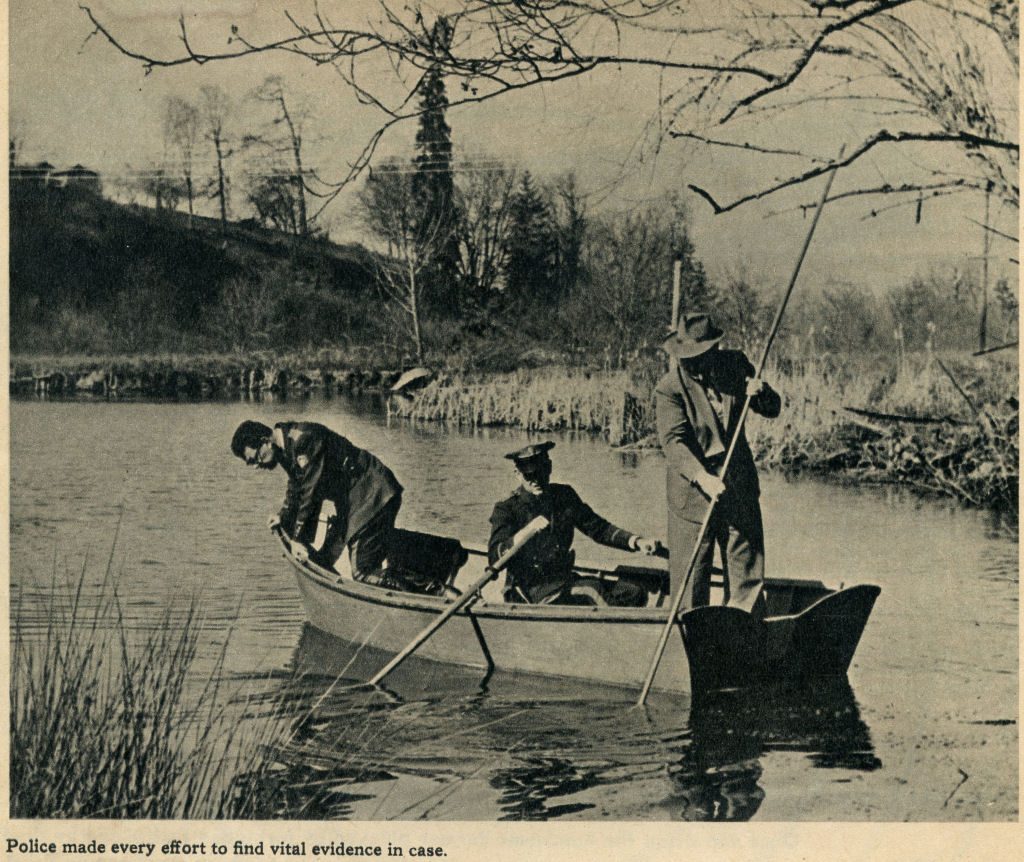
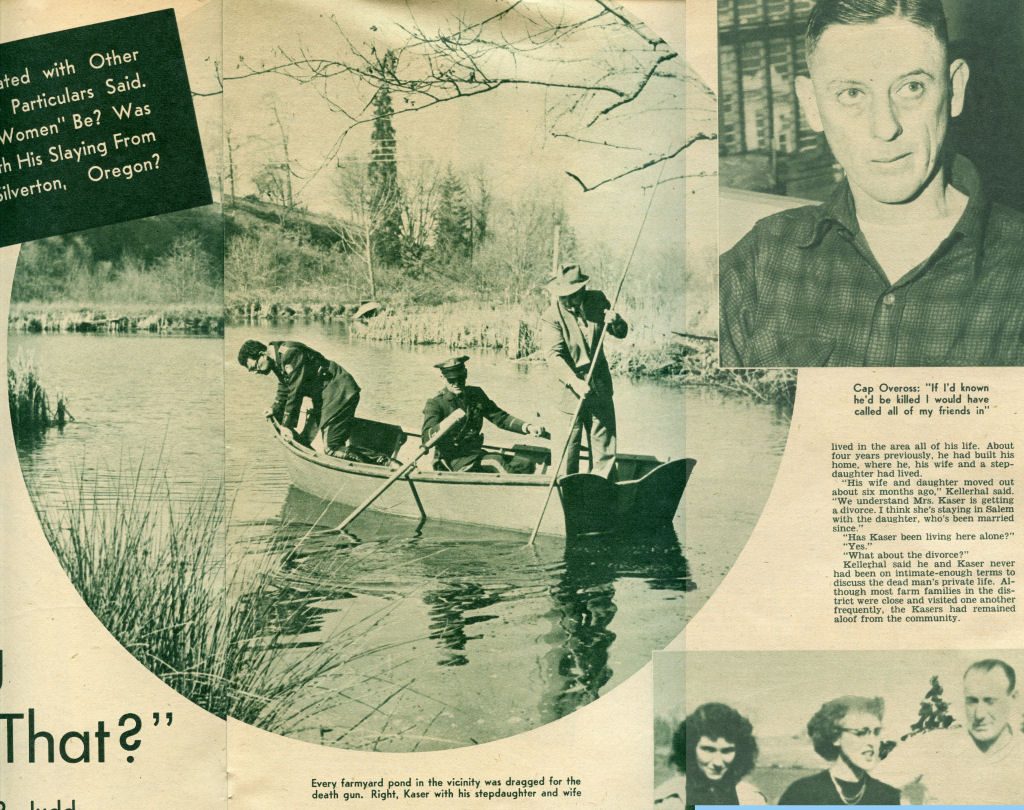
Other officers in boats probed all local bodies of water. Dragging operations on two ponds within earshot of the death scene were discontinued when a farmer reported no cars had used the road on Thursday night.

Meanwhile, State Officer Dunn, who had been sent to Madras in eastern Oregon to investigate the Kaser telephone call, returned to report it had no connection with the murder.

Late Sunday, Sheriff Young learned that Oveross had a target range behind his home where he test fired rifles for several of his friends. The sheriff directed that bullets be dug from the range and compared with the one taken from Kaser’s body.

Monday the search for the gun continued, and again on Tuesday morning.

It was late Tuesday afternoon that District Attorney Brown received a call which set him wondering about Paul Hatfield, a friend of Oversoss’ pretty 17-year-old daughter, Colleen. The person who called said the youth knew something.

Young Hatfield was extremely nervous and reticent when police started talking to him. He denied having had anything to do with the murder, but when the questioning swung to Oveross, he became agitated.

“I guess I’d better tell you,” the youth is alleged to have answered. “Cap came to my place a few minutes after the shooting. He said, ‘Kaser’s got three slugs in him and you’ve got to be my alibi. If anybody asks, I was with you last night.’”

Brown jerked his head for Young and Huffman to follow him into another room.

“If what the boy says is true, it looks as if we’ve hit pay dirt,” he said. “Bring Oveross in.”

A short time later, armed with a Marion County District Court warrant charging first-degree murder, Deptuy Sheriff Amos Shaw and State Patrolman Lloyd T. Riegel located Casper Oveross at the home of his niece in Silverton.

Oveross indignantly refused to accept his copy of the warrant, but he offered no resistance as he was taken back to Salem and booked into jail. The officers also impounded his 1950 black Ford coach and stored it in a Silverton garage.

All the way to Salem, the rough-clad carpenter refused to answer questions, and when he arrived at the sheriff’s office all he had to say was: “I’m waiting for my attorney.”

It wasn’t long before Defense Attorney Bruce Williams appeared and, after a brief conference with his client, told newspaper reporters there was no evidence whatsoever against Oveross and he would demand the earliest possible preliminary hearing or, failing that, a writ of habeas corpus to free his client from custody.

The next morning, Oveross was arraigned before District Judge Edward O. Stadter Jr., and was granted a March 2, 1955 preliminary hearing. He displayed the same unruffled composure as had marked his behavior almost from the beginning.

That same day, in Marion County Probate Court, Kaser’s widow, Mary Louisa Kaser, was appointed administratrix of her dead husband’s estate. Probable valuation was listed as $10,000 in real property and $1,000 in personal property.

Later, District Attorney Brown called the officers together. “Just because that boy claims Oveross wanted him to serve as an alibi doesn’t mean that Oveross is guilty. Oveross could have heard of the shooting and have known he would be the logical suspect,” the DA said to the gathered men.

When Huffman and Riegel returned to Silverton they found the town buzzing. Some people refused to believe that likable, easygoing Casper Oveross could have had anything to do with the crime. They said they would never believe it until the sheriff’s office proved it beyond a doubt.

Others said that if Oveross did fire the fatal shots, he only did it to scare Kaser – not to kill him. “Why, those shots came so fast that it should prove the rifleman had no intention to hit anyone,” a service station attendant said. “Anybody who deliberately was trying to kill a man under starlight would take a long time between shots.”

Thursday, February 24, 1955, one week after the murder, Dr. Harris and his assistant, Sergeant Prouty, returned to Silverton from Portland to pick up clothing found in Oveross’ car and to examine the interiors of both the Oveross and the Kaser cars.

The next day, District Attorney Brown again conferred with his officers, reviewing all of the evidence that had been collected. There still were some unanswered angles and the murder weapon still had not been discovered, but the DA decided to take the case to the grand jury on the following Monday.

Defense Attorney Williams objected bitterly when he heard the news, then said he would not permit his client to appear before the jury.

A parade of 17 witnesses started going into the grand jury rooms at 9:30 a.m. It included Sheriff Young and Dr. Harris, plus relatives of both Kaser and Oveross. At 4 p.m., the jury made its report to Circuit Judge George R. Duncan.

The jury failed to find the evidence sufficient to support an indictment. Oveross was released, completely exonerated.
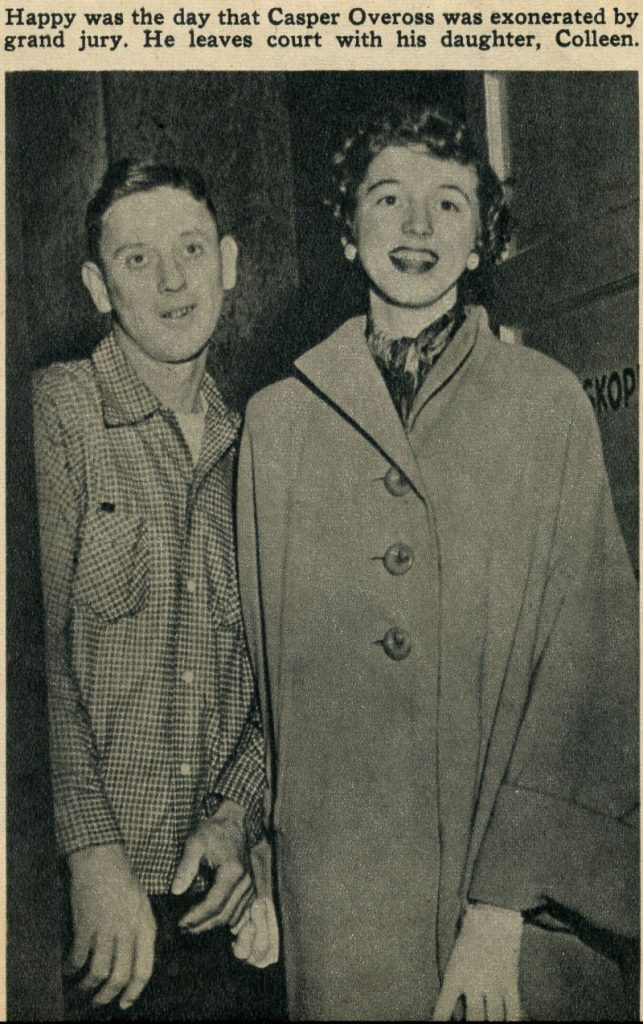
District Attorney Brown summoned the police authorities to his office. “We’ve got to start all over again. The murder of Ervin Kaser has got to be solved.”

The Officers reviewed again the facts and rumors they had gathered. Finally Riegel spoke up:

“It still goes back to that missing gun. We’ll have to find it.”

“There’s more to it than that,” the DA said. “Since Oversoss isn’t the guilty party, then it means there’s a killer loose somewhere around here. We still don’t definitely know he’s a jealous husband. He could well be a trigger-happy madman and he may strike again.

“I suggest we call for public help in locating that gun. Maybe the American Legion or the Boy Scouts or some similar group can help search.”

“We’ll keep on looking,” Sheriff Young promised grimly. “We’ll check every hardware store from here to Portland if we have to, and find out who bought 30-30 shells. Then we’ll go to their homes and look at those rifles. We’ll find that rifle and we’ll get the killer!”

The days changed to weeks and the weeks to months, and still the search went on. By the first of May, 1955, more than 100 persons had been talked to. Dozens of ponds were dragged. Dozens of hardware stores were checked. Still no luck.

Then Sunday afternoon, May 8, Larry Wacker, 12, of Salem, was playing along the banks of the Pudding River near the small community of Pratum. The spot was five miles by road from Kaser’s farm. Suddenly the boy pulled what he thought was an iron rod from the river. It was a .30-30 rifle.
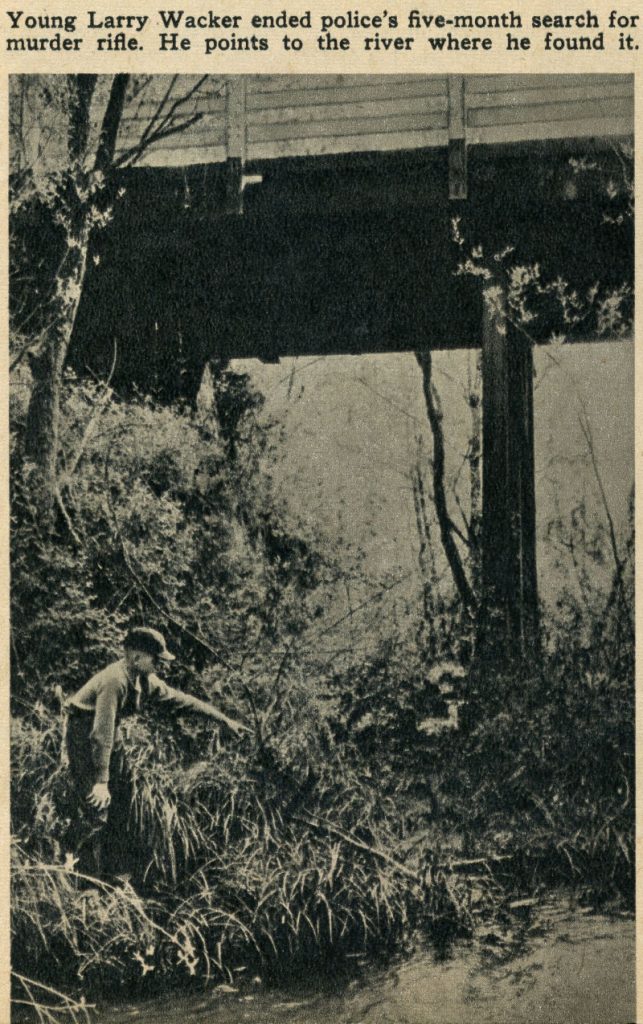
The boy excitedly turned to his companions, Neil Beutler, 11, and Roger Beutler, 8, and said, “Look what I’ve found!”

The gun was crusted with rust, but young Wacker managed to work the lever. The gun ejected an empty cartridge. A live cartridge still was in the chamber.

The boys rushed to the John Ross home where their parents were visiting. When the fathers examined the gun, they immediately notified the authorities.

Sheriff Young examined the rifle, and was elated. “There is a good possibility this is the murder weapon,” he declared.

The gun and cartridge were immediately sent to the crime laboratory and now the officers redoubled their efforts, this time to determine whether anyone had seen the dark-colored murder car in the vicinity of the Pudding River bridge at any time after the shooting.

On May 12, Sheriff Young received a telephone call from the crime laboratory. When he hung up the phone, he turned to his co-workers and said:

“That’s the death weapon. We’ve got the gun now, the right one. Now all we’ve got to do is prove ownership.”

When District Attorney Brown was informed, he said, “I don’t think we’ll have any trouble showing that Oveross had that gun. I’ll call the grand jury into session again.”

He was even more certain later that afternoon when the sheriff called him to report that a witness had been found who claimed he had seen Oveross near the Pudding River bridge the night of the murder.

On Monday, May 16, 1955, a new grand jury heard the now mountainous pile of evidence in the case. This time police were able to produce a murder weapon. Because of their exhaustive canvass of hardware and sporting-goods stores, they had reason to believe that Oveross had bought one like it; the district attorney was able to present ballistics findings that were not available for the first grand jury.

The jury did not take long to indict Cap Oveross with first-degree murder.

Then the officers got a shock. Oveross was not in Silverton. He reportedly was somewhere in northern California visiting relatives. Defense Attorney Williams, however, was unconcerned. He told police he was certain his client would return home as soon as he heard of the indictment.

The attorney was correct. A few days later, at Fairbanks, Alaska, where he had been working on a construction job, Oveross walked into the office of the U. S. Attorney and identified himself. He had just learned of the indictment and was anxious to prove his innocence. Sheriff Young and Sergeant Huffman soon went to Alaska to accompany the carpenter back to Silverton.

Oveross still maintained the same calm as before when he was returned to Salem. He still declares he is innocent and is ready to clear himself of the murder charge in court.

NOTE: The names James Lowrie and Paul Hatfield, as used in the foregoing account are fictitious to protect the identities of the persons innocently involved in the investigation.

NOTE: Obviously, Paul Hatfield was really Dan Gilham.


And that’s it for the second magazine. Next up, the third magazine, Real Detective.

Blogically yours,

Everett
Not Innocent: The Idiot Magazines (Part 1) – Official Detective Stories

In every era, there is always some form of mass entertainment masquerading as news or true stories. Today we have reality TV and endless forms on the internet. In the 1950s, there were at least three “true crime” magazines that carried the ‘story’ of Ervin’s murder. Each of them sensationalized the story to a certain degree, some more than others. They all re-arranged the sequence of exactly what happened (in order to make a better story for their readers), made up dialog they couldn’t possibly have known (as if they had been in the room while the police were interrogating people), and sometimes just got the facts wrong. So, the stories in these magazines should be read with that in mind. These should be the last resort for information about the murder and thrown out entirely when they contradict the police reports.

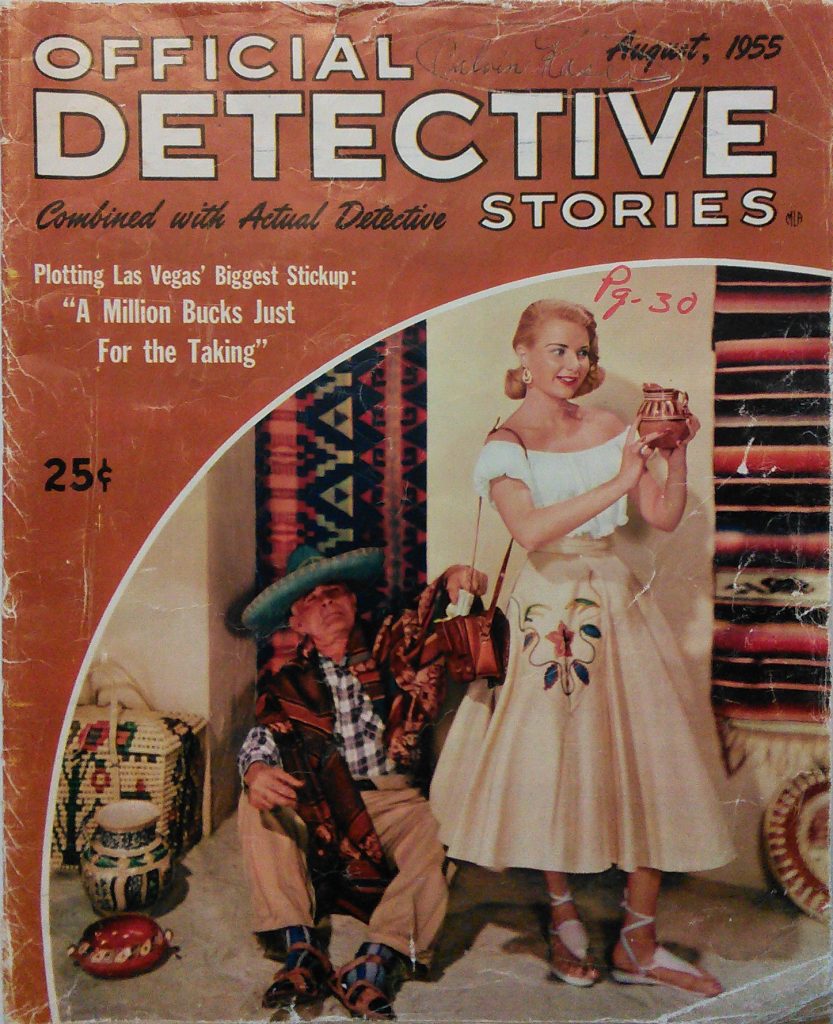
With that said, here’s the first of them: Official Detective Stories from the August 1955 issue. This would have been written in early June of 1955, as Cap Oveross was returned from Alaska in the very last days of May, and the trial started just over three weeks later, June 21, and this magazine story ends with Oveross awaiting trial. Magazines are generally “post-dated” by about 2-3 months in an effort to keep them on the newsstands longer, so this issue would have appeared in either June or very early July 1955.

The cover is apparently the east-coast publisher’s idea of what shoplifting in Mexico looked like: let’s throw in a few pots and baskets, a few seemingly Mexican wraps or blankets, what looks like a businessman in a poor-man’s Halloween costume, and what appears to be a Doris Day want-to-be as a southern senorita. I guess they didn’t have much of a budget for their cover art…

Cover of August 1955 Official Detective Stories

Official Detective Stories – August 1955

“Me, I Shoot. Anything Wrong With That?”

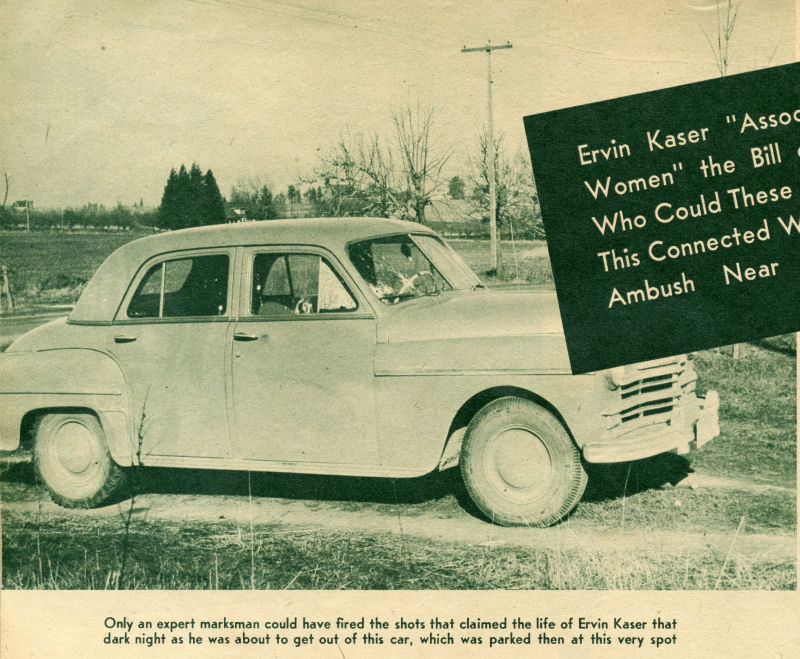
Ervin Kaser “Associated with Other Women” the Bill of Particulars Said. Who Could These “Women” Be? Was This Connected With His Slaying From Ambush Near Silverton, Oregon?

The first shot brought Emanuel Kellerhal upright in his bed. He and his wife had retired at 10:30 Thursday evening, February 17, 1955. It was now 25 minutes later.

The second shot took him to the window, where he could see across the highway to the ranch home of his neighbor, Ervin O. Kaser.

A pair of headlights illuminated the driveway, garage and front of the Kaser house.

The third and fourth shots exploded and Kellerhal could see the dirty orange flame of the blasts, for they were fired just beyond his window from a car parked in his own driveway.

A car motor roared. Tires whined and there was a hailstone sound of gravel being thrown by the spinning wheels. And then the silence of night that comes to those who enjoy the seclusion of country living.

The Kellerhal and Kaser hop-growing ranches are in the rural district of Evergreen, three miles south of Silverton, Oregon.

“What is it?” Mrs. Kellerhal asked.

“I don’t know,” her husband answered, still peering out of the window. “I can see Kaser’s car in his driveway. Somebody must have been shooting at him.”

“Shooting at Mr. Kaser? Why?”

Kellerhal turned away from the window and picked up his trousers.

“What are you going to do?” his wife demanded.

“I’d better get over there and see what’s the matter. Nobody’s moving around. Maybe Kaser was hit.”

“Please don’t,” Mrs. Kellerhal said. “Call the police.”

“You call them.”

“No, you call. It’s their business. Please stay here until they arrive. If some fool is shooting out there –”

“They’ve gone. I saw them leave.”

“It makes no difference. Call the police and we’ll wait.”

Silverton Marshal Harley DePeel was the first to arrive. He was followed shortly by Marion County Deputy Sheriff R. C. Boehringer. Within a few minutes more sheriff’scars and State Police rushed into the area.

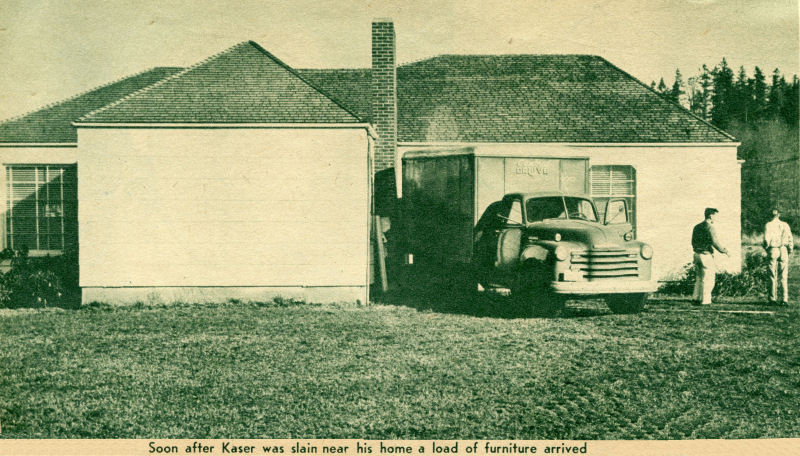
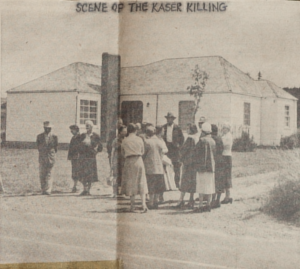
The Plymouth sedan owned by Kaser was parked almost beside the front door of his neat, nearly new white frame cottage. Its motor was stopped but the headlights and the dome light inside the car were burning.

Kaser was slumped on the right side of the front seat. Blood had spilled onto the floor mat.

A hole was drilled through the glass of the front door on the left side of the car. It probably had been made by a shot that had struck Kaser in the shoulder and penetrated his heart, killing him instantly.

Three other holes made a tight pattern in the frame of the front door, the post and the forward edge of the rear door.

Boehringer eyed the 75-yard distance across the front yard and the highway to the spot where Kellerhal said he had seen the other car. “Whoever he was, he was a marksman,” the deputy said. “That kind of shooting would win a medal on a target range.”

Kellerhal was questioned. He could not name the make of the car he had seen. “All I can be sure of is that it was a dark color. Maybe it was a Ford, but I couldn’t be certain.”

And he had not seen the killer, nor anyone else in the automobile. “Its lights were off and I didn’t notice it until I heard the third and fourth shots. I was looking over at Kaser’s place. Then this other car sped away.”

“How long after the shots?”

“Right away.”

“There wasn’t any pause?”

State Police Patrolman Robert Dunn was trying to determine if enough time had elapsed for the person who fired the shot to put down the gun and then start the car.

“It didn’t seem like any time at all.”

“Then two persons must have been in the car,” Dunn surmised. He radioed State PoliceHeadquarters and asked for a road block around the area. All cars would be stopped and their occupants questioned. The officers would search each automobile for the gun that had been used in the slaying.

Why had Kaser been ambushed?

The police officers readily realized that the killing had not been motivated by robbery. This was something personal between the victim and his slayer.

No attempt had been made to burglarize Kaser’s house or rob his person. The killer had fired the shots with the sole purpose of getting Kaser.

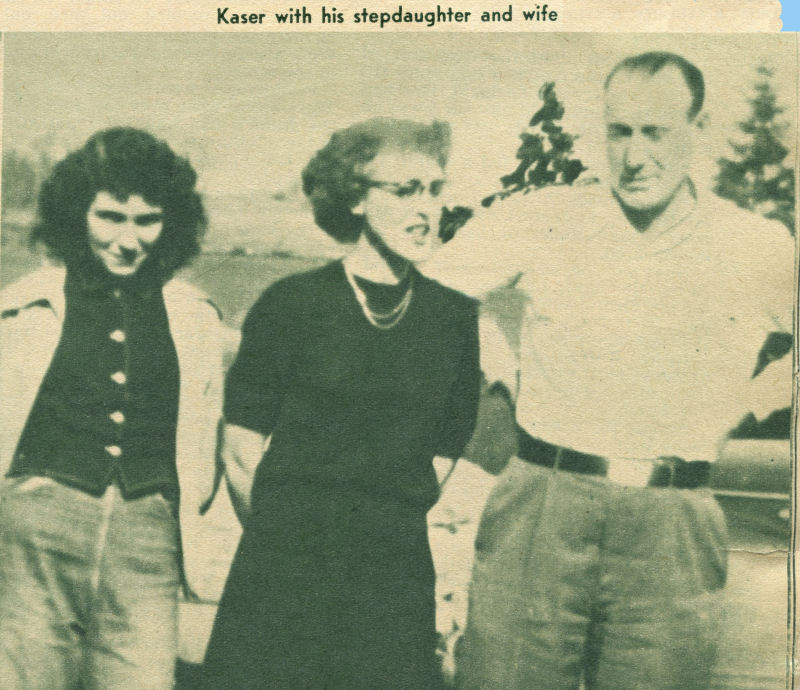
Kellerhal could tell the officers little about his neighbor, although Kaser had lived in the area all of his life. About four years previously, he had built his home, where he, his wife and a step-daughter had lived.

“His wife and daughter moved out about six months ago,” Kellerhal said. “We understand Mrs. Kaser is getting a divorce. I think she’s staying in Salem with the daughter who’s been married since.”

“Has Kaser been living here alone?”

“Yes.”

“What about the divorce?”

Kellerhal said he and Kaser never had been on intimate-enough terms to discuss the dead man’s private life. Although most farm families in the district were close and visited one another frequently, the Kasers had remained aloof from the community.

“Since his wife’s been gone,we’ve seen some men there at nights. We guessed maybe they were having a poker party. I’ve heard talk that Kaser liked to gamble.”

This could be a motive. The officers quickly seized upon it to ask more questions. They wanted to know if Kellerhal had recognized any of the men who had come to the house in the evening.

Kellerhal said that while he had paid no particular attention to the visitors at Kaser’s house and the men usually arrived after dark, he was almost certain they were not residents of the community. “Otherwise, we’d have heard talk.”

“How about the cars? Do you recall any in particular?”

Kellerhal could give no help on this point either.

About this time, Sheriff Denver Young and State Police Sergeant Wayne Huffman arrived on the scene. They examined Kaser’s car without disturbing the interior for Doctor Homer Harris, a pathologist, and Ralph Prouty, a criminologist with the State Police Crime Laboratory, were on their way.

Of the four shots that had entered the side of the car, two had gone out through the front windshield. One had struck the windshield and lay spent on the floor. The fourth was in Kaser’s body.

Sheriff Young directed a search for the two slugs that had gone through the windshield. A second search was started for any shell casings at the place where Kellerhal had seen the bullets fired.

However, no casings were found. Either the slayer had used a gun that did not eject its empty shells or he had fired from inside a car and the ejected shell casings were still in his auto.

Inside Kaser’s car was a sack of groceries on the back seat and the dead man clutched a carton of cigarets in one hand.

Apparently Kaser had turned on the dome light of his car and slid over to the right side of the front seat, preparatory to lifting the sack of groceries, when he was shot. The light inside the car had given the slayer an illuminated target.

Sheriff Young wanted the answer to one question right away. Had the killer been waiting in ambush for Kaser to return home, or had he followed Kaser’s car?

To the Sheriff, the answer meant a difference in the theories that could be formed for a motive.

Anyone planning the crime in advance, which would indicate a motive of long standing like a grudge, would have known where Kaser lived and his habits. He could have waited for Kaser to come home.

But if Kaser had been followed, then the motive might be a spur-of-the-moment decision, based on something that had happened during the evening. The slayer could have followed him from wherever he had been during the evening and used the first opportunity to send home the lethal slug.

Kellerhal had said that he heard Kaser’s car turn into the driveway across the highway and had heard the second car follow it within a few moments.

“I though the people in the second car also had gone into Kaser’s place,” Kellerhal said. “I remember thinking at the moment that Kaser probably was going to have another of his poker parties.”

Doctor Harris and Prouty arrived during this questioning. They recovered the spent slug inside the car and Prouty examined it carefully.

“I’d guess it to be about a thirty-caliber rifle slug,” he said. “It’s pretty badly mushroomed, but we may find enough land and groove marks on it to identify the gun if it can be located. We’ll also have a chance from the slug in the body.”

Photographs were made of the scene. The officers went over the area where the killer’s car had been parked in hopes of obtaining imprints of the tires but the graveled surface foiled this attempt.

A few minutes later Marshal DePeel came up to Sheriff Young and Huffman with some information. “I’ve been canvassing at the edge of town,” he said, “and I heard that two fellows who live out on this road left town at about the time that would bring them past here when the shooting took place. They are Ray Jackson and Fred Barto.”

“Do you know anything about either of them? Anything that might connect them to a feud with Kaser?”

“I know both of them. They’re nice fellows with families. We can go out and talk to them and then, on the way back, I guess we’d better notify Kaser’s relatives, his brother and his mother.”

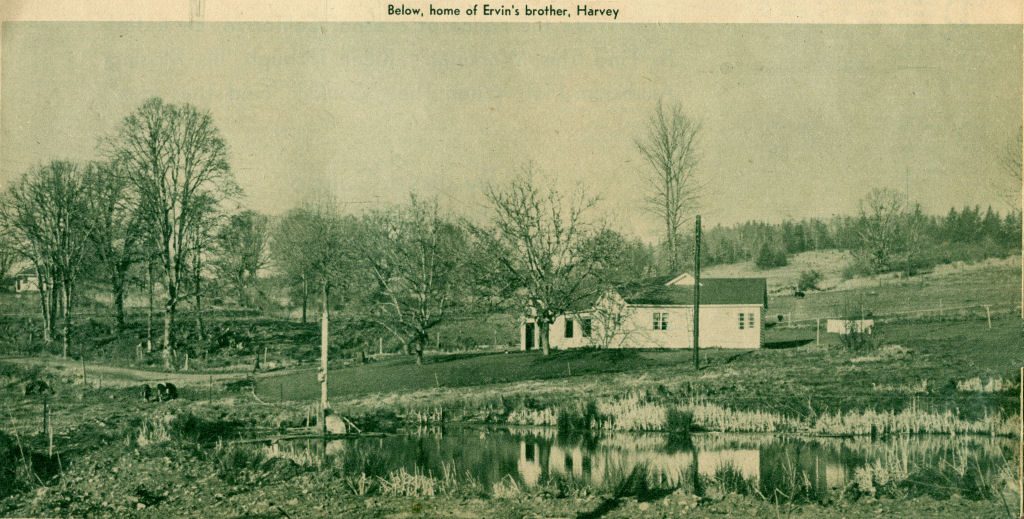
Kaser’s brother, Harvey, had a ranch about a half mile down the road. His mother also lived near by on the old family farm. Kaser’s father, who had passed away, had been one of the pioneers in the section. Two other brothers also lived in the area; a fourth brother lived in Bay City and a sister in Salem.

“The Kasers are a fine old family in this section,” DePeel said. “Folks aren’t going to take it kindly that Ervin has been killed.”

“It’s a break that he’s an old-timer,” Huffman said. “Maybe from all the friends and relatives we can come up with a motive.”

The officers went to see Ray Jackson first. The young farmer was already in bed. Barefooted and in his nightshirt, he invited the officers inside, expressing shock at the news that Kaser had been slain.

“What time did you get home?” Huffman asked.

“Ten fifty-five exactly,” Jackson declared.

Huffman’s eyes narrowed at the answer. Kaser had been killed at exactly 10:55, according to Kellerhal.

“How are you so sure of the exact time?”

“I looked at the clock when I came in.”

“Where were you tonight?”

“At the wrestling matches.”

DePeel said: “They weren’t over by that time. I was at the matches when I got the call Kaser had been shot.”

“I know. But I promised my wife I’d be home by eleven and I left before they were finished.”

Jackson claimed that he had seen nothing unusual along the highway on this way home and had not noticed any cars parked at Kaser’s place as he went by. If his story were true – and the officers had nothing to disprove it –he must have passed before Kaser and his slayer had arrived.

At the Fred Barto ranch, Barto told the officers that he had seen Kaser’s car parked in the driveway at the time he had gone past.

“I saw the headlights and slowed down, thinking he might be backing out,” Barto declared. “But the car was standing still so I went on by.”

Kellerhal had told the officers that he had not heard any other cars come down the highway after the slayer’s machine had left. But he might have been telephoning at the time Barto had passed, or Barto might have scooted by before the shooting.

Someone already had telephoned Harvey Kaser with the news that his brother had been killed when the officers reached his home and Harvey was getting ready to leave.

He drove to the scene with the officers while Huffman and Young questioned him. He claimed he knew of no reason for anyone to kill his brother.

Questioned about the divorce, Harvey said the only dispute still involved in the separation of his brother and sister-in-law was over a property settlement.

“Their marriage just didn’t work out,” Harvey declared.

Pressed for any other possible motives, Harvey recalled that his brother had been involved in a dispute with a bulldozer operator who had done some work on the ranch.

“This man didn’t do the job the way Ervin wanted it done and Ervin said he wouldn’t pay him unless he did it over. The guy refused and threatened to sue Ervin,”Harvey said. “I heard he threatened to punch in Ervin’s head.”

The man was Sam Lord, a contractor of Salem, the state capital, only fifteen miles from Silverton.

Huffman radioed State Patrol Headquarters in Salem to have Sam Lord questioned at once to determine the man’s movements during the evening.

Harvey was asked about the poker parties at his brother’s home.

“Ervin liked to play cards, but the stakes weren’t big,” he replied. “I doubt if that could have anything to do with this. All the fellows he played with were his friends.”

Harvey gave the officers the names of a number of the players. They would be questioned later to determine if any quarrel had developed as the result of the card games.

Back at the scene, Docter Harris and Prouty had concluded their investigation of the physical evidence and had the victim removed from the car. With Harvey’s permission,the body was taken to a mortuary in Salem where an autopsy would be performed in the morning.

The road blocks around the Evergreen area were maintained throughout the night and although several hundred cars were stopped and searched and the occupants questioned, no one was found who could be considered a suspect in the slaying.

One lead was reported by a motorist who said he had seen a dark Ford sedan speed through a stop sign at the Paradise Alley intersection on the way to Silverton at about ten minutes after the slaying. It might have been the fleeing killer but the motorist had been unable to get the license number and no further trace of the car could be found.

At a conference in the morning, after working through the entire night, Sheriff Young, Deputy Amos Shaw, Sergeant Huffman, Patrolmen Lloyd Riegel, Stan Barron and Robert Dunn, and District Attorney Kenneth E. Brown formed plans for continuing the investigation.

“The case amounts to this,” Huffman declared. “Kaser was killed by somebody who had a pretty strong motive. You don’t follow a man and mow him down with a rifle unless you’ve worked up a big hate.”

The others agreed. But how find the motive? How solve the killings?

“There are enough riflings on the slugs to identify the death weapon,” Prouty said. “Find the motive and that will give you the killer. The gun will be the evidence to convict him.”

It was that simple.

But where to start?

The report from Salem on Sam Lord was negative to the extent that police had been unable to find the man. He had left on a job three days previously. Friends thought he had taken his equipment to The Dalles area but did not know the exact location.

A rumor came in to the officers that despite Fred Barto’s statement that he and Kaser had been on friendly terms, the men had quarreled over marketing their crop the previous Fall.

Barto had no alibi from the time he had left Silverton until he had reached his ranch. By his own admission, he must have passed Kaser’s house around the time of the slaying.

Deputies were assigned to investigate further on the rumor. Two rifles owned by Barto were brought in to be tested by ballistics experts at the State Crime Laboratory.

The pending divorce between the slain man and his wife was examined to determine if it could hold a clue to the motive. The charges and counter-charges were examined.

They found the complaint by Mrs.Mary Louisa Kaser charged her husband with cruel and inhuman treatment, staying out all night on occasions and sometimes remaining away from home for days without explanation. She further charged that he had failed to support her, refused to buy food or clothing for her, refused to associate with her friends and locked her and her daughter out of their home.

The charges also declared that Kaser had associated with other women and had refused to speak to her, refused to share information about family finances and had struck and beat her.

Mrs. Kaser requested an undivided half interest in his property or a cash settlement of $15,000.

In his answer to the suit, Kaser had denied all of his wife’s charges.

The action had been started on August 6, 1954, and was scheduled to be heard in court on March 17,1955.

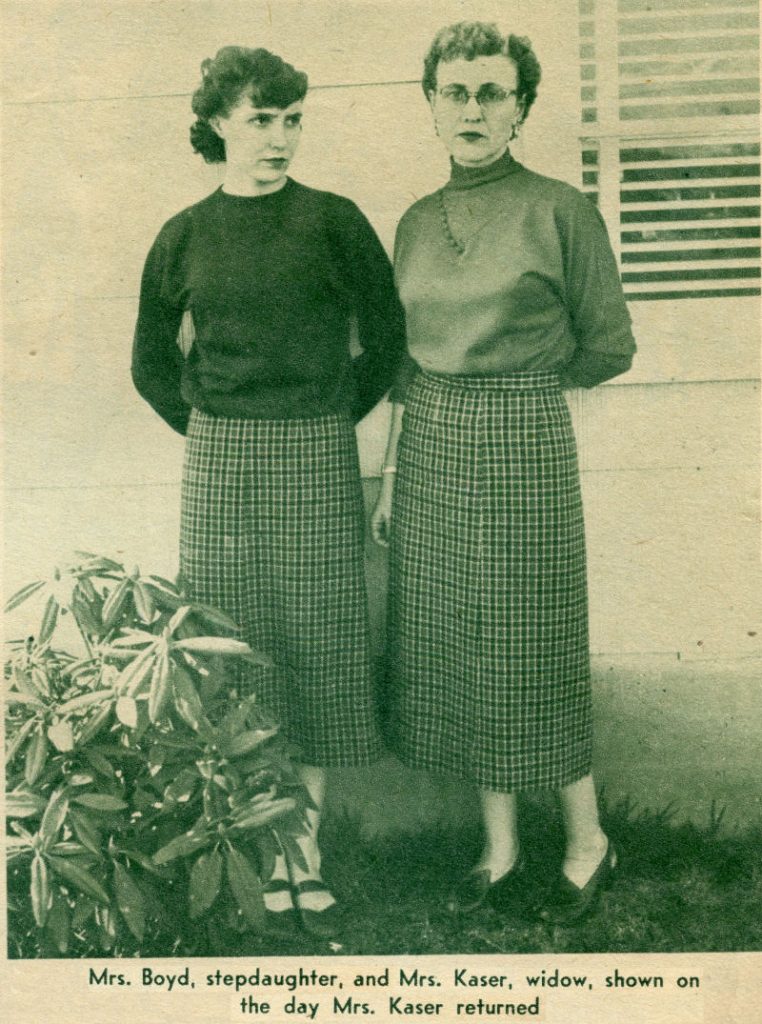
The officers drove to Salem, where Mrs. Kaser was living with her daughter and son-in-law, Mr. and Mrs. Virgil Boyd.

She was asked about the charges she had made in her divorce complaint, particularly those stating that Kaser often had stayed away from home overnight and had associated with other women.

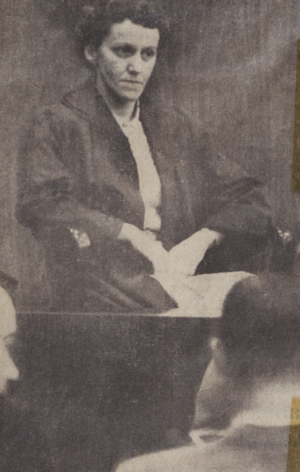
The widow, an extremely attractive woman with close-cropped curly hair, wearing ornamented glasses and dangling earrings, declared that all the charges she had made were true.

“Who were the women he assocaited with?” Sheriff Young asked. “you did not name them in the complaint.”

“I don’t know. That’s why they weren’t named.”

“But if you don’t know, how can you be sure that he ever saw any other women?”

“I know.”

“How?”

Mrs. Kaser hestitated a moment. “You ask his brother, Harvey,” she said. “He knows. Or Cap Oveross. I haven’t any proof but I’m sure of it.”

Huffman told Mrs. Kaser, “You don’t have to give us proof. But you can tell us whom you suspect. It could be a motive for the killing.”

As Mrs. Kaser hestitated again, Young pressed: “Why would his brother Harvey know about it?”

“Because Harvey is married to Edith Knight, and she has a twin sister Ethel, who was married to Casper Oveross. They all went to school together, the Kaser boys, the Knight girls and Casper Oveross.”

But who is the other woman?”

Mrs. Kaser shrugged. “When Ethel and Cap – that’s what they call Casper – were divorced last year, Ethel got the family ranch and custody of their two children. They lived just a quarter of a mile down the road from us. Ethel has been living there with the children ever since while Cap moved in to Silverton.”

That was all she would say except, “Ask Harvey or Cap Oveross.”

Harvey Kaser home and pond

The officers drove back to Evergreen to talk with Harvey Kaser. On the drive, they discussed possible angles.

“It sounds interesting, but when you analyze it, we don’t have much there,” Huffman pointed out. “The Overosses are divorced and everything is final. The only one with a motive from this would be Casper Oveross. And since everything is settled, his motive isn’t very strong.”

Harvey Kaser and his wife, Edith, were questioned about the possibility of a triangle existing between his brother and the Overosses.

“I think both Mary and Cap had some ideas about that,” Harvey declared. “I’m sure it wasn’t true, but Cap kept saying it until he got Mary to believing it.”

“Did your brother go to see Mrs. Oveross frequently?”

“We’ve all grown up together,” Harvey explained. “We’ve been friends since we were little kids. Ethel is my wife’s twin sister. We all live right here near each other and we’re bound to be good friends.”

“Whether there was any truth in it or not, could Casper Oveross have believed your brother was responsible for breaking up his marriage?” Huffman asked bluntly. “The truth would make no difference to a man blinded by jealousy.”

“Yes,” Harvey answered. “Cap blamed Ervin. I even heard that he threatened Ervin. But Cap was born right down at Rocky Four Corners on Abiqua Creek. We’ve all been like one big family since we were kids.”

Phyllis Boyd and Mary Kaser

The officers next stopped to see Mrs. Oveross. She repeated what they had heard from Harvey Kaser. The suspicions concerning herself and Ervin Kaser, she declared, were unfounded.

But she did admit that the suspicions were held by both her former husband and Mary Kaser.

“I don’t see any reason, though, why Cap would still have it in for Ervin,” Mrs. Oveross declared. “our troubles have all been settled.”

Casper Oveross was found in a small cabin in Silverton, where he lived alone. The former farmer, who has a local reputation as a hunter and woodsman, had turned to carpentry after his divorce.

“I filed the divorce and I got it,” the slender, gum-chewing man told the officers. “But the judge gave her the kids and our home out at Evergreen. I got twenty acres near Abiqua Creek.”

“You were sore at Ervin Kaser,” Young said flatly.

“I’m not denying it,” Oveross replied. “I said he broke up my marriage. And I’ll say it now. He used to be my best friend. We’ve gone hunting and camping together and we were neighbors for about twenty years. But just because he’s dead is no reason for me to change my mind. I think he was a dirty skunk while he was acting like my friend.”

“We also heard you’re an excellent marksman,” Huffman said. “And I see you have a number of rifles.”

Cap Oveross tucked his plaid shirt tighter into the beltless top of his blue jeans and smiled. “I guess it’s natural I’d be suspected.”

“Where were you last night?”

“Right here.”

“Was anyone with you?”

“Nope. If I’d known somebody was going to kill Ervin, I’d have invited half the town in so’s I could have had a good alibi. But I didn’t know it.”

Oveross gave the officer the three hunting rifles that he owned so they could be test fired at the Crime Laboratory. “These are all my guns,” he said. “I never owned a thirty.”

“Who do you think killed Ervin?” Young asked Oveross. “You knew him well. Maybe you can help us.”

Cap chomped on his gum for several seconds. Looking squarely at the Sheriff, he said: “Let me put it this way. I don’t know who killed Ervin, but to be truthful with you, even if I did I reckon I wouldn’t tell you. In my book,he got what was coming to him.”

Meanwhile, additional patrolmen brought into the area by Huffman were aiding the Sheriff’s deputies in searching the entire area around the Evergreen district on the theory that the slayer might have disposed of the death weapon in one of the many ponds, creeks and wells in the district.

Dredging the Harvey Kaser pond

Ponds had been dredged on almost every farm to collect the Winter rain and hold it to water the cattle in Summertime. Rowboats, carrying officers with grappling hooks and magnets, covered all the ponds along the road from Silverton to Stayton, in the direction Kellerhal had seen the killer’s car take from the slaying scene.

The poker-playing pals of Kaser were questioned. No game had been planned for the night Kaser was slain. All denied that any arguments had cropped up during the card games that would provide a motive for the killing.

At the request of Sheriff Young, those who had been at the poker parties surrendered their rifles for ballistics examination.

Numerous other acquaintances of Kaser were asked to turn in their guns for the ballistics test.

Sam Lord was located at The Dalles. He readily admitted that he and Kaser had had violent differences concerning the job and payment for the work Kaser had hired him to do. But Lord had an airtight alibi of being in The Dalles at the time Kaser was killed.

The rural community seethed with excitement over the first slaying that ever had been committed in that area. Rumors kept the officers busy investigating leads that all eventually petered out to be only gossip.

On Sunday afternoon, Mrs. MaryLouisa Kaser moved into the farmhouse where her husband had been slain. This started more rumors, but the widow explained that she was the sole heir of her husband’s estate and she intended to live at the farm.

Funeral services were conducted for Ervin Kaser in Silverton at two o’clock on Monday afternoon. The town was jammed with ranchers who put aside their farm tasks and came dressed in their Sunday best to pay their last respects. So many persons attended the services at the funeral home that a loudspeaker was placed outside the chapel so the huge crowd gathered on the lawn and in the street could hear.

But no arrest had been made.

The newspapers from Salem, which carried daily headlines on the slaying, had been hounding Sheriff Young, District Attorney Brown and Sergeant Huffman for facts on the progress of the case.

Young gave out a statement that made new headlines on Monday afternoon. The story quoted him as saying the officers had a suspect and as soon as a certain piece of evidence was uncovered, an arrest would be made.

When the other officers questioned Young about the story, he told them: “It’s half true. The piece of evidence we’re looking for is the gun.”

“How about the suspect?”

“I’m hoping the killer will see that and run. We’ll keep our eyes open. If anyone leaves the area in a hurry it could be the slayer thinking we are getting close to him.”

But no one ran.

Search for the rifle used to kill Kaser continued, for both Young and Huffman felt certain the slayer would attempt to get rid of the damning evidence.

“Whoever it is, he knows we have the slugs that can prove it’s the death weapon,” Huffman reasoned. “And he’s smart enough to conceal it because he took pains to make sure the cartridge casings couldn’t be found.”

“And the the chances are he got rid of it shortly after he killed Kaser,” Young added. “He’d know we’d put up road blocks. The logical place would be in one of the ponds or creeks near the Kaser farm.”

Deputy Shaw said: “We’ve just about covered all of them. But if he took time out to bury it, he may have us whipped. We’ll only get it if somebody should stumble onto it.”

One strong clue to the slayer was the tight grouping of the rifle shots into the car. Only an expert marksman could make a pattern so small. Oveross was an expert marksman: the officers investigated him as closely as they could Tuesday morning. A neighbor near the farm Oveross owned at Abiqua Creek reported that Oveross had a rifle range on his property.

“I’ve seen Cap out there practicing the past few weeks,” this neighbor said. “He’s been using up a lot of ammunition and it’s a long way until hunting time. Maybe you’d better ask him about it.”

Before requestioning Oveross, the officers went out to the farm to look over the rifle range. It had a number of old logs as backstop for the bullets.

Criminologist Prouty carefully dug some of the spent slugs from the logs. He came up with several he identified as .30 caliber.

“Cap told us he didn’t own a thirty-caliber rifle,” Young said. “those three guns he gave us were of a different size than this.”

The slugs from the rifle range were rushed to the State Crime Laboratory where they were put under a comparison microscope with the spent bullet found in Kaser’s car and the one removed from the body. Enlarged photographs were made so that every mark on the lead could be examined closely.

“I have found enough similarity in the samples to indicate that the bullets taken from the rifle range might have been fired from the same gun used in the killing,”an expert declared.

Was it enough to charge Oveross with the slaying?

“We have a motive,” Young explained to District Attorney Brown. “Cap thought Ervin had broken up his marriage. We have the evidence of the slugs.”

“I’ll issue a warrant,” Brown said. “we can bring him in and see what he says about it. But, of course, we can’t prove yet that Oveross owned such a gun. Anybody could have used his range.”

Oveross was arrested at the home of a relative.

“You guys are nuts,” Oveross told the officers. “I didn’t kill Ervin. I’ll admit I think he deserved killing, but I didn’t do it.”

Told about the slugs found at the rifle range on his farm, Oveross said: “I don’t know nothing about ballistics. Maybe you can tell if a gun shot a certain bullet.But it don’t mean it was my gun, or I did the shooting.”

“You were seen out there practicing.”

Calmly chewing gum, Oveross shrugged. “Sure, I shoot all the time. It’s my sport. Some men play golf. Some men bowl. Me, I shoot. Anything wrong with that?”

“You are going to be charged with killing Kaser.”

“In that case, I guess I’d better keep my mouth shut,” Oveross said. “I know you got good reason to suspect me, so it’s no use me helping you any. All I’m going to tell you is I didn’t do it.”

District Attorney Brown announced that Oveross refused to take a lie-detector test and quoted him as saying: “I’m just going to sit tight. You can’t prove a thing.”

Brown filed a charge of murder against Oveross in the court of District Judge Edward O. Stadter,Jr., and called a special session of the Marion County grand jury to hear the evidence that had been collected.

On Monday, February 28, he summoned seventeen witnesses before the jury.

At the end of an all-day session, the jury ruled that Brown did not have sufficient evidence to indicate Oveross should be held to answer the charge in court. Brown withdrew the charge before the district court and Oveross was released.

Brown announced immediately, “If I get additional evidence later, I’ll call the grand jury into session again.”

Pressed by reporters for a further statement, he said: “We have no other suspects at this time. All I can say is that the Sheriff and the State Police will continue to work on the case until it is solved.”

What could be done?

“Find the gun,” Brown said.“Find the gun and we’ve got a case. It may not be against Oveross, but if you can find the gun, I can make a case against whoever owns it.”

In a rural district like Evergreen, nearly every farmer has several hunting rifles. The .30-caliber gun is a favorite for hunting.

A tedious canvass began of all sporting-goods stores in the area to find out if anyone had purchased a .30-caliber rifle recently. It was a nearly hopeless task, but no other leads were open.

The gun might have been bought locally, or it could have come from Portland or some other big city. It might have come from a mail-order house or even have been bought secondhand.

Weeks went by and the excitement in the rural community that had experienced its first slaying failed to subside. It was the prime topic of conversation at every gathering.

The curious still drove out on the the highway and paused to look at the house where the widow of Kaser was living and to examine with interest the spot where the slayer had waited in ambush to slay Kaser.

Rumors grew rather than died as time lapsed. Sheriff Young and Sergeant Huffman constantly were investigating some new angle that was brought to them because of talk in the area.

Then, on Sunday, May 8, Larry Wacker, a Parrish Junior High School student, and two chums, Neil and Roger Beutler, were fishing in the Pudding River not far from the junction of the Pratum-Silverton-Sublimity roads, about five milesfrom Ervin Kaser’s farm.

Larry found a rifle in the river. An empty shell was in the chamber and a live shell in the magazine. The boys took the gun to the home of John Ross, where their parents were visiting. The Sheriff was notified.

Young asked the boys and their parents to make no mention of the rifle until he was ready to release the news.

The gun was rushed to the State Crime Laboratory. Ballistics tests, according to the police, gave definite proof it was the rifle that had fired the slug that killed Kaser.

Next came the serial numbers on the gun. Could it be traced to the last owner – the person who had used it for a killing?

The factory was called. Records there supplied the name of the wholesaler in Portland who had received it, way back in 1948.

The wholesaler had a record of the dealer to whom it had been shipped.

The hardware store dealer did not have a record of the purchaser of the serial number of the gun. (Records are required only on handguns.) But the owner of the store recalled that he had received only two guns of this caliber and model during that entire year, since the wartime shortage of sporting guns still existed then.

He had sold both of these guns shortly after he had received them in Jarnuary of 1949. One of the purchasers, according to the police, had been Casper Oveross.

Young first questioned the man who had purchased the second rifle. This man still had his gun.

Casper Oveross had disappeared from Silverton. After being freed from the murder charge by the grand jury, he had announced he was going to Southern California to work. He was believed to be in Santa Barbara.

District Attorney Brown once again called a session of the grand jury. He presented the evidence including the new facts about the gun and this time the jury, on May 16, returned an indictment charging Oveross with the murder of Kaser.

An all-out search was started for him. On May 21, the Territorial Police in Fairbanks, Alaska, located Oveross working as a carpenter on a construction job. He was arrested on a bench warrant issued from Salem, Oregon, charging him with first-degree murder and unlawful flight to avoid prosecution.

“I didn’t even know they wanted me again,” Oveross said. “I wasn’t running away, I just happened to land a good job in Alaska. I told them once I wasn’t guilty, but I guess they won’t be satisfied until I go to trial and prove it.”

At the present time, Oveross has been returned to Salem from Alaska and is being held in custody pending further legal action. Watch the department entitled “Up to the Minute” in a future issue for the results of this action.

The names of Ray Jackson, FredBarto and Sam Lord in this story are fictitious.


Next up: True Police Cases

Blogically yours,

Everett

Not Innocent: The Trial (Part 5) – The Conclusion

And here’s the conclusion of the trial, though not (entirely) the conclusion of the story.


The Statesman morning newspaper, Salem, Tuesday, July 12, 1955
Chemist Declares Murder Rifle Not In River 80 Days

A Portland chemist testified Monday that in his opinion the rifle which the state claims killed Ervin Kaser couldn’t have been in the Pudding River for some 80 days as attorneys opened their fight in defense of Casper Oveross, on trial here for the murder. A rusty rifle of the same type as the 30-30 Winchester carbine pulled from the river last May 8 was admitted as evidence for the defense after the chemist, E. Nealley Wood, testified that he had conducted tests on it to see how fast it would corrode.  Defense questioning of Wood and of Sheriff Denver Young who followed him to the witness chair set off some of the hottest debates of the trial thus far.  Judge Duncan at one point threatened to clear the courtroom of spectators after they had vocally sounded opinions against the merits of prosecution objections and the judge’s rulings on them.  Wood, qualified as a chemical and metallurgical expert, was a surprise witness Monday afternoon when the defense began its presentation.

Dr. Homer H. Harris

Capital Journal photograph — Dr. Homer H. Harris of the state crime laboratory, on the stand as he testified briefly. He said Ralph Prouty, ballistic expert of the crime laboratory would not be able to make further testimony in the case. Prouty was injured when he apparently went to sleep while driving from Portland to Salem last week.

The state rested its case Monday morning after Dr. Homer Harris, director of the state crime laboratory, appeared to report that Ralph Prouty, state ballistics expert, was still in no condition to testify as the result of a Friday motor mishap.  Harris said he doubted Prouty would be able to testify before trial’s end, ruling out the possibility of the state having entered as evidence the results of tests conducted last Thursday in the chambers of Circuit Judge George R. Duncan.  End of the state’s direct presentation came at 9:39 a.m. Monday after 12 days of testimony from 54 witnesses.  At that time Defense attorneys Bruce Williams and Otto R. Skopil Jr. made a motion for a directed verdict of acquittal and for dismissal of the first degree murder indictment against the 43-year-old Silverton carpenter stating the prosecution had failed to prove the allegations of its opening statement.  The motion was denied by Judge Duncan who granted the defense until 1:30 p.m. to begin its own presentation.

Members of the Oveross family were first to take the stand as the defense sought to emphasize that Oveross had apparently left this area about the middle of April and had gone to Alaska by way of Tacoma. This line of testimony, Williams asserted, was intended to link with the testimony of Wood to show that it could not have been Oveross who tossed the murder gun into the Pudding River near Pratum.  During the first day, the defense aimed all its questioning at this contention and it raised numerous objections from Special Prosecutor Charles Raymond and District Attorney Kenneth O. Brown.  The defense will continue its case at 9:15 a.m. today.


[page 2]

Defense Witnesses Tell of 2 Men ‘Shadowing’ Ervin Kaser in Car

Reference to an old car occupied by two men who had reportedly “shadowed” Ervin Kaser before his murder was brought out again Monday in testimony of witnesses for the defense of Casper Oveross. Oveross, whose ex-wife Ethel Oveross has admitted going with Kaser for some three years, is on trial in Marion County Circuit Court here for the slaying.

Mrs. Oveross was one of those testifying to the presence of the old car as defense counsel Bruce Williams and Otto R. Skopil opened their defense presentation Monday afternoon. Kaser was considerably excited about being followed, Mrs. Oveross said. She told of seeing the old car in the cutoff road north of Silverton where she had parked her car to meet Kaser.  She said she had seen it again last January and last October. On the October occasion she said she was driving in her car, followed by Kaser when she had noticed the third car following. She said she pulled off the highway near the Evergreen School and watched Kaser drive into his driveway and to the rear of his house. The old car went on by and then returned, she said, and when Kaser drove back along the road looking fro her she could see that two men were in it.  Mrs. Oveross also told of seeing her former husband follow when she was out with kaser on one occasion.

Efforts of two school teachers at the Evergreen School, just a few hundred yards from the Ervin Kaser home where he was shot, to testify that they had seen an old car parked near the scene on the day before the slaying were beaten down by prosecution objections.  The teachers were Mrs. Emma Wolfard, Silverton, sister of the defendant, and Mrs. Gertrude E. Twohy, now of Clackamas.

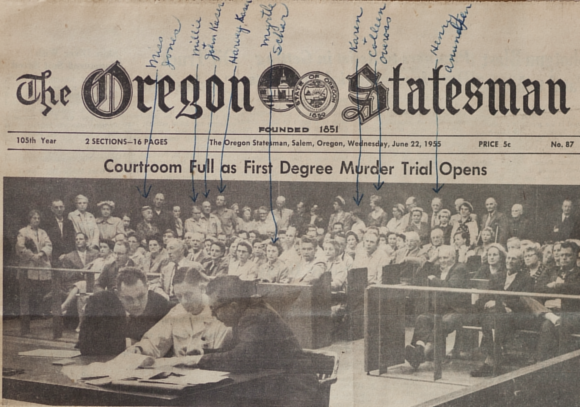
Testifying to the date Oveross was last seen in the Silverton area last April were his niece, Mrs. Jean Moon, her husband Robert Moon, Ruth M. Schubert, another sister of Oveross, Ed W. Schubert, her busband, Karen J. Oveross, the defendant’s 14-year-old daughter, Colleen Oveross, 19, another daughter, Henry Anunson, Oveross’ brother-in-law, and Mrs. Wolfard.  All had indicated the defendant had left about April 17 to find work and they did not see him again until he was returned from Alaska in custody.

Karen and Ila May Moore, 17, daughter of Wayne Moore who lives next door to the Oveross home south of Silverton, testified they had been to Salem rollerskating on Feb. 17, the night Kaser was shot in the driveway of his home.  They both told of returning home about 10:40 p.m. past the Kaser home and said they couldn’t recall seeing any cars along the way.

Defense witnesses up to its metallurgical expert were called in rapid fire order by the two attorneys. Beginning with Mrs. Moon the average stay of witnesses was something slightly over three minutes as the prosecution limited cross examination.  The trail of witnesses slowed when Mrs. Wolfard took the stand, opening a bitter fight between the defense and prosecution over admissibility of evidence concerning the old car.  Testimony on this count was interrupted by Special Prosecutor Charles Raymond who cited cases stating defense attempts to prove someone else committed the crime invalid.  Defense Attorney Skopil countered with several other cases which he said showed testimony which might show someone else guilty should be admissible. Raymond’s objection was sustained and subsequent questions by Attorney Williams on the same point brought a request from District Attorney Kenneth O. Brown that he be admonished for the tactics.  That began a series of maneuvers which saw the jury in and out of the jury box with almost comic regularity or trips to the judge’s chambers by counsel for the defense and prosecution during the rest of the afternoon so the two sides could argue the merits of their positions.

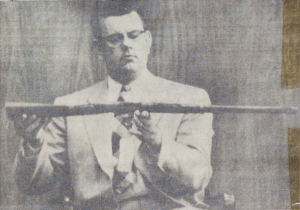
Portland Chemist E. Nealley Wood examines rust on the barrel of a Winchester rifle which he testified Monday was the result of an 11-day test in water taken from the Pudding River.  Wood's testimony was part of the defnese effort to show that a rifle taken from the river May 8 could not be linked to Casper Oveross who they claim left the area April 17.

Portland Chemist E. Nealley Wood examines rust on the barrel of a Winchester rifle which he testified Monday was the result of an 11-day test in water taken from the Pudding River. Wood’s testimony was part of the defnese effort to show that a rifle taken from the river May 8 could not be linked to Casper Oveross who they claim left the area April 17.

A roof-top rust test on a model 94 Winchester 30-30 carbine provided the most interest of the day. Portland Chemist E. Nealley Wood testified he purchased such a gun, the same type the state says is the murder weapon and which it says Oveross owned, for the test.  Wood told of drawing five gallons of water from the Pudding river near the point where the murder gun was found and of placing the gun in some of the water and some soil July 1 for the test. He said the test was conducted on the roof of the Charlton Laboratories in Portland where he works.  The rusty rifle, which Woods testified was taken from the water at 1 p.m. Monday, was presented as evidence by the defense.  He said he had fired three or four rounds through the gun to try and duplicate the condition of the murder rifle. Prosecution offered no objections to admitting the test rifle as evidence, but immediately rose to protest defense questions concerning which rifle had been in the river longer. Raymond’s objection was sustained.

On cross examination Raymond asked these questions: How much are you being paid to testify? Wood answered that his standard fee was $50 a day.  What was the consistency of water of the river when you took the water for the test? Amber but not muddy.  Wood answered “no” to Raymond’s questions of whether he knew what weather and water conditions were in the river between Feb. 17 and May 8, whether he had positive knowledge of the gun’s position in water, whether the two guns were manufactured from the same steel, how much mud was on the murder gun when found and what the gun’s condition was when put in river.  His closing question of “You don’t know much about it then?” brought an objection from Williams and the question was stricken from the record.

Some of the spectators who had been making their defense sympathies known vocally throughout the afternoon questioning became abusive to the court during the examination of the final witness of the day Sheriff Denver Young. At that point Judge Duncan threatened to have the court cleared and later voiced his impatience by ordering the bailiff to keep the spectators in the courtroom and in their seats until all members of the jury had cleared the room.  After Sheriff Young had testified that he had not determined the exact date of Oveross’ arrival in Alaska, Attorney Williams requested the right to recall Young today. In the meantime, Williams said an effort would be made to subpoena records of the Canadian customs authorities and border officials at the Alask line who had checked Oveross through on his way to Fairbanks.

This picture of Casper Oveross talking with his attorneys Bruce Williams, left, and Otto Skopil, Jr., was taken just before the three went into Judge George Duncan's chambers to argue on the defnse motion of a directed verdict of acquital. The motion was denied by the judge and the trial of Oveross for first degree murder of Ervin Kaser continues with the defense beginning its case.

This picture of Casper Oveross talking with his attorneys Bruce Williams, left, and Otto Skopil, Jr., was taken just before the three went into Judge George Duncan’s chambers to argue on the defnse motion of a directed verdict of acquital. The motion was denied by the judge and the trial of Oveross for first degree murder of Ervin Kaser continues with the defense beginning its case.

Williams motion for a directed verdict of acquittal at the morning session was denied by Judge Duncan after both defense and prosecution had cited numerous cases for and against. Duncan stated that the rule in Oregon is that a motion for directed verdict is not proper at this time without the defense resting.  Then Williams went on to assert that the state had failed to prove the indictment and the allegations in the opening statement by Special Prosecutor Raymond.  He stated that four witnesses for the state placed Oveross at four different places at the same time.  Reports of threats were too remote to have bearing in this case, Williams said.  Allegations that Oveross was at his old home looking for his ex-wife the night of slaying, that he had laid in wait for Kaser once before, that the death car had laid in wait for Kaser and Oveross’ arrival at the Gilham home just after crime also were not substantiated, Williams claimed.

Attorney Skopil took up the argument to attack the inferences brought in by the state, asserting they were not consistent with each other. He said the state had failed to link the defendant with the car at the scene, failed to connect up the murder gun, and failed to place Oveross at the scene at the time of the slaying. After Judge Duncan denied the motion, Williams indicated it would take the defense only about one day to present its case. When the defense began its presentation Monday afternoon, Williams filed a motion to strike all testimony by Ralph Prouty from the record on the grounds he was not available for adequate cross examination.  Judge Duncan took the motion under advisement after hearing Attorney Raymond state that the defense had had opportunity to cross examine Prouty on every phase to which he had testified so far.  Raymond said the state had reserved the right to recall Prouty to testify solely to the results of the Thursday comparison tests with the murder gun.


The Statesman morning newspaper, Salem, Wednesday, July 13, 1955
Jurors Bed Down at County Courthouse

Twelve jury members and two alternates hearing the first degree murder charge against Casper Oveross were bedded down in Marion County Courthouse for the first time Tuesday night. The jury is housed on the mezzanine floor which contains dormitory space for men and women. Efforts to get facilities ready were not without pitfalls. The women’s dormitory will hold only nine bedgs; one alternate, a woman, will therefore sleep just inside the entrance to the dormitory.  This move meant Oliver Rickman, building superintendent, had to change a lock on the entrance door so that the door would not open form the outside. Only one bailiff, Mrs. Ervin Ward, will stay with the jury at night.  She will sleep in the hallway which separates the two dormitories.

The usual tomb-like quiet of the mezzanine floor was replaced Tuesday afternoon by hurried and harried activity as building employes made up beds, provided soap, face and bath towels for jurors, and installed a telephone on the mezzanine floor.  Families of the jury were also busy bringing suitcases of clothing and other necessary items to them.

The jury was taken to dinner at the Marion Hotel “so they could get a little more fresh air and exercise,” according to Mrs. Rose Howard, head bailiff.  The evening was to be spent either in dormitory rooms or in the court room.  Both dormitories are on the west side of the building and were “warm” from afternoon sun. The jury quarters are equipped with rest rooms, including shower stalls, but otherwise contain only beds and a small chest.  No reading material will be provided.

Oveross Case May Go to Jury Today; Testimony Completed

After 13 days of testimony both the prosecution and defense rested Tuesday in the first degree murder trial of Casper Oveross, and it appeared that the jury would begin deliberation late today on whether or not he shot and killed Ervin Kaser last Feb. 17. At 10:22 a.m. Tuesday, after recalling only one of 13 witnesses, Defense Attorney Bruce Williams announced with dramatic suddenness: “Your honor, the defense rests.”

Apparently caught by surprise by the short defense presentation, Special Prosecutor Charles Raymond and District Attorney Kenneth E. Brown asked for a recess until 1:30 p.m. before making their rebuttal.  At that time they called to the witness stand Joseph Schulein, an associate professor in chemical engineering from Oregon State College who testified there was no way to determine how long a gun had been exposed to the water short of exhaustive tests. The testimony was aimed at refuting that of defense witness E. Nealley Wood, a Portland industrial chemist, who told Monday of taking water from the Pudding River to make an 11-day corrosion test on a Winchester 30-30 carbine. Wood had stated in his opinion a gun which the state claims belonged to Oveross and killed Kaser could not have remained in the Pudding River from the time of the crime until it was found May 8.  Schulein was the final witness of 68 called to testify in the 16-day-old trial.

After that testimony the state rested and Defense Attorneys Williams and Otto R. Skopil Jr. motioned again for a directed verdict of not guilty.  The motion was denied by Circuit Judge George R. Duncan who announced that final arguments would be heard beginning at 9:30 a.m. today.  Defense arguments will be presented first, and following prosecution arguments, Judge Duncan will give his general and special instructions to the jury.  It seemed likely that the jury, which was kept in the courthouse overnight would begin its deliberation sometime this afternoon.  Included in its instructions from Judge Duncan will be the five possible verdicts it may return. The jury may find Oveross guilty of murder in the first degree as charged, guilty in first degree with recommendation for life imprisonment, guilty in second degree, guilty of manslaughter, or acquit him.


[page 2]

Defense Rests Case in Trial Of Oveross in Surprise Move

In a move which apparently took the prosecution and spectators by complete surprise, counsel for Casper Oveross rested their defense Tuesday after only 2 hours and 29 minutes of testimony.  Fate of the 43-year-old Silverton carpenter, charged with shooting his one-time neighbor Ervin Kaser with a high-powered rifle last February, will probably pass to the Marion County Circuit Court jury late today.

Almost as much a surprise as the shortness of the direct presentation by the defense was the decision by Defense Attorneys Bruce Williams and Otto R. Skopil Jr. not to put the defendant on the witness stand in his own behalf. By law, however, this decision cannot be legally held as evidence against him.

Burden of the defense testimony, given by 13 witnesses of which 9 were members of Oveross’ family, was aimed at two positions maintained by the defense. One of these was that testimony by several persons indicated that Kaser had been followed and shadowed on several occasions by two men in an old model car variously described as a coupe and a sedan.  The second is that condition of the murder weapon at the time it was found in the Pudding River near Pratum May 8 was such that it could not have been placed there by the defendant before he left for Alaska about April 17.

Only defense testimony offered Tuesday centered on the reported presence of the old car near the Evergreen School the day before the crime.  Again efforts to have the testimony of Mrs. Emma Wolfard, sister of the defendant, convering the car admitted as evidence were beaten down by prosecution objections. Attorney Williams succeeded, however, in getting into the record just before the defnse rested the testimony of Mrs. Wolfard that Mrs. Edith Kaser had told of stopping at the crime scene before police arrived and of continuing on home. During cross examination, Mrs. Kaser, wife of Harvey Kaser who is a brother of the murdered man, denied making the statement or of having stopped. Williams asked Mrs. Wolfard if Mrs. Kaser hadn’t told her on Feb. 23 that she had seen the lights on the Kaser car, stopped her pickup at the scene, walked over to the car, seen Kaser slumped in the seat, returned to her truck and continued on home. Mrs. Wolfard answered with a firm “yes.” Williams then asked the judge if it was the ruling he could not pursue the testimony concerning the old car further.  When Judge Duncan reaffirmed his earlier ruling concerning the matter, Williams stated, “Your honor, the defense rests.”

At that point Williams asked that all final arguments be held to a single day. Special Prosecutor Charles Raymond arose to express surprise at the early completion of the defense presentation and to announce that the state had one rebuttal witness to call, but that he was not then available.  Then the jurors, who through the 22 days since the trial stared had been permitted to go home at nights, were advised by the judge that from now on they would be kept together until they had reached a verdict.  He reminded them not to read newspaper accounts of the trial or to discuss the case with anyone.  After the jury has heard the final arguments and the judge’s instructions today it will begin its deliberation.  If not needed at that time the two alternate jurors, Mrs. Pearl Gwynn of Salem Route 6 and Walter Oldenberg, Clear Lake farmer, will be excused. Only the 12 original jurors will deliberate.

The regular jury consists of nine women and three men. They are Mrs. Louise Franzen and Perry Baker, both of Turner, Mrs. Myrtle Rogers, Mrs. Delores Throneberry, Mrs. Doris McMullen, Mrs. Bessie Edwards, Mrs. Helen Taylor and Mrs. Norma Lawless, all of Salem, Mrs. Evelyn Beard, Aurora, Mrs. Margaret Edgell, Woodburn, David H. Barnhardt, Gates, and Harry Oldenberg, Jefferson.

The state’s rebuttal testimony was also brief, taking about 20 minutes.  Prof. Joseph Schulein who said he had been in the chemical engineering profession since 1928 and had testified as an expert witness several times before was the only rebuttal witness.  Shown the 30-30 Winchester rifle which the state says is the murder gun, he said, “I’m sure I’ve nver seen it before.” Prof. Schulein said it was his opinion that the gun had been subjected to moisture, but that he wouldn’t have any idea how long.  He explained that to tell how long would require knowledge of the nature of the water, temperature, acidity, concentration of oxygen, volume, motion and other materials in contact. “Even then I would hesitate to make an opinion without making tests.”  Under cross examination by Attorney Skopil, Schulein stated he would probably need hundreds of like pieces in similar situations to make a specifical analysis of the length of time the gun had been exposed.

Spectators, jammed into the courtroom for the brief morning and afternoon sessions Tudesday, got another lecture on decorum from Judge Duncan, this one preventative.  Before the jury was brought in for the morning session, Judge Duncan reminded the spectators that the relations for most of the trial had been good despite the intense feeling in the case. But he stated that any repetition of Monday’s actions by a few spectators would lead to removal by the bailiff if it could be determined who the individuals were.  If this could not be determined he said the courtroom would be cleared of all spectators for the balance of the trial.  Tuesday’s audience, largest of the trial, was extremely quiet throughout the sessions.

A witness-by-witness and point-by-point attack on the evidence presented by the state is expected in the defense final arguments beginning this morning.  This was indicated in the arguments of the two defense attorneys for acquittal Monday and Tuesday. At that time Williams stated the state had presented “not an iota of evidence” to link this weapon to Oveross.  Williams moved again Tuesday to have the testimony of Ralph Prouty stricken from the records on the grounds the state’s ballistics expert was not available for adequate cross-examination by the defense. Judge Duncan denied this motion stating that Prouty had been cross examined on every phase of his testimony.

In Tuesday’s arguments for a directed verdict Williams asked “brevity of remarks not to be taken as retreating from our position” of the “absolute insufficiency of the state’s evidence.” Voluminous special instructions for the jury, requested by both sides in the case, were presented to the judge Tuesday afternoon.  They will be presented along with general instructions required by law.


The Statesman morning newspaper, Salem, Thursday, July 14, 1955
Oveross Jury Quits for Night After Deliberating 3 Hours
Final Pleas of Prosecution, Defense Heard

A jury of nine women and three men retired for the night late Wednesday after failing in the first few hours of deliberation to reach a verdict in the first degree murder case against Casper A. Oveross.  Circuit Judge George R. Duncan ordered the jurors to their dormitory rooms at 11:22 p.m. after they had deliberated a total of three hours and 16 minutes.  There was little indication of votes or progress by the jury.  When Judge Duncan sent the order for them to cease deliberation until 9:30 a.m. today Mrs. Bessie Edwards, who has apparently been chosen foreman, was overheard to say, “We’re not getting anywhere.”

Only members of the Oveross family, newsmen, counsel for the defense and a half dozen other spectators were still in the courtroom when the jury retired for the night.  The jury received the case at 5:56 p.m. after hearing final arguments of defense and prosecution throughout the hot, humid day.  Temperatures, like the voices of pleading counsel, had risen in the courtroom far beyond the 91 degrees registered as Salem’s official reading.

Despite the heat which prompted a number of improvised fans among spectators and members of the jury, defendant Oveross remained apparently calm and impassive during the final hours of the trial.  Oveross, 43-year-old Silverton carpenter and father of two daughters who were in the courtroom Wednesday, is charged with shooting Ervin Kaser to death in the driveway of Kaser’s home last Feb. 17.

Jury

Capital Journal–The Oveross jury is shown here listening to an argument by District Attorney Kenneth Brown, standing at right. Front row, left to right: Mrs. Bessie Edwards, Salem; Mrs. Norma Lawless Salem, Mrs. Evely Beard, Aurora; Harry Oldenberg, Jefferson, Mrs. Helen Taylor, Salem; Mrs. Margaret Edgell, Woodburn rural. Back row: David H. Barnhardt, Gates; Mrs. Doris McMullen, Salem; Mrs. Delores Thorneberry, Salem; Myrtle Rogers, Salem; Perry Baker Turner, Mrs. Louise Franzen, Turner. (Alternates seated out of box are Walter Oldenberg, Clear Lake, and Mrs. Pearl Gwynn, Route 2, Salem).

Recounting of the state’s case against Oveross was District Attorney Kenneth E. Brown who was first to speak for the prosecution.  The evidence shows, Brown said, that Ervin Kaser was “shot down, shot in the back, dry gulched, shot down like a dog without a chance to turn on his attacker.”  Then he recounted the testimony offered by state’s witnesses — the bullet which killed Kaser, testimony of the Kerllerhals, the Gilhams and the Barnes relating to threats by and location of the defendant.  Oveross’ activities of the murder night, traced in testimony of witnesses, was reconstructed by Brown. He said he was first at Shorty’s Tavern, then at his former home about 8 o’clock, then driving slowly past Kaser’s place, at Frank’s Grocery store, at LeGard’s service station, at his own cabin for a few moments at 8:30 p.m., back at Shorty’s which he left again after 10, then near the scene again about 10:30 p.m., about 10:45 to 10:50 to do the killing and about 11 p.m. at Gilham’s calling to Danny.

Brown hit the defense failure to explain where Oveross’ gun was. “Where is his gun?” he asked.  Then pointing to the state’s exhibit No. 21, “It’s obvious, that’s his gun.”  He emphasized the motive, that Kaser had been going out with his wife.  “Consider the implications of the statement about three slugs,” Brown told the jury. “Why three, not four?  Because his first shot missed.  Nobody but the man who killed Ervin Kaser would have said, ‘Ervin’s got three slugs in him.’  That man is this man,” Brown said, pointing his finger at Oveross across the counsel table.

Defense Attorney Otto R. Skopil Jr. opened final arguments for the defense.  Referring to “red herrings” which Brown had accused the defense of throwing into the case, Skopil said, “I’m not going to talk about 17 red herrings, I’m not even going to talk about pink elephants.  I’m going to talk about facts.”  Skopil charged that the prosecution had failed to prove its allegation that the defendant had “laid in wait,” had come “looking for his ex-wife.”  There was no evidence to show that Oveross was at the scene Skopil asserted.  “He would have to be there in order to shoot someone,” he said.  “How could he shoot the deceased Ervin Kaser when he was not there.”

Attorney Bruce Williams took up the defense argument from Skopil, making an impassioned plea for acquittal of Oveross. “This is no Sunday school picnic, a man’s life is at stake,” he stated.  He rapped hard at the presence of Special Prosecutor Charles Raymond in the case, and at the actions of police officers both at work and as witnesses.  Williams pointed to Oveross and said, “I think he still loves Ethel Oveross.  He’s been stripped of everything; all he has is the love of his two daughters.”  “I think he was a lonely little guy.  I know I’m a better man for having known Cap, and Karen.” As he closed his arguments he approached the bar between him and the spectator seats where Oveross’ family sat in the front row.  “We know, each and everyone of us, that Cap is not guilty,” he concluded.  A short burst of applause shocked the courtroom.  One man who had apparently begun the clapping was escorted from the courtroom by the bailiff at the direction of Circuit Judge George Duncan.  He was identified as a Mr. Sleighter.

[page 2]

Trial Evidence Taken To Deliberation Room By Oveross’s Jurors

Jury deliberation

Statesman–Camera Catches Glimpse of Jury Deliberation. Casper A. Oveross, on trial for murder, spent Wednesday night in Marion County jail while three floors below these juurors debated the firsdt degree murder charge against him. Taken with the aid of a telephoto lens from the Grand Hotel building, this photo looks through windows in the jury room which are normally curtained. Extreme heat in the courthouse Wednesday night probably caused jurors to open them. The jury of nine women and three men retired late Wednesday night without reaching a verdict.

Some 44 separate items of evidence, including the 30-30 Winchester rifle which the state claims is the murder weapon, were taken into the jury room with the jury considering the case against Casper Oveross.  During the state’s case, which took 13 days to present, a total of 53 separate items of evidence were offered and 41 of them admitted as evidence.  Three exhibits of defense evidence were admitted.

Going into the jury room along with the material evidence were the detailed instructions of Circuit Judge George R. Duncan.  He told the jury they could return one of five verdicts.  They are first degree murder with no recommendation, first degree with a recommendation for life in prison, second degree, manslaughter or acquittal.  Judge Duncan instructed the jury that to return a first degree verdict the decision must be the decision of all the jurors.  For any of the other verdicts 10 of 12 jurors must concur in the decision.

All members of counsel participated in the closing arguments which took all the day Wednesday.  Defense Attorneys Bruce Williams and Otto R. Skopil Jr. teamed in a scathing attack on the state’s case.  Special Prosecutor Charles Raymond and District Attorney Kenneth E. Brown teamed in a broad review of the case and in criticism of the defense for failure to explain away evidence.  District Attorney Brown, who had generally taken a secondary role during the rest of the trial, took the major role in the final arguments.  However, Raymond carried the burden of final summing up for the prosecution and the final refuting of defense statements.

Defense arguments centered on the testimony of Ralph Prouty, the state’s ballistic expert, who appeared as a witness three times during the course of the trial.  Pointing to Oveross, Skopil stated, “If you send this man to the gas chamber it will be on the basis of Officer Prouty’s testimony.”


The Statesman morning newspaper, Salem, Friday, July 15, 1955
Jury Frees Oveross of Murder Charge
Jurors Consider Case 24 Hours Prior to Verdict

Cap Oveross, the man almost no one wanted to see convicted, went free Thursday night.  It was the second time the lean-faced Silverton carpenter had been cleared of a murder charge since Ervin Kaser was found shot to death in his car last Feb. 17, but this time it was by the conclusive, unanimous vote of a hot, tired and solemn-faced jury.

Jury Foreman Mrs. Bessie Edwards read the verdict at exactly 5:26 p.m., just 30 minutes short of 24 hours after the Marion County Circuit Court jury of nine women and three men began deliberation.  Oveross heard the verdict “Not Guilty” with little outward emotion, but tears moistened the eyes of many of the 44 spectators, most of them members of his family who were on hand for the jury decision.  Defense Attorney Bruce Williams hugged Oveross’s shoulder at the verdict, almost it seemed to keep him from sliding back into the chair he had occupied during the 18 days of the trial.

Family

Statesman–Family Rushes to Congratulate ‘Cap’ on ‘Not Guilty’ Verdict. A relieved family, led by his two daughters, surrounded Casper Oveross Thursday evening when a jury returned a verdict of not guilty in his trial for the murder of Ervin Kaser, a one-time neighbor. Here left to right in the courtroom a few seconds after the jury decision was read are Oveross, his brother-in-law, Henry Anunson, daughters Colleen, and Karen, siter-in-law Mrs. Henry Oveross, and sisters Mrs. Lillian Anunson and Mrs. Ruth Schubert.

When Circuit Judge George R. Duncan told Oveross he was released, he walked back to the second row of spectator seats and sat down with his relieved family.  Then they all filed quietly out of the courtroom. Some five minutes after the verdict Oveross, with daughter Colleen on one arm and daughter Karen on the other, walked out of the courthouse, presumably to a family reunion at the home of one of his sisters or his brother.  All had kept an unbroken vigil outside the courtroom while the jury was deliberating.

Oveross, forever free of the charge of slaying Kaser, plans to stay a few weeks in the Silverton area with his family.  Then he intends to find a job to prove himself to his daughters, his family and to the 12 jurors who acquitted him.  he says he wants to work to provide a college education for Colleen and Karen. He didn’t say whether his plans would take him back to Alaska where his car and his carpenter tools are.

Casper Oveross and daughters

Statesman–Oveross Daughters Grip Freed Father. Colleen Oveross had a proud grip on one arm and Karen had a firm hold to one hand as they escorted their dad Casper Oveross from the Marion County Courthouse Thursday. A few minutes before the poicture was taken Oveross was freed of a first degree murder charge by a tired jury of nine women and three men. Oveross said he planned to go to work to provide a college education for the two daughters, who stayed by him faithfully through two arrests and a long trial for the shooting of Ervin Kaser.

Judge Duncan thanked the jury for its public service.  “No other jury will be called on probably for many years to come to hear such a difficult case,” he said. Then the judge excused the jurors, Mrs. Edwards, Mrs. Louise Franzen and Perry Baker, both of Turner, Harry Oldenberg of Jefferson, Mrs. Myrtle Rogers, Mrs. Delores Throneberry, Mrs. Doris McMullen, Mrs. Helen Taylor and Mrs. Norma Lawless, all of Salem.  Mrs. Evelyn Beard of Aurora and Mrs. Margaret Edgell of Woodburn.

Defense attorneys Williams and Otto R. Skopil Jr. were jubilant over the verdict.  District Attorney Kenneth E. Brown appeared satisfied that the long deliberation of the jury was indicative of careful consideration of all the evidence. Special Prosecutor Charles Raymond, contacted in Portland, said, “The jury has spoken. We presented all the evidence available. Judge Duncan gave us a very fair trial.”  At 5:28 p.m., only four minutes after the jury had filed back into the jury box, Judge Duncan recessed the court in the case of State vs. Casper Arnold Oveross.

[page 2]

Acquittal of Oveross Adds Kaser’s Death To Unsolved Crimes

Acquittal of Casper Oveross Thursday of the charge that he killed Ervin O. Kaser adds the Silverton area shooting to the list of unsolved mysteries. Oveross, himself, by law can never be retried for the crime. The kaser murder case, which since the first areest of Oveross had become the Oveross case, has commanded the highest interest of any criminal case in recent Marion County history. The quiet little Evergreen Community some two miles south of Silverton was torn in two by the rifle shots that ripped through the frosty, starlit night last Feb. 17.

One of the four slugs tore through the doorpost of Ervin Kaser’s Plymouth sedan, tore a gaping wound in Kaser’s back and killed him instantly.  Across the Silverton-Stayton Highway from the white frame house where Kaser lived alone, Mr. and Mrs. Emmanuel Kellerhals had just retired for the night.  They told of hearing the first shot, of rushing to their bedroom window, of seeing the last three flashes, and of seeing a dark sedan speed off south into the night.  It was only a matter of minutes before police, called first by Kaser’s brother Melvin, began the search for “Cap” Oveross, who many knew had blamed Kaser for breaking up his home.  Cap, a slender, taciturn carpenter, had lived alone in a small cabin apartment in Silverton since he moved out of his Evergreen home last August.  There, about three hours after the slaying, police found him and began a night-long interrogation which became a temper point in the investigation and trial to follow.

Evergreen community was made up for the most part by residents who had lived all their lives in the area. Melvin and Harvey Kaser, both brothers of the slain man, lived within a short distance of the murder scene, Melvin just next door to the south.  Ethel and Cap Oveross, both born within a few miles of Silverton, had lived there for many years.  Both their pretty young daughters, Colleen 19, and Karen 14, had attended the two-room Evergreen school where Ethel was the clerk of the school board.  Mrs. Oveross had been Ethel Knight before her marriage to Cap twenty years ago.  She was a twin sister of Edith Knight who married Harvey Kaser.  The Kellerhals, the Wayne Moores, the Barnes families–all of them were long-time residents of the community, all of them were to play roles in the tragedy.

Sympathies of the community mostly went to Cap Oveross.  Ervin Kaser, described as a “lone wolf” was not on speaking terms with his two nearby brothers, hadn’t been for over a year.  He was described as a man who feared for his life, careful of his actions, driving behind his home so he could enter the house from the rear.  Since 1952 he had been seeing Ethel Oveross.  She said they had met frequently at a trysting place north of Silverton.  Last year Kaser’s wife Mary moved out and started a suit for divorce.  Earlier Cap had taken steps to divorce Ethel, blaming her associations with Kaser in the complaint.  Their divorce, result of a countersuit by Ethel, was granted in October.

Oveross made damning denials during that night and morning of questioning, police said. Sheriff Denver Young, who direct the investigation, testified Oveross had denied owning a rifle, denied being south of Silverton that night, told of spending the evening between two Silverton taverns.  After some 10 hours, during which time he was questioned at his cabin, enroute to the sheriff’s office, back to the scene and in Silverton, Oveross was taken back to his cabin. The 10 hours, because of the testimony and through accusations of defense counsel, played a heavy part in the trial. Oveross’ attorneys Bruce Williams and Otto R. Skopil Jr., who he had retained shortly after his release, accused police of gestapo tactics, of denying constitutional rights to a free American.  They said his cabin was entered and searched without benefit of a search warrant in violation of the bill of rights.  They said he was held through those hours without a warrant being issued for his arrest, without being able to contact an attorney. They fought the admission of evidence based on that period.

For five days the Silverton seethed with rumors, of a rendezvous near Silver Falls, of two men in an old car, of the unexpected death of one of Kaser’s one-tim friends.  Ponds and streams, wells and brush in the vicinity of the crime were searched for the murder weapon. Then, after a long session with an unnamed witness, a deputy sheriff and a state policeman went to Oveross’ niece’s home with a warrant for his arrest on a charge of first degree murder.  A week later, after 17 witnesses had testified, a Marion County Grand Jury declined to indict him and Oveross walked unbelievingly and happily from the jail a free man. Police went back to work investigating.  Oveross went back to work as a carpenter.

Then after about six weeks he paid up his bills, said goobye to his daughters, his sisters, his brother and his friends and drove his 1950 Ford to Alaska where he got a job carpentering. In the meantime voices of complaints were heard that District Attorney Kenneth E. Brown, himself a Silverton resident, hadn’t called all his witnesses for the grand jury. possibility of a special prosecutor was raised.  And police kept looking for the murder gun, the one piece of evidence they felt they needed to break the case. That break came on May 8.  It was Sunday, Mother’s Day, and Larry Wacker, aged 12, was down on the Pudding River near Pratum looking for crawdads.  He spotted the butt end of a .30-.30 Winchester carbine sticking out of the muck and the water, so he pulled it out and carried it up on the bridge to show his two young friends Neil and Ralph Beutler. They carried the rifle home and the sheriff’s office was notified.  Next day the gun was at the State Crime Detection Laboratory where Ralph Prouty conducted some tests and said it fired the bullet which killed Ervin Kaser.

Police had already checked through Silverton hardware and sporting goods store records.  They knew Cap Oveross had bought a gun from the Ames Hardware Co. in 1949 about the time the store got a shipment of two .30-.30 Winchesters.  One of those guns had the same serial number as the murder gun. WIth this new evidence District Attorney Brown took the case to the grand jury again and came away with a first degree murder indictment against Oveross.  Police began a widening search for the defendant.  So did his attorneys who found him first through a letter he sent Colleen from Alaska. Oveross, notified of the indictment, turned himself in to authorities at Fairbanks, Alaska, and a week later was returned to Marion County by Sheriff Denver Young and Sgt. Wayne Huffman of state police to stand trial.

The trial began on June 21, 24 days ago.  It took three days and 123 prospective jurors to get a jury. It took 13 days for the state to present its case.  It took 13 witnesses and 2 hours and 29 minutes for the defense.  It took 23 hours and 30 minutes for the jury to deliver a verdict.


[undated, unattributed newspaper article, from June/July 1957]

Gun Presented in Murder Trial Now Used by Deputies

A 30-30 rifle which played a major role in the Kaser murder trial here two years ago this month was released by court order Tuesday to the Marion County sheriff’s office for use in the sheriff’s official business.

The Winchester carbine, which allegedly was the weapon used to slay Ervin Kaser, had been held by the Marion County clerk’s office since the conclusion of the trial in which Casper Oveross was acquitted in June, 1955.

Release of the gun was ordered on a motion by the district attorney’s office pointing out that the weapon had never been claimed by its rightful owner.


And that concludes the trial. Next up: The Idiot Magazines

Blogically yours,
Everett


Not Innocent: The Trial (Part 4) – Week Three

The murder and trial was such popular fodder for the local newspapers that even when there was nothing new to report, because court had been adjourned on Sunday, the Monday paper had a “human interest” story about the trial, and the Tuesday paper, because Monday was the 4th of July and court was adjourned that day, too, had a brief story speculating about what was to come next.  So, here’s the week’s action in court, exactly 59 years ago this week.


The Statesman morning newspaper, Salem, Monday, July 4, 1955
Oveross Trial Draws Crowd of Spectators

As door bailiff during the Casper Oveross first degree murder trial, Bill Barlow, Willamette University law student, has something many courtroom spectators must have envied since the trial began June 21–he has a good seat for every day of what promises to be Marion County’s lengthiest trial in recent history.  It’s Barlow’s job to handle the standing-room only crowds which have been packing Circuit Judge George R. Duncan’s courtroom daily since opening day.  The crowds have been so large, in fact, that Judge Duncan has set an age limit for admittance.  Only those over 15 years old can attend.

“Twice,” Barlow said, “I’ve had to turn away the nine-year-old son of one of the attorneys on the case.”  The first few days, he said, weren’t too bad as far as the crowd was concerned. But the day they started calling witnesses, spectators were packed in the hallway.

“I couldn’t even get both courtroom doors open because they started pushing and shoving to get in just as soon as I opened one door,” he said Saturday.  During the past 10 days of the trial, Barlow has spotted many regular attenders.  In fact, two gray-haired ladies occupy the same seats nearly every day.  One arrives before the doors open each morning and never leaves, even during a recess, until about 10 minutes before the day’s session ends.  One old gentleman who arrives late each day has yet to hear any of the trial.  He comes in, looks around, observes that there are no seats and stomps back out with the comment, “I can’t hear what they say anyhow!”

During the first few days of the trial one of the door bailiff’s biggest headaches was separating the spectators from the witnesses, who are not allowed inside the courtroom except while testifying.  One witness, however, got by him and Barlow had to take him out of the courtroom, much to the witness’ annoyance.  Another witness got bored just waiting in the hallway to be called.  When his turn finally came to testify, Barlow found him riding up and down in the elevator.  Most of the spectators, Barlow said, appear to be retired elderly people with nothing else to do but listen to the testimony. Many, of course, come from Silverton where both Oveross and Ervin Kaser, the man Oveross is accused of murdering last February, are well-known.

Some of the people really get carried away in their interest in the trial.  The other day, Barlow said, a man stopped by his chair on the way out and whispered, “I sure hope nothing much happens this afternoon, I’ve got to go to the dentist, but I’ll be back just as soon as he’s finished with me.”

The Statesman morning newspaper, Salem, Tuesday, July 5, 1955
Detective Work to Unfold at Casper Oveross Trial Today

Details of long weeks of detective work by sheriff’s deputies and state policemen are expected to be unfolded today as the first degree murder trial of Casper A. Oveross opens its third week in Marion County Circuit Court here. The prosecution will probably put Deputy Amos Shaw on the stand first today as it begins it attempt to link the rifle which it claims killed Ervin Kaser last Feb. 17. Much of today’s testimony is expected to be built around the investigation of Shaw and State Policeman Lloyd Riegel, concerning ownership of the 30-30 Winchester carbine which has been admitted as evidence in the trial.

Among those witnesses who may also testify in the half-day of court are Marion Zahler and Omer Bailey, both employes of a Silverton hardware store which had reportedly sold Oveross such a gun in 1949.  The trial resumes at 1 p.m. after a Fourth of July holiday recess.  Just how detailed the chain of evidence is concerning the ownership of the murder gun has been a closely guarded prosecution secret.  The gun ownership, the motive for murder and the expected testimony of persons who saw Oveross the night of the slaying have been labeled the key points in the state’s case against the 43-year-old carpenter.  Oveross, who witnesses have testified blamed Kaser for break-up of his marriage and threatened to kill him for it, is accused of firing four shots into Kaser’s automobile at the victim’s home south of Silverton. One of the bullets struck Kaser and killed him instantly.


The Statesman morning newspaper, Salem, Wednesday, July 6, 1955
Ex-Store Clerk Says Oveross Bought Rifle

Ownership of a rifle of the same type as the weapon which killed Ervin Kaser was linked Tuesday to Casper Oveross, now on trial here for Kaser’s murder.  Mrs. Marion Zahler, now of Eugene but formerly of Silverton, testified in Marion County Circuit Court that she sold a 30-30 Winchester carbine to Oveross on March 5, 1949, when she was an employe of the Ames Hardware store at Silverton.

Linking Oveross to a gun of the type which state’s testimony indicates was the murder weapon was the major evidence presented Tuesday, the 11th day of the first degree murder tiral before Circuit Judge George R. Duncan. Police officers who interrogated Oveross after the Feb. 17 slaying at Kaser’s home south of Silverton testified earlier that the defendant had denied ever owning a 30-30 rifle. Defense Attorney Bruce Williams states Oveross has never made such a denial.

Testifying also in connection with the reported sale of the gun to Oveross were Deputy Amos Shaw, State Policeman Lloyd T. Riegel, Norris Ames, Omer Bailey and Carl Handy. Shaw and Riegel told of finding the sales slips, invoice, letter and account sheets in the records of the Carl Handy Hardware store, owned in 1949 by Ames.  Bailey was also an employe of the store at the time Oveross is reported to have made the purchase.  All of the records except the invoice were admitted as evidence Tuesday.  The prosecution is expected to call Steve Zolotoff and Casper Towe, both of Silverton, to the witness stand today in an attempt to shorten the link of ownership and establish the invoice, which contains serial numbers of two rifles, as evidence.  The trial will resume at 9:15 a.m. today.


[page 2]

More Kaser Slaying Scene Photos Offered

A second set of murder scene photographs, aimed at countering defense counsel hints that the death car may have been moved prior to complete investigation, was admitted as evidence Tuesday in the murder trial of Casper Oveross here.  Deputy John Zabinski of the Marion County sheriff’s office testified he took the several pictures of the scene of the slaying of Ervin Kaser about an hour and half after the crime.  He testified that the car was not moved or touched to his knowledge before Ralph Prouty of the state crime laboratory took other pictures several hours later.  The pictures taken by Prouty were the first seven exhibits submitted in the prosecution’s case over a week ago.

Zabinski was the last of seven state’s witnesses called during Tuesday’s session and he was still on the stand when court recessed for the night. At the time of the recess defense attorneys Bruce Williams and Otto R. Skopil Jr. had opened a battle against further testimony by Zabinski relating to some measurements made by him at the crime scene last week.

Bulk of Tuesday’s testimony centered around the sale of a 30-30 Winchester rifle by the Ames Hardware store of Silverton in 1949.  Mrs. Marion Zahler, then a bookkeeper and clerk at the store, said she sold such a gun to Oveross at that time.  Mrs. Zahler identified sales slips and invoices involving receipt and sale of the rifle and testified she had actually concluded the sale to Oveross.  Records of the store show Oveross bought a rifle on March 5, 1949 for $62.45, charging it to an open account.

Testimony of Mrs. Zahler, Omer Bailey, another employe at the same time, and Norris mes, then owner of the store, indicated that guns were then in short supply and that rifles were bought almost as soon as they arrived.  Ames said the invoice, offered for evidence Tuesday, indicated that two .30 caliber Winchester were received at the same time.  Testimony indicated one of the two, listed on the invoice by serial numbers, was sold to Oveross by Mrs. Zahler, and the second was sold to Steve Zolotoff by Casper Towe, also a store employe at that time.

Special Prosecutor Charles Raymond and District Attorney Kenneth O. Brown said Zolotoff and Towe would be called to testify today to show that the second gun is still in Zolotoff’s possession.  They say this will prove that the gun sold to Oveross is the same gun which was found May 8 in the Pudding River and which ballistics tests prove was the murder weapon.

First on the stand for the state Tuesday was Deputy Amos Shaw who testified he was called to the Pratum home of John Roth the afternoon Larry Wacker and two companions discovered the rifle in the river. He said he took possession of the gun, taking it the next day to the state crime laboratory in Portland for examination by Prouty.  Shaw said he did not attempt to look through the barrel of the gun when it was turned over to him.  He described the gun as being muddy with some rust on it at that time. He would make no estimate under cross-examination as to how long the gun had been in the water.  Shaw also testified to a search of records of the Ames Hardware store back in March when documents showing the sale of a rifle to Oveross were located. He said he, Officer Lloyd Riegel of the state police and Carl Handy, present owner of the store, made the original search March 10, about two weeks after the slaying. A letter found in the letter file of the Ames’ records only Tuesday morning, was among the records offered in evidence during the day by the prosecution.

Officer Riegel and the rifle

Which is the heavy end? Officer Lloyd Riegel of the State Police attempts to ascertain the balance of a 30-30 Winchester Carbine while testifying as state’s witness in the first degree murder trial of Casper A. Oveross Tuesday. Riegel made the tests on the stand after Defense Attorney Bruce Williams asked him on cross-examination which end of the rifle he though was the heavier. The rifle which the state claims is the murder weapon in the Ervin Kaser case was reportedly found muzzle down in the mud of the Pudding River near Pratum. Riegel decided the muzzle end was heaviest.

Riegel corroborated Shaws’ testimony concerning the records and testified also to the location of a sales slip showing sale of a 30-30 Winchester also to Zolotoff.  He said that the slip was found in the records by him and Sgt. Wayne Huffman of the state police on the same day the gun was found.  Riegel also testified that several empty rifle cartridges entered as state’s evidence were the same ones turned over to him by Harvey Kaser, brother of the slain man, and which Harvey’s 10-year-old son testified he had found in the neighborhood. Under cross-examination by Williams, Riegel spent 15 minutes in a search of several report books to answer Williams’ question as to how many times he had visited the Harvey Kaser home during the course of the investigation.  At the end of the search in which the court was recessed he noted that he had been there twice.  Williams questioned Riegel closely also on condition of the rifle which Riegel said he saw for the first time on May 9, the morning after it was found, when he and Shaw took it to Portland. he declined to estimate how long the gun had been in the water, saying, “I wouldn’t say it was in very good condition.”


The Statesman morning newspaper, Salem, Thursday, July 7, 1955
Mrs. Oveross Tells of Meeting Victim on Night of Slaying

Ethel Oveross

Mrs. Ethel Oveross testified in circuit court Wendesday that she was with Ervin Kaser a short time before he was slain near Silverton. Her former husband, Casper Oveross (back to camera at right) is on trial for first degree murder in the Feb. 17 slaying.

The curtain of rumor covering the activities of Ethel Oveross and Ervin Kaser on the night Kaser was slain was pulled back Wednesday when Mrs. Oveross took the stand as state’s witness in the murder tiral of her former husband Casper Oveross.  Mrs. Oveross, poised but soft-spoken during her testimony, was one of 18 witnesses called by the prosecution Wednesday as the tempo of the trial picked up in Marion County Circuit Court here.  Appearance of Mrs. Oveross on the stand opened a running battle between defense attorneys Bruce Williams and Otto Skopil Jr., and prosecution counsel Charles Raymond and Kenneth O. Brown, Marion County district attorney over admissibility of evidence.  Mrs. Oveross told of meeting Kaser north of Silverton about 7:45 p.m. Feb. 17, the night of the slaying.  She said they drove onto Monitor highway in Kaser’s car and around toward Mt. Angel before parking on a side road for about an hour and a half.  No other details of the evening were given except the return home, which she said was made in their separate cars about 10:40 p.m. She said she never saw Ervin Kaser again after they drove away from their rendezvous place on the north side of Abiqua Creek. Attempts by the defense to ask several questions about the family relationship of the Oveross couple in the past three years were beaten down for the most part in objections by the prosecution.  Twice, however, Mrs. Oveross answered defense questions during cross-examination before the objections could be heard.

Activities of Oveross during much of the night of the murder were traced by nine of the witnesses appearing Wednesday. They were called after defense counsel blocked attempts by the prosecution to enter testimony about a second 30-30 Winchester rifle reportedly on the same shipment as the one which witnesses said Tuesday Oveross bought back in 1949.  A new effort to have the testimony entered will probably be made today when Steven Zolotoff, reportedly the owner of the gun, is called back to the witness stand. The trial, starting its 13th day today, resumes at 9:15 a.m.


[page 2]

Oveross, Former Wife Meet During Murder Trial

Casper Oveross and his former wife Ethel faced each other Wednesday for the first time since Oveross was charged with slaying Ervin Kaser, the man he blamed for breaking up his marriage of nearly 20 years.  They faced each other across a scant 10 feet of courtroom, Oveross at the counsel table as defendant in a first degree murder trial, and Mrs. Oveross on the witness stand as a witness in the state’s case against him.  No sign of recognition crossed Mrs. Oveross’ features and Oveross retained the same expressionless composure he has held through the twelve days of the trial.  Only once did Mrs. Oveross appear to take a fleeting look at her former husband. Mrs. Oveross, who divorced her husband last Oct. 7, was on the stand for 21 minutes, relating mostly the events of the night of the slaying last Feb. 17.  In a voice so barely audible that Circuit Judge George R. Duncan requested her to speak louder and address her answers to the jurors, Mrs. Oveross told of her activities during the evening in answer to District Attorney Kenneth Brown’s questions.

Question: Did you see Ervin Kaser on the night of Feb. 17, 1955?
Answer: Yes, I did.
Q: Where?
A: At a place about 2 miles north of Silverton on the north side of Abiqua Creek.
Q: What time did you arrive at that place?
A: About a quarter of eight in the evening.
Q: How did you get there?
A: I drove in my car.
Q: And how did he arrive?
A: In his.
Q: And what did you do then?
A: I left my car there.  We drove onto the Monitor highway, around toward Mt. Angel and back toward Silverton.  We drove up a side road and stopped for awhile.
Q: About how long were you there?
A: I couldn’t say how long we were there, probably about an hour and a half.  Then we drove back to my car.
Q: And then what did you do?
A: I drove home in my car by the way of the lower bridge (James Street bridge).
Q: What time did you arrive at your home?
A: I got home about 10:40 p.m.

Mrs. Oveross said the last she saw of Kaser was just this side of their rendezvous spot when he took a different route into Silverton. She said she never saw him again. At that point Mrs. Oveross was turned over for cross-examination which touched off a series of objections by prosecution which continued through the examination of Mrs. Mary Kaser, widow of the slain man, who followed Mrs. Oveross to the stand.  Questions by Defense Attorney Bruce Williams on circumstances surrounding the Oveross divorce and family life in the years immediately preceding the divorce, brought rapid fire objections by Brown who during one period of the cross-examination objected to six defense questions in succession.  Two questions, one on whether the Oveross couple were “very happy until a point in 1952 when you stared seeing Ervin Kaser,” were answered “yes” by Mrs. Oveross before Brown could voice his objections.  The series of objections came on the following questions: “Isn’t it true Ervin Kaser could not open the front door of his house?”  “Didn’t Ervin tell you he had reported to police about being followed by two men in an old car down near his mother’s place?”  “Where did Colleen (the Oveross’ daughter) park her car in Silverton on her way to work in Salem?”  “Was it a common practice to meet there north of Silverton?”  “You were submitted at one time by Sheriff Young to a lie detector test?”

Preceding Mrs. Oveross to the stand was an Evergreen Community couple who testified they had seen Casper Oveross at his former home the night of the slaying.  Robert Barnes and his wife Sibyl, who reside about a mile and half south of the Ervin Kaser home, told of seeing Oveross’ car back out of the driveway as they headed for Silverton enroute to a Woodburn Grange meeting shortly after 8 p.m. that night.  They told of following behind Oveross car until in front of the Kaser home where they said Oveross slowed down to 10 to 15 miles an hour and appeared to be leaning over in the driver’s seat to observe the house. [EK_NOTE: this would have been when Oveross was, as Collen Oveross and Danny Gilham told police, visiting her at her home, and both cars were now traveling north toward Silverton, so Ervin Kaser’s house would have been on their right-hand side.]  They returned after 11 p.m. they testified, relating that several cars were at the murder scene at that time.  Barnes estimated the time at about 11 p.m. and Mrs. Barnes 11:30 p.m.

A visit to the Barnes home by Oveross on the day his divorce settlement was made was also recounted by the couple who testified Oveross had made the statement then, “One thing, if I catch Ervin Kaser under any roof I’m working on, I’ll kill him.”  Barnes told also of a visit paid by Oveross on the day of the slaying, but didn’t recall that Kaser was mentioned on that day.  Mrs. Barnes said the first they knew that a shooting had occurred was when they dropped her mother-in-law off at her home between Kaser’s and their home.  She said Mr. Barnes remarked about hearing shots, but she didn’t recall any mention of Kaser being shot at that time.  First knowledge of the slaying was later that night when her brother, who had baby sat for them, returned after taking his girl friend home.  Her husband had made no mention of this during his testimony.

Mrs. Kaser, separated but not divorced from Ervin Kaser at the time of the murder, appeared to be quite emotionally disturbed during her testimony.  She related of talking briefly to Oveross on Jan. 27, 1955 at the state capitol building where she works concerning her divorce.  She said she had also talked to Oveross at other times about the possibility of his becoming a witness in her suit.  A string of objections met defense cross examination of Mrs. Kaser and twice led to mild admonishments by Judge Duncan against the line of questioning by Defense Attorney Otto R. Skopil Jr.  Objections rose over questions regarding when Mrs. Kaser had stared going with Ervin, whether she had had any difficulty with Kaser regarding her daughter and if it hadn’t been necessary to call police to protect her daughter.  A photostatic copy of Mrs. Kaser’s divorce complaint was offered as evidence by the defense, but was not admitted after Special Prosecutor Charles Raymond objected the complaints were not substantiated by legal action.  Further objections were voiced to defense questions “Haven’t police officers accused you of seeing Oveross up near Silver Creek Falls?  Did you ask for a special prosecutor? and were you given a lie detector test by Denver Young?”

Oveross’ activities for part of the evening of the crime were traced in testimony of several state’s witnesses.  Richard (Shorty) Kiefer, owner of Shorty’s Tavern near Silverton, stated Oveross was in his tavern at 3 p.m., again between 6 and 7 p.m. and from about 7 to about 10 p.m.

Rodney Oster testified he talked to Oveross during the evening at Shorty’s.  He said Oveross told hiim some of his troubles, stating his wife was supposed to be out to lodge but he knew she was not. “They’re out together,” he was quoted as saying. he also remarked about a friend who was serving 99 years for murder and that it wasn’t worth doing anything about. Oster and his wife both told of going to the Town House, a combination bar and restaurant in Silverton, where they were from about 10:30 to 12:30 o’clock that night.  Both stated they did not see Oveross there during that time.  They said they heard of the shooting while there, but couldn’t recall the time.

Mrs. Rose Mary Teglund of Silverton testified she saw Oveross at Frank’s Grocery in Silverton about 8:15 p.m. that night. She recalled the time because they had rushed downtown between TV programs which they wanted to see.

Denny Legard, who operates Legard’s Union Service station in Silverton, testified Oveross bought $2 worth of gasoline at his station about 8:30 p.m. that night.  On cross examination he reported he didn’t recall Oveross’ car making any undue noise as it arrived or left the station.  He said he thought Oveross drove toward town when he left.

George L. Hopkins and his wife, Shirley, who occupied the cabin adjacent to Oveross at the Holland Apartments, and Mrs. Hopkins’ brother, Duane L. Mattox who was at their home during part of the evening, testified about comings and goings at the Oveross place.  All stated a car came to the cabin about 8:30 p.m. and another time a car came shortly after 11 p.m.  Hopkins insisted that lights were not on at the Oveross cabin when he arrived home at 10:30 p.m.  He said newspapers had been over the windows of the Oveross cabin since he had moved in.

Wayne Moore, next-door neighbor to Oveross for several years, told of going hunting with Oveross in 1951-52-53.  He said Oveross owned a 30-30 carbine but he didn’t know what kind of a gun it was.  When shown state’s exhibit No. 21, the gun fished from the Pudding River, he said it looked lie the gun but, “I couldn’t swear it was the gun.”  Moore said the last time he saw the gun was in the spring or summer of 1954 when he saw it standing in the corner of the kitchen at the Oveross home.  He testified also Oveross had talked to him in the spring of 1953 about Ervin Kaser, stating that his wife was stepping out with Ervin Kaser.  Just before the divorce Moore said Oveross told him if “I didn’t quit associating with Ervin Kaser we weren’t going to be very good friends.”  He also said an Oldsmobile is mixed up in it and he hoped it wasn’t mine.  “I would consider him a good shot,” said Moore when asked by District Attorney Brown on that matter.  Moore said he had never heard Oveross deny owning a 30-30 rifle and had no knowledge that he had ever denied it to anyone else.

At the close of the trial day, Silverton policemen James Painter and Merle Bethscheider were called back to the stand to testify concerning their entry of Oveross’ cabin during the night of the slaying.  Both stated they entered the cabin because they considered the possibility there may have been a suicide.  They said the lights were on, newspapers over the window, key in the outside of the door and they knew the cabins were equipped with gas.  They stated that a box containing .30 caliber shells, shotgun shells and other items which were later found in the cupboard were on the draining board when they entered the cabin the first time.  Both admitted they did not have a search warrant at the time and Oveross was not there, but said they felt that knowing Oveross was a suspect in the crime that there was a possibility of suicide.


The Statesman morning newspaper, Salem, Friday, July 8, 1955
Rifle Fired as Test In Trial of Oveross

Chambers of Circuit Judge George R. Duncan became an unprecedented rifle testing area Thursday as the state sought to bypass defense objections to evidence in the first degree murder trial of Casper A. Oveross.  Materials for the test were rushed to the Marion County Courthouse from the State Crime Detection Laboratory in Portland in order to permit use of the 30-30 Winchester carbine which the state claims is the gun with which Ervin Kaser was slain last Feb. 17.  The test, conducted by Ralph Prouty of the crime laboratory, climaxed the 13th day of the trial in which one state’s witness asserted two others had lied, and another couple testified Oveross paid a nighttime visit to their home on the night of the slaying.

James Gilham and his wife Jennie Gilham, who reside about seven miles south of Silverton, testified Oveross was at their home to see Gilham’s son Daniel the night Kaser was shot to death at his home.  Mrs. Gilham fixed the time as 11:15 p.m. by her clock “which always gains a little.”  Gilham said the clock was 15 minutes fast when he retired at 9:30 p.m.

“That’s a lie, yes!” Gerald (Jerry) Hoyt, Silverton bartender, said on the stand Thursday when Bruce Williams, defense counsel for Oveross, asked what would you say if I told you two Silverton policement quoted you as saying Oveross was a good suspect in the murder.

It was a day of some frustration for prosecutors Charles Raymond of Portland, and Marion County District Attorney Kenneth O. Brown.  They were blocked on attempts to have admitted as evidence what was described as two key exhibits in the case.  One of these blocks they hoped to get around with the test firing Friday night.  Attempts to have the Ames Hardware Company invoice, showing shipment of two 30-30 Winchester rifles to the store in 1949, admitted as evidence for the state were blocked by sustained objections of the defense.  The invoice contains serial nubmers of the two guns, one of which was sold to Steven Zolotoff of Silverton.  The state contends the second rifle was sold to Casper Oveross and is the rifle with which Kaser was slain.  The serial number of the murder weapon is the same as the one of those appearing on the invoice.

An attempt to enter a test-fired cartridge from the murder gun which the prosecution said would compare with one taken from a target range in back of the Oveross home was also blocked by the defense on the grounds the test was not made by legal standards.

Court resumes at 9:15 a.m. today in what may be the windup of the state’s direct presentation of evidence.  Only a handful of witnesses remained to be called.  One of these, however, is Daniel Gilham who his parents testified talked with Oveross outside their home on the murder night.


[page 2]

Ballistics Expert Makes Rifle Test At Oveross Trial

A third long battle of wits developed Thursday between Defense Attorney Otto R. Skopil Jr. and Ralph Prouty, the state’s ballistics expert, during the trial of Casper Oveross, charged with the first degree murder of his one-time neighbor Ervin Kaser.  Prouty, making his third appearance as a witness in the trial, was on the stand for 2 1/2 hours during the day, much of it under sharp cross-examination by Skopil.  During Prouty’s stay on the stand the state succeeded in having two 30-30 cartridges admitted as evidence, but lost out on attempts to have two others admitted. A live round, reportedly taken from the .30 caliber Winchester found in the Pudding River, was admitted over defense objection. Also admitted was around reportedly found under Oveross’ couch a few hours after the murder

Prouty told of comparing the round from the gun and two of those found in the Oveross cabin and said it was his conclusion they were the same type and make (Remington UMC). A third round was not the same, Prouty testified.  An empty cartridge which Sheriff Denver Young had testified to removing from Oveross’ jacket pocket on the night of the slaying was withdrawn from consideration after Prouty testified his examination indicated it was fired from another gun.  He said comparisons shoed the cartridge had been fired from a .30 caliber Savage owned by Virgil Huddleston of Silverton and which Oveross said he had test fired on Feb. 17, date of the slaying.

A cartridge from a round test fired through the murder weapon was brought in by Prouty who said it compared with another shell which Jeffery Kaser, young son of Harvey Kaser, told of picking up at the Oveross home some two or three years ago. He said it was his conclusion they had both been fired in the chamber of the death gun.  Also offered were photographs aimed at showing points of comparison of the two shells. All of these exhibits were offered as evidence but were rejected when Skopil stated that one of the rounds was of Winchester make and the other of Remington.  He quoted Oregon law to show that tests must be made with material as nearly identical as possible after drawing the admission from Prouty that he had Winchester cartridges with which he could have conducted the test. Prouty stated the reason he had not used identical brands was that it did not make any difference for this particular test.

The defense action brought a request from Special Prosecutor Charles Raymond that the state be permitted to use the evidence rifle to make tests with the similar cartridges. The permission was granted by Judge George R. Duncan over the objections of Skopil.  The test was conducted in the presence of the defendant after court recessed Thursday night. A special box used at the crime laboratory for catching bullets without damage was brought to Salem from Portland and the test was made in the office of Judge Duncan’s secretary, Mrs. Rose Howard.  It was expected the prosecution would make an attempt to have the new cartridges admitted as evidence for the jury sometime today.

Technique of photographing bullets for comparison purposes got some close examination from Counsel Skopil, too.  He questioned Prouty for some 20 minutes at one time on the lighting used for microphotography.  Prouty testified that every effort was made to have light strike both the evidence and test bullets in the same way, but that often the differences in coloration on the bullets did not indicate this.  This was his explanation for the fact that what he had described as peak characteristics did not always appear to be the same color in the comparisons.  Skopil asked Prouty why he didn’t use some cleaning solution such as a salt solution for cleaning foreign matter from  the bullets. Prouty answered that he had not wanted to destroy any of the original characteristics of the bullet and thus be open to criticism on that count.

Prouty was one of 13 witnesses appearing for the state which appeared likely to wind up its case today. Bulk of the day’s witnesses testified to activities of Oveross on Feb. 17 or to knowledge of a gun.  One of these, Gerald Hoyt, a bartender at the Town House in Silverton, denied testimony of two Silverton police officers that he had named Oveross as a suspect after hearing of the shooting.  Hoyt also testified he had not seen Oveross during the evening of the crime, but that he came in about 12:45 a.m. the next morning and had a 7-Up highball.  Hoyt’s wife testified Oveross had had a cup of coffee in the cafe portion of the Town House before leaving between 1 and 1:30 a.m.

Preceding the Hoyts on the stand were Ray Ruscher of Mt. Angel, M. G. Eisenhart, Silverton gunsmith, Charles Hopkins, formerly of Silverton but now of Salem, Sgt. Wayne Huffman of State Police and Joseph Walker, a Mt. Angel area farmer.  Ruscher told of seeing Oveross at Shorty’s Tavern at Silverton until Oveross left about 10 p.m.  Eisenhart recalled that Oveross had a 30-30 rifle, but he didn’t know what kind.  Hopkins told of a sidewalk conversation with the defendant in the fall of 1954.  He said Oveross had been drinking and was feeling badly about his family situation and remarked he though he should have killed both of them.  Oveross also mentioned a friend who was doing 99 years for murder, and also about lying out all night watching while Kaser visited his former home, Hopkins said.  Sgt. Huffman told of contacting Ethel Oveross, ex-wife of the defendant who was with Kaser until a few minutes before he was slain.  He mentioned of contacting a Joseph Walker, a farmer near Mt. Angel during the investigation.  Walker took the stand to report a conversation with Oveross near his farm about two miles south of Mt. Angel in which Oveross had stated he was looking for tire tracks in October of 1954.  He mentioned something about his divorce and alimony, Walker testified. Walker said he observed a part of a case of beer and a gun in the car, but couldn’t say whether it was a rifle or a shotgun.

Some details of the night Oveross was first arrested in connection with the crime were reported in testimony of Lt. Farley Mogan of the Salem district office of State Police.  he said he had asked Oveross if he wanted to make a statement when he first saw him at 8:50 p.m. on the night of Feb. 22, adding he declined to answer at all to this question or any others about age, physical description, etc.  Mogan said Oveross was at the state police office for about 45 minutes and that he had personally made attempts during that time to contact his attorney Bruce Williams. During cross-examination he explained the presence of newspaper reporters by saying they had apparently sensed something was up and had been around the office for several hours.

Two other policemen followed Mogan to the stand.  Frank Dederick now with the State Police at Eugene told of target practice at his uncle H. A. Barnes’ place south of Silverton which was joined by Oveross last September. Shown the 30-30 carbine, he stated “It looks like it; It was a gun similar to this…” Oveross used.

Lewis G. Johnson, assistant director of the state bureau of identification, testified he was not successful in securing any fingerprints of value at the crime scene the night of the shooting.

Marian Zahler, onetime bookkeeper for the Ames Hardware Co., returned to the stand during the afternoon as the prosecution attempted once again to have an invoice admitted as evidence. She testified that a jobbers’ invoice file shown was the file for the company for Jan. 1 to June 1949 and indicated that no other .30-.30 Winchester rifles than the two in question were received by the store during that time.  Defense blocked the new effort charging there was no proof that Mrs. Zahler was the custodian of the records, and that the invoice in question was a copy.

The nighttime visit to her home by Oveross was related by Mrs. Jennie Gilham who testified he had been there for a few minutes Feb. 17, 1955 shortly after 11 p.m. She said she could see him arrange something in the back seat with a folding motion while he waited for her step-son Daniel Gilham to come outside.  Part of her testimony was corroborated by her husband James Gilham, who said he recognized Oveross’ void when he called to Daniel.


The Statesman morning newspaper, Salem, Saturday, July 9, 1955
Oveross Sought Aid in Alibi, Youth Says

Daniel Gilham, 19-year-old boyfriend of Casper Oveross’ daughter, testified Friday under oath that Oveross had come to his home during the night Ervin Kaser was slain and asked him to be his alibi.  “Ervin has three slugs in him and I was with you last night,” Oveross was quoted as saying by young Gilham.  Oveross, 43-year-old Silverton carpenter, is on trial in Marion County Circuit Court here for the rifle slaying of Kaser at the Kaser home south of Silverton last Feb. 17.

Gilham, apparently torn between two allegiances, was on the witness stand for nearly an hour as the state moved toward the close of its case which has now taken 11 days to present.  Prosecution plans to rest its case Friday were detoured because its final scheduled witness, Ralph Prouty of the State Crime Detection Laboratory, was involved in an automobile mishap while en route to Salem from Portland to testify.

Gilham, a husky looking blond who had been one of Oveross’ hunting companions last fall, related details of the night of the slaying, and of threats of arrest if he “didn’t cooperate” with police.  Marion County Sheriff Denver Young threatened to “put me in the Marion County jail and hold me under $50,000 bail as a material witness” if he didn’t cooperate, Gilham asserted.  Gilham said Young also accused him of driving the car for Oveross on the night in question and of getting rid of the murder weapon. He said he was later submitted to a lie detector test at Eugene but did not know the results.

Special Prosecutor Charles Raymond, who questioned Gilham about the events of the night, interrupted him once to say he was surprised at his testimony.  Gilham was then shown a signed statement by Raymond to “refresh your memory.”  This was apparently directed at Gilham’s testimony that he could not identify the driver and car which had honked at him as he backed from the Oveross driveway after spending the evening of Feb. 17 with Colleen, Oveross’ attractive young daughter.  Gilham stated that the statement was written by Sheriff Young, but that he had signed it on Feb. 22 the same day Oveross was first arrested in connection with the murder of Kaser.

Final state’s presentation, which Prosecutor Raymond promised the court would take only ten minutes, was postponed until Monday because of the inability of Prouty to take the stand. Dr. Homer Harris, director of the crime laboratory who examined Prouty at Salem, said he was apparently suffering from exhaustion. he was taken to Portland where he was scheduled to be hospitalized for observation Friday afternoon.


[page 2]

State to Rest Case In Oveross’s Trial

The state will rest its first degree murder case against Casper Oveross Monday morning, prosecutors said Friday after an automobile accident forced postponement of testimony by the final state’s witness.  Ralph Prouty, state ballistics expert who was scheduled to testify to the results of new cartridge tests Friday in the windup of the Ervin Kaser murder case, was hospitalized in Portland for observation following the mishap.  Dr. Homer Harris, director of the State Crime Detection Laboratory, took the stand briefly Friday afternoon to tell the court that he had examined Prouty and considered it unwise for the young technician to testify at this time.

Prouty was the object of a valley-wide search by police Friday morning when he failed to appear at the Marion County Courthouse here to testify as scheduled.  His wife had reported he had left his home in Portland to drive to Salem about 7:45 a.m.  According to state police, Prouty was found at 11:54 a.m. either unconscious or asleep in his car where it had run into a ditch near the Wilsonville Bridge about midway between Salem and Portland.  He had apparently gone to sleep and driven off the road, police said.  Patrolman Malcolm Clarkson, who found Prouty, said he had considerable difficulty arousing him.

Dr. Harris explained that Prouty had been keeping a heavy schedule of work and had not had sufficient sleep for several days.  He had spent much of the night completing comparisons on cartridges fired through a 30-30 carbine which the state claims is the murder weapon.  The gun was test fired Thursday night in the chambers of Circuit Judge George R. Duncan after Defense Counsel Bruce Williams and Otto R. Skopil Jr. had objected to the legality of earlier exhibits presented by the state.  Special Prosecutor Charles Raymond said Friday he had talked by telephone with Prouty at the crime laboratory at midnight relative to results of the test and that he had been told the test was successful but that comparison pictures had not been taken yet.  Prouty, who has testified three times during the course of the 14-day trial, had been under close cross-examination by the defense regarding his expert testimony.

Though shortened by the mishap, Friday’s court action marked important developments and testimony for both the state and the defendant.  The development evolved from the testimony of Daniel Gilham who said the defendant had asked him to be his alibi after stating “Ervin has three slugs in him…”  Gilham said he had left his Victor Point home about 6:30 p.m. the night of Feb. 17 and had gone to Colleen Oveross’s home.  He told of the arrival of Oveross there about 8 p.m. and his departure about half an hour later.  Gilham stated he stayed at the Oveross home until about 10:30 when he left for home.  As he was leaving he said a car went up the hill (toward Silverton) and honked twice at him.  He said the car “resembled Cap’s.”  Gilham said he went to bed right after getting home and was awakened by his step-mother, Mrs. Jennie Gilham, who said someone wanted to see him.

“Who was that someone?” Prosecutor Raymon asked.
“Cap,” Gilham replied.
Q. What did you wear outside?
A. My pajamas.
Q. Now, Daniel, what did Cap say to you?
A. He said, Ervin has three slugs in him and I was with you last night.  He didn’t say what time or anything like that.
Q. Anything else?
A. No.

“I am surprised,” Raymond exclaimed.  At this point he had a signed statement handed to Gilham on the witness stand.

Q. Did you make that statement on the date mentioned which was on Feb. 22, 1955?

Before Gilham could answer Defense Attorney Williams arose as if to object and asked “Is it in his handwriting?”

“No, Sir, it isn’t in my handwriting,” Gilham answered.  Gilham said the statement was written by Sheriff Denver Young.  He said Young “told me at the time if I didn’t cooperate…”

“Wait a minute!” said Raymond.  Later after Gilham had viewed the statement, again Raymond continued the questioning.

Q. Now Mr. Gilham hvaing refreshed your memory — Have you refreshed it?
A. Yes.
Q. Is there anything you wish to add about what Mr. Oveross said to you at that time?
A. Well, he said I was his witness that he was with me that night.

During cross examination Gilham was allowed to extend his statement about a threat of arrest by Sheriff Young despite repeated objections by District Attorney Kenneth O. Borwn and Raymond.  Williams asked “Is it not true that Sheriff Young stated that unless you cooperated you would be placed in jail as a material witness under $50,000 bond?”  “That is right,” Gilham answered quickly.  Gilham told of being followed from Silverton by Deputy Sheriff Amos Shaw and State Patrolman Lloyd Riegel when Colleen was with him and stopped about half way to the Oveross home.  They said he had to go with them for questioning, Gilham said.  “Did they have a warrant for your arrest?” Williams asked.

“No,” Gilham replied.

“Did you go on to Colleen’s home?”

“Yes.”

“What happened at Colleen’s home?”

“They said I should go with them to make a statement,” Gilham said, adding thta he wanted to drive over in his car but they said he should go over with them.

“Then what happened?  Was there an altercation between you and Deputy Amos Shaw?”

“Yes,” Gilham answered.

“Explain it.”

“They were standing in what I call the living room there and I said…” At this point Gilham’s testimony was interrupted by Judge Duncan who asked what the defense intended to show with the line of questioning.  “To show that Mr. Gilham was taken without benefit of warrant,” Williams asserted.  Prosecutor Raymond’s objection which had prompted the judge’s action was sustained and testimony was concluded on that question.  Attorney Williams was reprimanded by the judge a few moments later after a series of questions in which he asked about the sheriff’s reported threat, the accusation about driving for Oveross and the lie detector test.  Gilham answered all three before prosecution objections could be interjected.  GIlham testified that Oveross had appeared calm during the two times he saw him that night.  He said after talking to Oveross he had gone back to bed and went back to sleep after awhile.

Only other witness to testify Friday was Deputy Amos Shaw who pointed out to the jury the relationship of the Gilham home, the place where the rifle was found, Kaser’s residence, Shorty’s Tavern, the Joseph Walker farm, and the Holland Cabins where Oveross lived.  Shaw stated he measured the distance from the murder scene to Gilham’s as 5.3 miles and the same distance from Gilham’s to the Pudding River bridge.  He estimated it was about eight miles from the bridge to Silverton and about two miles from Shorty’s Tavern to Silverton.


And that concludes week three of the trial. Next up: The Trial’s Conclusion

Blogically yours,
Everett


Not Innocent: The Trial (Part 3) – Week Two

The trial now really gets under way, with the prosecution trying to squeeze in every bit of evidence they have, and the defense doing everything they can to get evidence disallowed and witnesses discredited.


The Statesman morning newspaper, Salem, Tuesday, June 28, 1955
Bullet Expert Quizzed
Photos Admitted as Evidence in Murder Trial of Oveross

Testimony of the state’s ballistics expert was questioned critically Monday by defense counsel as the first degree murder trial of Casper A. Oveross resumed in Marion County Circuit Court.

Attorney Otto R. Skopil Jr., leading the defense cross-examination of state’s witnesses, challenged crime laboratory technician Ralph Prouty repeatedly on the accuracy of his testimony relating to bullet holes in the automobile of the slain Ervin Kaser.  Prouty, with the crime laboratory since July 1953, was on the witness stand most of the afternoon as the state sought to set the technical scene of the Feb. 17 murder south of Silverton.

The young Portlander was the sixth state witness to take the stand in the five-day-old trial, and the fifth called to the witness chair Monday.  Previously Mr. and Mrs. Emmanuel Kellerhals, only known witnesses to the slaying, were among those offering testimony.  They followed Deputy Sheriff Richard C. Boehringer to the stand and were followed by Melvin Kaser, brother of the dead man.

Mrs. Kellerhals, who has lived for 18 years across the highway from the Kaser home, was the first to recount details of the first few minutes following the shooting of Kaser.  She told of hearing Kaser’s car pull into his driveway and of a car door slam about the same time a second car halted on the highway a few yards north.

“Mannie, someone’s shooting at Ervin,” she recalled saying after hearing one shot.  She said both she and her husband jumped from bed to the front window of their home in time to see flashes of three more shots, and to see the second car speed away south.  Mrs. Kellerhals testimony differed slightly from that of her husband on details of the second car’s movement.  She said the car identified as dark in color, appeared to leave the scene about two or three seconds after the last shot, while Mr. Kellerhals said the car started immediately.

Tire tracks on the shoulder of the highway

Police photo of tire tracks on the frozen shoulder of the Silverton-Stayton highway.

Additional photographs with which the state hopes to help build its first degree murder case against Casper A. Oveross were admitted as evidence Monday over the objections of defense counsel.  Four colored slides of the slain Ervin Kaser’s car, and a black and white photograph purporting to show a tire track on the highway shoulder near the shooting scene were officially entered during the three-hour testimony of Ralph Prouty, state ballistics expert.  Prouty, who was under close cross-examination by the defense attorneys, testified that his investigations at the scene indicated that the four shots fired into Kaser’s parked car came from a point at a 45 degree angle to the side of the car.

It was his testimony to width of the road shoulder where the killer’s car was believed to have halted, and to the location of bullet holes in the car that brought the sharpest examination by Defense Attorney Otto R. Skopil Jr.  At one point Prouty was permitted to review his notes to give exact measurements.  Then the defense ordered two pages of the notes admitted as defense exhibits to show that Prouty had given only approximations of distances in his direct testimony.  Jurors spent some 15 minutes individually examining the notes which contained drawn diagrams of bullet holes in the car.

Prouty, whose testimony will resume at 9:15 a.m. today when court reconvenes, said he had taken the color pictures shortly after arriving on the death scene.  Skopil objected to admission of each of the four slides on the grounds they were merely accumulative to black and white exhibits entered earlier, but was overruled by Circuit Judge George Duncan.  The defense won its motion to have the individual pictures projected out of the presence of the jury, however, until their relativity to the case could be determined by the judge.

The four shots, one of which struck Kaser in the left shoulder and caused his death, apparently came from a point on the aline from about six feet above the far edge of the west shoulder of the highway, Prouty testified.  This testimony also brought critical examination from the defense who asked Prouty how he could correlate this with the fact that the line of flight of one of the bullets was upward and at the same time entered the Kaser car about 50 inches above the ground. Prouty said the shoulder of the road which he was using for a reference point was considerably lower than the pavement and about three feet below the level of the ground where the Kaser car stood.  He said he had chosen that point on the shoulder because he had detected a tire mark in the grass there. The tire did not make enough of an impression in the hard and frozen ground for making a cast, Prouty said.

Testimony of earlier witnesses, especially that of Mr. and Mrs. Emmanuel Kellerhals, fixed the scene of the Feb. 17 slaying.  Mrs. Kellerhals, an Evergreen community Sunday school teacher, said she had just gone to bed and was not asleep when the shooting occurred. She looked from the front window of her home after hearing the first shot in time to see three more in rapid succession, she testified.  After seeing the killer’s car race away and noting that lights were on the Kaser car and in the house, she said she telephoned the Kaser home but got no answer. She said she and her husband watched the Kaser car and after a couple of minutes when the lights were not turned out she called again to the Kaser home.  Then she called the home of Melvin Kaser, brother of Ervin who lives on adjoining property to the south and through his wife advised him of the shooting.

Melvin called back in a few minutes and said he would call the Silverton constable to the scene, she testified. She said she and her busband watched the Kaser residence until Constable DePeel arrived on the scene about 15 minutes later.  Both Kellerhals estimated the killer’s car had stopped at a point near the driveway north of their home.  Mrs. Kellerhals answered questions by Defense Attorney Bruce Williams relating to what was termed a “episode which I didn’t like” involving Ervin Kaser before an objection by Special Prosecutor Charles Raymond halted the testimony.  Mrs. Kellerhals explained outside the courtroom that the episode had involved an offer of a drink by Kaser. She said there had been no trouble about it.

Melvin Kaser admitted on the stand that he and Ervin had not spoken for about a year prior to the slaying.  He did not say what the nature of the difficulties with his borther were.  Melvin, second known person on the scene, testified it had been a habit of his brother for several months to park at the rear of his residence.  Kaser told also of the discovery by Sheriff Denver Young some six weeks after the shooting of a spent bullet in the strawberry patch between his home and Ervin’s.  This bullet, with the one found in the seat of Kaser’s car and the one taken from his body, is expected to support the state’s conclusion that a rifle linked to Oveross was the death weapon.

Burden of testimony by Deputy Richard C. Boehringer, also an early arrival on the scene, was that no one had touched the death car prior to its examination by Prouty and Dr. Homer Harris, head of the state crime laboratory.  Boehringer said he had heard the report that Melvin and Ervin Kaser had not spoken for about a year, but had not heard a report that Ervin and Harvey Kaser, another brother, had had a violent fist fight a few days prior to the shooting.


The Statesman morning newspaper, Salem, Wednesday, June 29, 1955
Rifle Bullets, Car Testimony Added At Oveross Trial
Tempers Fray at Oveross Murder Trial

An empty rifle shell, a box containing two 30-30 cartridges and a witness’ assertion that Casper Oveross’ Ford was “definitely” not the killer’s car were startling developments Tuesday in Oveross’ trial for the murder of Ervin Kaser.

Testimony scene shifted Tuesday to Silverton and the apartment home of Oveross as the state continued the time sequence presentation of its case against the Silverton carpenter.  It was in the Oveross apartment where Silverton Policeman James painter testified he saw Sheriff Denver Young take the empty shell from Oveross’ plaid jacket about three hours after the Feb. 17 slaying at Kaser’s home south of Silverton.  Painter also testified he discovered a cardboard box in a cupboard at the apartment which contained two .30 caliber rifle cartridges.  he told of finding another on the floor under the couch.  Indications were that the state intended to show that the box had not been in the cupboard, but was visible elsewhere in the room about two hours before.

A longtime friend of both the Kaser and Oveross families testified, “I would say it definitely was not” Oveross’ car he saw leave the murder scene a few seconds after hearing four shots.  The testimony came from E. A. (Ted) Finlay, witness called by the state, during cross-examination by Defense Attorney Bruce Williams.  Finlay, who resides a short distance south of the Kaser home, fixed also the time of the shooting at 10:50 p.m., testifying he looked at an alarm clock in his bedroom at the time.  He told also of seeing a pickup truck go by on the highway a few seconds after the killer’s car and identified it as being driven by Mrs. Harvey Kaser. Reportedly Mrs. Kaser’s sister, Ethel Oveross, former wife of the defendant, was a passenger in the truck.  [EK_NOTE: that’s newspaper rumor, as Ethel Oveross was at home at the time of the shooting.]

Finlay, who said he had ridden in the Oveross car many times, said he based his statement about the killer’s car on his observation that the headlights were wide apart, indicating an older model, and the noise that it made. He said he was able to determing by sight only that the car was a sedan.

[EK_NOTE: In contrast to Ted Finlay’s testimony at the trial, another point of view from Calvin Kaser:
Manny Kellerhal and Ted Finlay were scared shitless that Cap was going to come back and shoot them.  I was working at the S&M Truck Line, and Ted Finlay had an electrical shop and would come down there all the time to pick up his freight.  He’d say, “I knew who the hell that was, hell, that was Cap, sure as hell.  I heard those shots, and I heard that car come off, and I was up in the upstairs window.”  Cap drove a Ford, I don’t remember what year Ford it was, and they had a round deal like this right in the grill, and Ted said, “I can still see that round emblem, and hell, it was Cap’s car.  I couldn’t see him, but I’d bet my life that it was Cap’s car.”  Manny Kellerhal seen the car take off, and he knew who it was.  They were all saying this before they arrested Cap, “Hell, that’s Cap Oveross.”  Then, when it came to testify in the trial, he didn’t know nothing.  Manny Kellerhals, he didn’t know nothing, they couldn’t say who it was.  Didn’t know.  They were afraid Oveross was going to come back and shoot them.  Connie Kellerhals, she was just scared shitless.  She didn’t want Manny to testify about nothing.  She told everyone out there, “Cap’ll come back and shoot us if you testify!”  They knew goddamn well who it was, they’d told all of us, prior to the trial, that they knew who it was, that they recognized the car.  But when it came to the trial, and they were asked if there was anything they recognized about the car, “Nope.”   Now, back to the newspaper report.]

Counsel for both the state and defense were cautioned Tuesday to refrain from personalities as tempers began to fray in the first degree murder trial of Casper A. Oveross. The rebuke for both sides came from Circuit Judge George Duncan, in whose court the case is being heard, after a sharp exchange between Defense Counsel Bruce Williams and Special Prosecutor Charles Raymond over a speculated objection by Williams.

James Painter, Silverton policeman who testified to a search of Oveross’ Silverton apartment on the night of the shooting, was on the stand when Williams rose to say he was going to object to any testimony involving a converstation between Painter and Richard Keefer, operator of Shorty’s Tavern at Silverton.  Williams took exception to Raymond’s remark of “I don’t blame you,” telling Judge Duncan it was the same type of remark the prosecution has been reverting to all through the trial. District Attorney Kenneth O. Brown entered the exhange to term Williams statement unfair.

Bulk of the testimony Tuesday centered on police activities in Silverton during the hours just after the slaying of Ervin Kaser.  But before the scene shift, Defense Attorney Otto R. Skopil continued his critical cross-examination of Ralph Prouty, ballistics expert for the state crime laboratory.  He challenged Prouty’s experience and knowledge in an effort to refute the state’s claim he was an expert.  Skopil drew several admissions from Prouty that he was not sure of distances and angles which he had testified to earlier in establishing the direction from which bullets entered the Kaser car.  He also admitted there was no way to state scientifically that the car had been moved.  Monday he had said presence of glass particles on ledges of the windows and windshield was evidence to him that the car had not been moved from the time of the shooting to the time he investigated it. Skopil questioned Prouty also on the creditability of Stanley McDonald as a ballistics expert, indicating the defense may call the head of the Multnomah County identification bureau chief in an effort to refute further Prouty’s testimony.

Marion County Coroner Leston Howell followed Prouty to the stand to testify to his actions at the crime scene. his reference to a state crime laboratory report on the witness stand to refresh his memory on certain facts caused a subpoenaing of the report by the defense as part of the trial record.  Attorney Williams took exception to a court ruling that the defense was entitled to see only that part of the report to which Howell referred, labeling the report a part of the public record of the county. Defense counsel subpoenaed the report during the noon recess, causing the recall of Howell to the witness stand for a few seconds as the afternoon session began.

Afternoon testimony was mostly that of Officer Painter, first policeman to go to Oveross’ home after the slaying.  He told of approaching Cabin No. 6 at the Holland Court first about 11:40 p.m., knocking on the door and getting no answer though lights were on at the time.  He said newspapers were over the windows so that he could no see into the cabin. Later entry of the cabin through the door was reported by Painter who was not permitted to testify to what he saw there because of defense objections.  He told of going to the Town House in Silverton and asking if Ervin Kaser had been there during the evening and said it was there he was told by Gerald Hoyt, the bartender, of bad feeling between Kaser and Oveross. This, he said, led to his going to the Oveross home and later going inside.

Painter told of returning with several police officers to the Oveross cabin after Oveross himself had returned home.  He said Oveross invited them in and said they could search the cabin after Sheriff Denver Young had asked for permission.  He told of locating the box containing the two 30-30 cartridges, some shotgun shells and miscllaneous screws and nuts, on a cupboard shelf of the cabin.  He said his inquiry of Oveross as to when he had last had the box was answered with the statement “not for a couple of weeks.”

Discovery of a third cartridge on the floor under a couch was reported also by Painter who testified that three cartridges entered as evidence by the state in the courtroom appeared to be the same as the three he found.  Also entered as state’s exhibit was a diagram of the Oveross cabin which Painter said he had drawn from a preliminary diagram made a week ago. Painter said Oveross was questioned on his whereabouts of the evening and replied he had been to “just Shorty’s and the Town House.”  When asked if he had been anywhere else he said, “No, just driving between Shorty’s and the Town House.”  Asked if Oveross said anything else, he reported that Oveross was questioned on whether he owned a .30 caliber rifle and that he had replied he never owned one.

The fact that police spent the early part of their search for Oveross looking for the wrong license plate was brought out in cross-examination of Painter by Williams.  Painter said the license number given them by the registration office of the secretary of state’s office was for the expired license while Oveross car carried new plates with the number 1A118.  Apparently the defense intended to show later that Oveross car could have been parked or operated in Silverton without the search being able to recognize it.  Painter admitted under cross-examination that his testimony that Oveross was wearing the plaid jacket from which Young extraced an empty cartridge may have been in error.  He said it was his impression that Oveross had the jacket on at the time.

On the stand at the close of the day was Merle Bethscheider, also a Silverton policeman, who corroborated much of Painter’s testimony.  He said he was on a “stake out” or watch near the Oveross cabin when Oveross returned about 1:25 a.m. in the morning following the fatal shooting.  Bethscheider is expected to be first on the witness stand today and will probably be followed by Dr. Home Harris, head of the state crime laboratory.  Harris is expected to testify to the cause of Kaser’s death and to the result of an autopsy performed on the dead man’s body.

A defense accusation that Oveross was being prevented from seeing his family was denied by Sheriff Young Tuesday night.  Attorney Williams had prefaced the day’s trial activities with a motion for a half hour recess during the day to permit the defendant to see his family. He said, “Sheriff Young has consistently declined to permit him to do that…” before he was interrupted by Judge Duncan who said such a request should be made outside the courtroom.  The request repeated in the judge’s chambers was approved and Oveross was permitted to see several members of his family including his daughter Colleen and two sisters during a half hour recess beginning at 3 p.m.  Young said Tuesday night that Williams’ statement was a “deliberate falsehood.”  He added that Oveross had been granted the same visitation privileges of all other county prisoners and that he had taken under consideration a request by Defense Attorney Otto Skopil Jr., to permit vistis outside the regular visiting hours.  Regular visiting hours at the jail are from 9:30 to 11:30 a.m. and 2 to 4 p.m. on Tuesday and Friday.  He said Oveross had been in court during those periods last week.


The Statesman morning newspaper, Salem, Thursday, June 30, 1955
Police Interrogation of Oveross Pictured

Wednesday court pictures

Standing Room Only crowds jammed into Circuit Judge George Duncan’s courtroom again Wednesday for the seventh day of the first degree murder trial of Casper Oveross. At top a large group of spectators jams up outside the courtroom door awaiting court to reconvene Wednesday afternoon. Lower right, Dr. Homer Harris, director of the state crime laboratory, examines the jacket which he testified Ervin Kaser was wearing the night he was slain. The jacket had just been handed to him by Special Prosecutor Charles Raymond whose back is shown in the picture. On the stand also Wednesday was Harley DePeel, Silverton area constable, first policeman to arrive at the murder scene south of Silverton last Feb. 17.

Details of the interrogation of Casper Oveross after the fatal shooting of Ervin Kaser were brought out Wednesday in testimony of four police officers as the Oveross murder trial ground through its seventh day.

State Policeman Robert Dunn, who said he was present during a two hour “talk” with Oveross at the Marion County Sheriff’s office, testified he had heard Oveross say he had never had a .30 caliber rifle and had not owned any rifle for 2 or 3 years.  Dunn also said Oveross had asked 4 or 5 times during the course of the interrogation at the courthouse and en route back to the Silverton area if he might contact his attorney. he said the request was not denied by Sheriff Denver Young; but htat he was asked if he wouldn’t wait until they got through talking.  Oveross was not under arrest, Dunn testified, and as far as he knew was free to go at any time he was with the police officers from about 2 a.m. to 11 a.m. on the morning following the shooting.

Silverton District Constable Harley DePeel, Silverton Policeman Merle Bethscheider and Deputy Sheriff Amos Shaw also testified during the day to Oveross’ actions during the period he was being questioned.  They, with Dunn and Dr. Homer Harris, director of the state crime laboratory, were on the witness stand during the day.  Colored slides showing Kaser’s body in the car and wounds in his left shoulder were admitted as state’s evidence during the testimony of Dr. Harris, who also testified to the cause of Kaser’s death.  Dr. Harris said the jagged jacket of a .30 caliber rifle slug had torn into Kaser’s back, lodging in the main artery to the heart. Asked if death was instantaneous, Dr. Harris said in his opinion the wound was the equivalent to decapitation in effect.


[page 2]

Police Tell Of Oveross Interrogation

Investigating police testified Wednesday that Casper Oveross, charged with the Feb. 17 slaying of Ervin Kaser, had acted normally during his long interrogation after the crime.  Oveross was first questioned about his activities at his Silverton home, on the way to and from Salem and at the Marion County sheriff’s office on the morning following the shooting, officers testified.

The statement, “It’s a funny thing about these foxes running around here with their throats cut,” was attributed to Oveross in testimony of Deputy Sheriff Amos Shaw, one of the principal investigators of the Silverton area murder.  Shaw said Oveross made the statement while they were enroute from the Kaser home to Salem.  He said Oveross had also made some comment about a friend of his who was doing 99 years for murder at the state penitentiary.  Shaw, 12th of the state’s 63 witnesses to appear, was still on the witness stand when Circuit Judge George Duncan recessed the trial until 9:15 a.m. today.  The soft-spoken deputy told of going to the Oveross cabin in Silverton early on the morning after the slaying with Sheriff Denver Young and six other police officers.  He said Young knocked on Oveross’ door and heard a voice say, “Who’s there?”  He said after the sheriff had identified himself, Oveross came to the door and was asked for permission to come in and talk.  Shaw said Oveross agreed to the request and to one to permit a search of the small cabin where he had lived since being divorced from his wife, Ethel Oveross.  Shaw quoted Oveross as saying, “Help yourself” in answer to the request and “If it’s marijuana you’re looking for, I don’t know anything about it.”

State policeman Robert Dunn of Salem, preceded Shaw on the stand, and testified also to phases of the night’s activities involving Oveross.  He said he had entered the Oveross cabin with other officers at the invitation of Oveross, but had gone back outside to look around because he felt there were too many there already.  Dunn said he was in the cabin long enough, however, to hear Sheriff Young ask Oveross where he had been and heard Oveross answer something about being to a couple of taverns.

Dunn said he left the Oveross place with other officers and Oveross and went to Dick Huddleston’s home just outside Silverton where Huddleston substantiated Oveross’ story that he had test fired a rifle for him on the day of the shooting.  He said they went then to the Huddleston lumber yard where they viewed the gun.  It was the fact that Oveross had fired a gun on that day which headed off any attempt to take a paraffin test of Oveross’ hands, Dunn said. Earlier Dr. Homer Harris of the state crime laboratory had explained that a paraffin test involved making a paraffin cast of hands and arms to determine if any powder residue from a fired gun had collected there.  Dunn said Oveross was not coherent in speech during part of the interrogation later, stating he wouldn’t stay on the subject, wouldn’t finish some of his sentences and appeared nervous.  He stated that in his opinion Oveross was not drunk, but had “odor which I took to be liquor on this breath.”

Dunn, with the state police since 1950, said he was present during all but 5 to 10 minutes of the interrogation conducted at the sheriff’s office.  He recalled Oveross was asked where he had been and had answered at two taverns.  he denied being anywhere else between 8 p.m. on Feb. 17 and 1:30 the next morning, Dunn said.  Oveross said at that time he did not own a 30-30 rifle and had never owned one, Dunn testified.  he told of owning a 32-20 rifle which he said he had sold two or three years before, Dunn said.  Dunn said Oveross was asked if he had been near Kaser’s place and answered he had not been that night, or during the daytime or morning.  he told of wiring up the bumper of his daughter Colleen’s 1936 Chevrolet while it was parked on a Silverton street, Dunn said, but had first related that had been about 5:30 p.m., then said it had been in the morning.  Oveross denied being south of Silverton anytime that evening according to Dunn.

Dunn also told of a conversation with Oveross about family troubles and reported he was asked if Kaser had any connection with breaking up his home.  He said he considered his wife the finest woman in the world, but wouldn’t marry again in view of the circumstances.  He said Oveross told of watching with the late Constable Emory Jackson and Harly DePeel while Kaser visited his wife. Oveross said he would have ikilled Kaser when that occurred and not now and considered it all “water under the bridge,” Dunn testified.  Oveross also talked about going deer hunting, but was vague about the rifle he used, according to Dunn. Dunn said they had also talked about making venison hamburger, the remark sending a ripple of laughter through the packed courtroom.  Under cross-examination Dunn said Oveross had shouted to Mr. Anunsen, a brother-in-law, to telephone Mr. Winslow during a stop at the home of Ed Shubert, brother of another one of Oveross’ sisters.  Mr. Winslow was identified as a Salem attorney who had represented Oveross in the divorce proceedings with his wife last year.

Clothing which Kaser was wearing at the time he was slain was admitted as evidence during Dr. Harris’ testimony Wednesday morning.  The torn red plaid jacket and blood-stained grey shirt were admitted over objections by defense counsel Attorney Bruce Williams and Otto R. Skopil Jr.  Also admitted was the fragment of rifle bullet which Harris testified caused Kaser’s death.  Two other bullet fragments taken from Kaser’s body were also admitted.  Dr. Harris, who was on the witness stand for direct examination by Special Prosecutor Charles Raymond for an hour and a half, got the briefest cross-examination yet in the trial from the defense.  Harris, testifying that he had conducted some 1,500 autopsies, was asked only one question by Attorney Williams.  That was whether he had ever testified before for Mr. Raymond.  He answered that he had on occasion.

Officer Merle Bethscheider of the Silverton police, who was on the stand first Wednesday, corroborated much of the testimony offered Tuesday by James Painter, also a Silverton policeman.  His deliberate answers to both prosecuttion and defense questions on events of the night were substantially the same as those of Officer Painter on the same matters.  Deputy Shaw is expected to resume testimony this morning, and it appeared likely that he would recieve close attention on cross-examination.  The prosecution also will probably recall Officer Painter today.


The Statesman morning newspaper, Salem, Friday, July 1, 1955
Attorneys Charge Oveross Illegally Held After Killing

Defense attorneys charged Thursday that Casper Oveross was held illegally for some nine hours the night of the Ervin Kaser murder and asked that all testimony based on the period be stricken from the trial record.  The motion came during the eighth day of the first degree murder trial of Oveross and was denied by Circuit Judge George Duncan just before the alleged murder gun was presented in evidence by the prosecution.  Defense Attorney Bruce Williams moved to have the testimony thrown out because he said it was illegally secured during “the illegal detention and illegal search and seizure” and violates guarantees under the 5ht amendment of the constitution.  The action followed by a few minutes the admission under oath by Police Chief Rell R. Main of Silverton that Oveross was “in custody at that time.”  Other law officers who participated in the questions of Oveross, including Denver Young, Marion County Sheriff, had testified Oveross had voluntarily agreed to accompany them for questioning purposes.

Brought into court Thursday was the .30 caliber Winchester carbine which the state asserts is the death gun.  Three boys, one from Salem and two from Pratum, testified the gun was the one found in the Pudding River near Pratum last May 8, nearly three months after the fatal shooting south of Silverton.  Larry Wacker, 12, who will be in the eighth grade at Parrish Junior High School next fall, told how he found the rifle in the stream.  He said he and Neil and Ralph Beutler of Pratum had gone down along the river “to look for fish and crawdads” when he spotted the gun lying partly in the water and mud.  Wacker and the Beutler boys, aged 11 and 9, told also of working the lever on the gun and seeing an empty shell pop out.  They told of playing around with the shell before Ralph threw it back into the stream. An unfired round, which the boys said was stuck in the gun, was also marked for identification as possible evidence.

The day’s action came as the prosecution speeded the temp of its case against the 43-year-old Silverton carpenter.  Members of the Harvey Kaser family will probably be called first today and are expected to testify to the finding of other empty shells linked to the death gun. Testimony about the reported sale of a .30 caliber Winchester rifle to Oveross is also expectedd in today’s presentation by Special Prosecutor Charles Raymond and District Attorney Kenneth O. Brown.


[2nd page]

Dramatic Development Hinted During Oveross Murder Trial

A dramatic development was hinted “in the next day or two” by Attorney Bruce Williams, who with Otto R. Skopil Jr., is defending Casper Oveross against a first degree murder charge in Marion County Circuit Court here. Williams’ hint of the surprise came after court had recessed Thursday on a day of dramatic developments, one of which was Williams’ own motion to have nearly all the testimony taken thus far in the case thrown out on the grounds it was illegally obtained.  Williams’ motion was based substantially on a statement by Silverton Police Chief Rell R. Main, last of the state’s witnesses to testify on events surrounding the morning-long questioning of Oveross the day after Ervin Kaser was shot to death at his home south of Silverton.

Cross-examination of officers by Williams and Skopil had been directed at the questioning of Oveross from about 1:45 a.m. to about 10:30 a.m. the morning of Feb. 18, a few hours after Kaser’s death.  Sheriff Denver Young, Deputy Amos Shaw, Silverton Policemen James Painter and Merle Bethscheider, Silverton Constable Harley DePeel and State Policeman Robert Dunn had each been cross examined closely on phases of the interrogation elarier and each had stated Oveross had come along voluntarily and was free to go at any time.  Young, Shaw, Dunn and Main all said Oveross had asked several times if he might call an attorney during the questioning at the Sheriff’s office in Salem and en-route back to Silverton. Each had said Oveross was not blocked from calling, but had been asked to wait until they were through talking.  Each of the four officers recalled that Oveross had called to his brother-in-law at the Ed Shubert place and asked him to contact Norman Winslow, a Salem attorney, who had handled his divorce case against his wife Ethel Oveross.

Expected fireworks failed to materialize Thursday during the cross-examination of Sheriff Young, who was on the witness stand for the first time during the trial.  Young’s testimony was substantially the same as that of preceeding police officers testifying to events of the murder night.  Young told of going to Silverton and talking to Oveross at his Holland cabin home and said he asked Oveross to accompany them to Salem where they might talk some more.  The sheriff said Oveross agreed and that at no time was he under arrest.

Testimony of other officers concerning the finding of three .30 caliber cartridges and one empty shell at the Oveross cabin was corroborated by Young.  Young told also of going to the home of Mrs. Ethel Oveross, about a half mile south of the murder scene, earlier where he said he learned Oveross had visited there during the evening of Feb. 17.  Later, Young said, Oveross denied he had been to his former home and alos denied having been south of Silverton during that day or night.  Oveross was asked point blank whether he had shot Kaser, Young stated. He said Oveross answered, “I didn’t shoot him, not old Cap.”

Chief Main’s testimony closely paralleled that of Young’s in most respects.  At the conclusion of cross-examination on events concerning departure from the Oveross cabin Williams asked, “He was in custody at that time though?”  Main answered, “Yes, sir!”  It was the first police statement that Oveross was being held.  After Williams’ motion to throw out police testimony based on the questioning period the prosecution called Larry Wacker, 12-year-old Salem boy, who found the rifle which the state asserts was the murder weapon.  Young Wacker said he could tell the gun shown him in the courtroom Thursday was the same gun he found in the Pudding River May 8 because he remembered the serial number.  He said only the butt of the rifle was sticking out of the water when he spotted it while “I was looking for fish and crawdads.” The boy drew a sketch for the jurors of the spot close by the bridge over the river just east of Pratum where he first spotted the gun. Larry answered questions of both prosecution and defense without hesitation in relating circumstances of the discovery.

Neil and Ralph Beutler, who had accompanied Larry on the Mother’s Day bicycle jaunt to the stream, testified they saw the rifle in the water after Larry had pointed it out to them.  They told of seeing him pull it from the mud and examining it on the bridge.  Neil said it was he who worked the lever, extracting an empty cartridge onto the road.  Ralph picked it up he said and later threw it back into the stream. It was never recovered.  Wacker and Neil Beutler differed somewhat in their estimation of the condition of the gun.  Both agreed there was rust on the end of the barrel and on other parts of the gun, but Beutler said the inside of the barrel was clean.

Presentation of the rifle Thursday set the stage for the state’s plan to link Oveross to the murder gun.  Young Jeffery Kaser, son of Harvey Kaser who is the brother of the slain man, is expected to testify today concerning finding other empty cartridges.  His mother, Edith Kaser, a sister of Ethel Oveross, and Harvey Kaser are also expected to take the stand today.


The Statesman morning newspaper, Salem, Saturday, July 2, 1955
Attorneys Charge Oveross Illegally Held After Killing

A day long battle Friday over admitting a 30-30 rifle as evidence and over the qualification of a state’s witness to testify on comparison of bullets fired from it filled the ninth day of the first degree murder tiral of Casper Oveross in Circuit Court here. Except for one question asked of another witness, all testimony of the day came from Ralph Prouty, ballistics expert of the state crime laboratory, who said the bullet taken from the body of the slain Ervin Kaser was fired from a gun found later in the Pudding River. Kaser was killed Feb. 17.

The gun itself was admitted as evidence just before the noon recess over repeated ojbections from defense counsel Bruce Williams and Otto R. Skopil Jr., that no relativity to the crime had been established for it.  At one time after a series of objections to each question concerning the rifle, Skopil asked that a blanket objection be applied to all testimony about it.  Such a policy was established.

Prouty, testifying for the second time during the trial, was under stiff cross-examination agin but seemed to weather Skopil’s questions with much more authority than during the earlier phases.  A question at one point on comparison of bullets, brought the statement from Prouty, “I’m confused.”  Skopil quickly said, “Do you mean you are confused again today? Is that what you mean?”  After hearing the question read back by the court reported Skopil stated, “I had better rephrase that question, I don’t believe I can even understand that.”

Prouty spent much of the day explaining how bullet comparisons are made, and explaining the comparisons on photographs which were also admitted as evidence. He noted that markings made on bullets by the lands and grooves (riflings) leave individual characteristics which are never identical in two guns.  Normally at least 10 or 12 established characteristics are required for a conclusive comparison, Prouty stated.  Photographic comparisons showed at least 45 such characteristics between the death bullet and one test fired through the rifle after it was found, he testified.  “It is my conclusion they (the death bullet and the test bullet) were both fired through the bore of the same gun–state’s exhibit No. 21,” Prouty said.


[2nd page]

Long Oveross Trial ‘Likely’ to Continue ‘Two More Weeks’

One of the longest criminal trials in recent Marion County Circuit Court history, the murder trial of Casper Oveross, moves into its tenth day today in an unusual Saturday session.  Through nine full days, six of them for testimony by state’s witnesses, the prosecution had called only 18 of its list of 63 witnesses.  “All of the witnesses will be called to testify,” District Attorney Kenneth O. Brown said Friday.

Considering evidence yet to be presented by the state and the presentation of witnesses for the defense it seemed likely the case would run two more weeks.  The Fourth of July holiday Monday and a half-day schedule of other business Tuesday for Circuit Judge George Duncan will bite heavily into the trial time available next week.  After all the evidence is in, both sides will be allowed time for a summation before the case is handed over to a jury.  Adding to the unusual length of the trial was the testimony Friday which consisted almost entirely of direct and cross-examination of Ralph Prouty, fire-arms expert for the state crime laboratory.

Prouty took the stand at 9:41 a.m. Friday and was still there when the court recessed for the night at 4:53 p.m.  Deputy Amos Shaw of the Marion COunty sheriff’s office was on the stand briefly at the beginning of the day, but was dismissed after one question when defense counsel Otto R. Skopil Jr. objected to it relevancy. The prosecution had planned to have the gun admitted as evidence through Shaw and Prouty before the defense objection. It was Shaw to whom the 30-30 Winchester carbine was turned over after it was fished from the Pudding River last May 8 by Larry Wacker, 12-year-old Salem schoolboy.  Blocked in that sequence, Special Prosecutor Charles Raymond pushed the step by step admission of evidence through Prouty who came to court Thursday armed with a whole box of exhibits.

Prouty stated that through measurements and microscopic comparisions it could be determined if a certain bullet was fired from a certain gun. Then he testified he had determined by measurements and compairson with bullets of known standards that the bullet which caused Ervin Kaser’s death last Feb. 17 was .30 caliber.  When Skopil objected to admission of the rifle at that stage, Raymond brought in six photographs, over objections, which Prouty said showed comparisons of a test bullet and the fatal shot.  Then the test bullet, which Prouty testified was the same manufacture and caliber as the death bullet, was offered in evidence.

At that stage Skopil shifted tactics and pressed for display to the jurors of the six photographs which had officially been admitted as evidence.  At the insistence of both Skopil and Bruce Williams, co-counselor for Oveross, the jury was permitted to view the photographs, which they did for several minutes.  The pictures were then placed on a board and individually interpreted for the jurors by Prouty who pointed out a total of what he called 45 characteristic points of comparison for the two bullets.  Prosecution again asked that the rifle be admitted as evidence.  This time it was admitted over the objections of Skopil who said there was nothing to show how Prouty came into the possession of the gun.  Three more photographs of a bullet which Prouty said he found in the seat of Kaser’s car after the shooting were then offered as evidence. Prouty said that this bullet also carried the corresponding characteristics to the death bullet and the test bullet.

Cross-examination of Prouty took most of the afternoon session and consisted principally of a point by point questioning by Skopil on the whole procedure of bullet comparisons.  During this examination Prouty stated powder load made little change in the markings.  He explained he made a total of seven test shots with the rifle before settling on the second of the series as the best basis for comparison.  When Skopil attempted to read a statement from a book on ballistics he was blocked by Raymond that neither the book nor the author had been established as an authority.  Prouty told Skopil he had never heard of the Maj. Gerard listed as the author.  He cited several other persons who he felt in his opinion were experts on the subject.  Prouty stated he felt a heavy responsibility on his part to determine that he was correct on the comparisons.  He said he made more tests than were normally required to eliminate doubts. “Are you still doubtful?” Skopil asked.  “No, I am not,” he replied.

Prouty explained that apparent differences in color between compared markings on the two bullets were caused by a number of factors including oxisation of metal and the way light struck the two under the comparison microscope.  He admistted that it was much easier to compare the two in the microscope than from the photographs because the pictures did not show the indentations or elevations in three dimensions.  Condition of the rifle was described as generally good by Prouty who said it had some moisture, mud and what appeared to be rust in the bore when he received it. he said he could not venture an opinion on how long the rifle might have been in the river on the basis of the condition.

In the half day session today members of the Harvey Kaser family, who were originally scheduled for appearances Friday, are expected to take the witness stand in connection with the finding of the other empty cartridges.


The Statesman morning newspaper, Salem, Sunday, July 3, 1955
Oveross Threatened Kaser, Brother Says

“I’ll kill him if I ever catch them together,” Casper Oveross was quoted as saying in testimony of Harvey Kaser and his wife Edith Saturday in Marion County Circuit Court here. Harvey, brother of Ervin Kaser who was slain at his Silverton area home last Feb. 17, said Oveross was referring to Ervin and to Oveross’ wife Ehtel when he made the threat in September or October of 1954.  Oveross is on trial charged with the murder of Kaser.

Mrs. Harvey Kaser, believed to be the first person to drive by the murder scene, testified she noticed Ervin Kaser’s car parked in the driveway of his home as she returned from a lodge meeting in Silverton about 11 p.m. that night.  She denied on cross-examination that she had stopped her pickup at the death scene, gone over to the car and then continued on home.  Defense Attorney Bruce Williams asked her several times during eh questioning if she hadn’t told two sisters of Oveross that she had stopped.  “That is not trued,” she answered.  Williams asked if she was sure.  “Absolutely,” Mrs. Kaser replied. Both Mr. and Mrs. Kaser recalled a visit late at night by Oveross to their home about a quarter mile south of the death scene.  Mrs. Kaser, twin sister of Ethel Oveross, said Oveross had said then, “I don’t give a god damn if he is your brother, I’ll kill him if I ever catch them together.”

Testimony of Harvey Kaser was interrupted frequently by objections by Williams and by Special Prosecutor Charles Raymond.  Three times during the half day session counsel conferences were held in Judge George Duncan’s chambers on defense objections.  The first came when Harvey testified he had been shown a new 30-30 Winchester rifle by Oversoss at the Oveross home in 1949.  The testimony was admitted as evidence along wth Harvey’s report that he had seen Oveross with a rifle on many occasions after that time including target shooting behind the Oveross home. It was at this target area that Jeffery Kaser, 10-year-old son of the Harvey Kasers, testified earlier that he had found an empty cartridge two or three years before and which was admitted as evidence Saturday.  Several other cartridges which Jeffery said he had collected about the Evergreen neighborhood were also admitted.  Ironicall, Jeffery Kaser is the nephew of both the murdered man and the man accused of shooting him. The trial was recessed at noon Saturday and will not resume until 1 p.m. Tuesday after the Fourth of July holiday.


[2nd page]

Harvey Kaser Tells of Fight With Brother

A bloody fist fight between his brother Ervin and himself over settlement of their father’s estate was described Saturday by Harvey Kaser, witness in the trial of Casper Oveross who has been charged with Ervin’s murder.  Harvey said the fight occurred Dec. 12, 1953 more than a year before the Feb. 17 slaying. He said he and his borther hadn’t talked since that time.  The fight started after a discussion concerning a letter about settlement of the estate and began when Ervin took a swing at him, Harvey said.

Harvey denied during cross-examination by Bruce Williams, counsel for Oveross, that he asked that a special prosecutor be assigned to the case. He did say that there was dissatisfaction with the handlin of the first grand jury and “We asked after the grand jury that Mr. Brown withdraw.”  Brown is Kenneth O. Brown, Marion County District Attorney who with special prosecutor Charles Raymond is handling the state’s case.

Oveross, who had been arrested a few days after the slaying on a criminal complaint for first degree murder, was freed shortly after when a grand jury declined to indict him.  Brown was criticized at that time for handling of the grand jury in that all witnesses subpoenaed to appear were not called to testify. It was nearly three months later, after a rifle was found in the Pudding River near Pratum, that the case was agin presented to a second trand jury.  This grand jury indicted Oveross for the murder and he gave himself up to Alaskan authorities to be returned to stand trial.

Harvey’s testimony Saturday brought a series of sharp objections by Attorney Williams.  First was on his testimony he had been shown a 30-30 Winchester by Oveross in 1949.  Shown the rifle recovered from the river, he said it was the same kind as the one Oveross had shown.  Williams challenged the materiality of the testimony, stating it was too remote in time and asked to be heard by the judge in chambers.  The objection was overruled by Juge George Duncan and a defense exception to the ruling entered in the record.

When Harvey Kaser began testimony concerning Oveross’ visit to his home back in 1954, Williams also objected, again was heard in chambers, again was overruled and an exception allowed.  The third argument in chambers, again requested by Williams, came on Raymond’s objection to a defense question of kaser, “Whose idea was it to hire a special prosecutor? Was it yours?”

Harvey Kaser said his first knowledge of the slaying was about 11:30 p.m. that night when his brother Melvin called him. He said up until that night he had never believed that his brother and Mrs. Oveross had been going together.  Ethel confessed to her sister Edith, wife of Harvey, that she had been out with Ervin that night, Harvey said.

Mrs. Edith Kaser detailed her activities of the murder night, stating she had attended a meeting of the Pythian Sisters in Silverton from 8 p.m. until just before 11 p.m.  She told of driving home in their 1949 GMC pickup truck and noticing lights both in the Ervin Kaser home and automobile.  She said she slowed down to an estimated 20 to 25 miles an hour as she drove by, but did not stop.  She estimated that it had been about 11 o’clock when she drove by, apparently only a short time after the slaying.

Her testimony refuted earlier reports not a part of the testimony that her sister Ethel was a passenger in the pickup.  She said Ethel was not at the lodge meeting and she had not seen her all that night until after they were notified of the slaying. Attorney Williams asked Mrs. Kaser several times during the questioning if she had not stopped at the scene, despite repeated denials.  Then he asked her if she hadn’t said a few nights after the slaying in the presence of Mrs. Ruth Schubert and Mrs. Emma Wolford, both sisters of Oveross, “If I had been a few minutes earlier I could have prevented the shooting.”  This she also denied after Attorney Raymond’s objection.  She said she had talked to the two sisters about the matter.   She said it was just before the Statesman-KSLM spelling contest in which Karen Oveross, daughter of the defendant, was a semi-finalist.  They talked then also about whether the events might bother Karen in the contest, she recalled.

Mrs. Kaser was questioned at length by Williams on what she was able to observe as she drove slowly by the murder scene.  She said she could see through the automobile windows because of the lights and dome light being on but could see no one in it.  She said she could not see any bullet holes and did not notice the shattered glass of the window or windshield. She declined to venture an opinion on how far the car was parked from the highway at the time, after questions by Williams.


And that concludes week two of the trial.  Next up: Week Three (imagine that!)

Blogically yours,
Everett


Not Innocent: The Trial (Part 2) – The Beginning

With the jury selection completed in the afernoon of Thursday, June 23, 1955, the jurors and the two alternates were sworn in by the end of the day. On Friday, the first day of the actual trial, the morning was spent taking the jury to see the scene of the murder, then the afternoon saw opening statements and the testimony of Officer Harley DePeel. I’ll let the newspaper articles give you the details.


Capital Journal afternoon newspaper, Salem, Friday, June 24, 1955
Oveross Jury Sees Scene of Kaser Murder
Accused Calm as He Watches Inspection of Death Premises

Jury visits the scene

Members of the jury selected to try Casper A. Oveross on a first degree murder charge, visit the scene of the killing last February 17 of Ervin Kaser. Kaser was shot while sitting in his car in the driveway leading to the residence. The first witnesses in the trial were scheduled to take the stand Friday afternoon in Judge George R. Duncan’s court.

The 12 jurors and the two alternates who will sit in the trial of Casper A. Oveross, charged with the furst degree murder of Ervin Kaser last February 17, a few miles south of Silveron, visited the scene of the killing Friday morning.  The jurors, accompanied by Circuit Judge George R. Duncan, were driven in a chartered bus to a point about 150 yards south of the Evergreen School, where they were shown the residence of Kaser and of Emanuel Kellerhals, Jr., immediately across the highway.

Attorneys for the defnse, Bruce Williams and Otto Skopil, asked that the jurors’ attention be called to the front window of the Kellerhals house, the drive that circles completely around the Kaser residence, and a point 26 1/2 feet east on the driveway from the Silverton-Sublimity highway. [EK_NOTE: this last is probably a muddled attempt to describe the point on the shoulder of the road across from the Kaser residence and north of the Kellerhals residence from which the shots were fired.]  The prosecution had no particular points that they wished called to the attention of the jurors, with the exception of the Kellerhals front window.

It is understood the prosecution desired that the jurors be taken to a point on Pudding River where a rifle was found.  However, Judge Duncan, the sole arbiter in the matter, ruled out any stops other than the Kaser residence.

Oveross made the trip to the point of inspection with his attorneys and E. J. (Bud) Boust, deputy sheriff. Oveross stood silently by the side of the road with the same calm demeanor that has characterized his appearance in the court room, smoking a cigarette. No one emerged from either the Kaser or Kellerhals residences while the jury was there.

Early Friday afternoon, opening statements of the prosecution and the defense were made in Judge Duncan’s courtroom.  The parade of witnesses was expected to follow.  District Attorney Kenneth Brown expressed the belief that the trial would no consume as much time as had been anticipated.  However, he would not hazard a guess as to whether it could be concluded before July 4.

Selection of the jury to hear the case was completed Thursday afternoon afrter three days of questioning of prospective jurors. A total of 123 prospective jurors were questioned before the jury and two alternates were sworn in.  The jury of nine women and three men were sworn in by Judge Duncan at 2:14 p.m.  Selection of two alternate jurors who will sit outside the jury box and take a seat with the jury only if a regular juror is unable to continue was completed at 4:30 p.m. after 19 persons on the panel had been questioned by the defense and prosecution attorneys.

Upon motion of Defense Counsel Bruce Williams all witnesses who are to give evidence in the case will be barred from the court room except when they are giving testimony.  The prosecution agreed with the defense motion except questioning whether the representative of the sheriff’s office who will have the defendant in custody might not be required to testify. The motion to exclude all witnesses was granted.  Williams also requested to be heard in the judge’s chambers after the opening statements are presented and before the witnesses have been called.  For the time being the jury will not be locked up.  Judge Duncan cautioned the jurors against talking to any person regarding the case.


Oregon Statesman morning newspaper, Salem, Saturday, June 25, 1955
Mystery Driver Hinted In Opening Statement

Jury visits the scene

The jury which will decide the fate of Casper A. Oveross, now on trial in Marion County Circuit Court for first degree murder, paid a brief visit Friday to the scene where Ervin Kaser was slain last Feb. 17. Here the jury stands in the driveway of the Kaser home 2 1/2 miles south of Silverton while surveying the area. Some of the jurors look across the highway to the Emmanuel Kellerhall home from which the Kellerhalls saw the flashes of the murder gun. In addition to the 10 women and 4 men, including the two alternates, making up the jury, two court bailiffs and Circuit Judge George Duncan are also in the photo.

A mystery driver who may have visited the death scene before the police arrived, and reports that the murdered Ervin Kaser had been watched by two men in a car in days before his slaying were hinted Friday in the first degree murder trial of Casper Oveross.  The new elements were brought out in the defense’s opening statement made by Attorney Bruce Williams Friday just before the state began presenting its evidence.  Williams said the defense would show in its case that an unidnetified driver stopped in front of the Kaser home, got out of the car and then continued on home between the time of the fatal shooting and the arrival of Harley R. DePeel, Silverton constable.

The state, with special prosecutor Charles Raymond of Portland handling the preliminaries, took only six minutes for its opening statement in which the prosecution claimed it would show every allegtation of its secret indictment against Oveross for murder. Raymond said the state will show Oveross had threatened to kill Kaser and at one time had laid in wait for him.  He said the state’s case will include testimony that Oveross appeared at the J. R. Gilham home near Victor Point a few minutes after the shooting and called to Daniel Gilham, boyfriend of his daughter Colleen Oveross, that “Kaser’s got three slugs in him, and you’re my witness.”  Oveross will be linked by ownership to the 30-30 Winchester rifle which the state claims was the murder weapon, Raymond said. The state will show Oveross bought the rifle from a Silverton hardware store in March 1949, he indicated.

Constable DePeel was the state’s first witness and the only one to testify during the fourth day of the Marion County Ciruit Court trial before Judge George Duncan.  DePeel was the first police officer summoned to the murder scene 2 1/2 miles south of Silverton and was presumed to have been the first person on the scene.

Three full days were required to secure a jury for the case and the jury spent Friday morning at the murder scene to get a general idea of the lay of the land.  A prosecution request was denided that jurors be taken to two taverns in Silverton which Oveross is reported to have visited on the night of the slaying, to the Gilham home 5.2 miles south of the scene and the Pudding River bridge near Pratum where the rifle was found.

Counsel for Casper Oveross, on trial for the murder of Ervin Kaser, opened the way to appeal Friday in case Oveross should be convicted by making a verbal motion objecting to testeimony of all witnesses on the record.  The objection was based on the defense’s earlier motion that the first degree murder indictment against Oveross was illegal on the grounds District Attorney Kenneth O. Brown failed to get a court order for resubmitting the case to the grand jury. The motion offered by Defense Attorney Otto R. Skopil Jr. just before the state called its first witness Friday, was denied by Circuit Judge George Duncan in whose courtroom the case is being heard.

Constable Harley R. DePeel, 47-year-old Silverton district constable, was the first witness called, being sworn at 2:40 p.m.  His testimony concluded just before the weekend at 4:55 p.m.  The trial will resume at 9:30 a.m. Monday.  DePeel testified he was summoned to the murder scene south of Silverton on the Cascade Highway by Melvin Kaser, brother of the dead man at 11:05 p.m. Feb. 17 and arrived there at 11:16 p.m.  He said he parked his car immediately behind Kaser’s where it set in the driveway of the Kaser home with the headlights and domelight on.

DePeel testified he noticed the bullet hole in the left door glass of the 1949 Plymouth and saw Kaser’s body slumped off the front seat with his head angled back over the seat. He identified photographs of the car and the dead man as being the scene as he first saw it and they were entered as state’s exhibits 1 through 5. [EK_NOTE: see Not Innocent: The Murder (Part 1)]  Frequent objections were made by both sides during the examination and cross-examination of the opening witness.  One of these which was overruled by Judge DUncan was a defense objection to entering a photograph showing Kaser’s body in the car.

DePeel was questioned closely by both sides on the chain of events from the time of his arrival on the scene until he left it about an hour later.  He told of crossing the highway to the home of Mr. and Mrs. Emmanuel Kellerhalls to telephone the Marion County sheriff’s office and to call his daughter in Silverton to bring his camera to the scene.  [EK_NOTE: to those born after the mid-1970s, remember, no cell phones, no digital cameras everywhere, even the radios in the police cars were limited in their range and abilities!]  Melvin Kaser, whose home is adjacent to the Ervin Kaser place on the south was the next person on the scene, DePeel said.  His arrival was followed shortly by that of two Silverton policemen and by Sheriff’s Deputy Richard Boehringer.  Sheriff Denver Young and Silverton Police Chief Rell (Buck) Main came to the scene a few minutes later as did State Patrolman Robert Dunn, and two other deputies, according to DePeel’s testimony.

During cross examination DePeel said Oveross had once come to his home in Silverton about a year ago and asked him if he could recall the exact date which he had discovered his (Oveross’) wife’s car parked on Bartlett Street in Silverton at 4:30 in the morning.  DePeel said Oveross had also said, “What could you do with a man who breaks up your home?”  He testified he told Oveross, “Cap, I don’t think a man should just blame another man.  The woman is usually 50 per cent to blame.”  DePeel said it was Kaser who was the man being talked about at the time.

Defense Attorney Bruce Williams closed his opening statement the jury with admission “The motive was there, we are not denying it. Cap Oveross had amotive, we do not deny that.  It is certinaly true, too, he is not guilty.  Williams had also brought out Oveross’ conversation with DePeel in his opening statement.  But most of the defense opening statement centered on assertions by Williams that they would prove many people had reason to hate Ervin Kaser, that Kaser feared for his life and had once contacted state plice about being followed.  Williams said a car with two men in it was seen parked near the Kaser home on the day before the slaying.  He said the defense would show that Kaser had made propositions to Mrs. Kellerhalls, Mrs. Myrtle Schar and to other women, and had gone with Mary Kaser, his divorced wife, while she was still married to her previous husband.  They would also show that Mrs. Kaser had threatened to have her husband followed, Williams said.  Williams said the defense would show Kaser’s fear for his life in the fact he left the lights on in the house when away and sat in the dark when he was home; also that Kaser normally used the circular driveway which led to the back door of his home because of his fear of ambush.  A defense witness, Ted Findley of Silverton who testified at the grand jury which first declined to indict Oveross, will testify he saw the flashes of the shots, saw the car and determined it was not Oveross’ 1950 black Ford, Williams said. [EK_NOTE: All of this is standard defense tactics–cast “reasonable doubt” by showing that someone else COULD have been the murderer.  Also, of course, the defense is trying to paint a very bad picture of the victim.  Keep in mind that the morals of the day were FAR stricter than now, that adultery and even divorce was much more of a stigma, and nine of the twelve jurors were women.]

Little detail of the evidence which the state plans to present through its 63 witnesses was revealed in the opening statement made Friday by Charles Raymond, special prosecutor hired by Marion County to assist Brown.  Raymond said the state would show Oveross’ activities of the day and night of the crime including a visit to his former home during the evening of that day.  Ethel Oveross, labeled by the state as the “Cause Celebre” of the case, will take the stand to testify she was with Kaser during the evening he was slain, Raymond said.

First witness to be called Monday when the trial resumes will probably be Deputy Boehringer, one of the early arrivals on the death scene.  Also scheduled for questioning Monday are Mr. and Mrs. Kellerhalls who were reported to have seen the last three flashes of the four shots fired into Kaser’s car and then saw a car speed south into the starlit night.  Mrs. Kellerhalls is reported to have stated after hearing the first shot, “Somebody’s shooting at Ervin.”  The Kellerhalls phoned first to Kaser’s house and then called Melvin Kaser, according to reports. Other witnesses on schedule early in the testimony are Melvin Kaser, Silverton Policeman James Painter, Marion County Coroner Leston Howell, Dr. Homer Harris, head of the state crime laboratory, and Ralph Prouty, ballistics expert with the laboratory.


And that, being the end of the first week of the trial, is probably as good a place as any to stop this post.  Next up: Week Two of the trial (or, at least, the beginning of it…)

Blogically yours,
Everett


Not Innocent: The Trial (Part 1) – Jury Selection

Statesman newspaper, Salem, Tuesday, June 21, 1955
Oveross Trial Jury Selection Starts Today

Case No. 42100 of state of Oregon vs. Casper A. Oveross charged with the rifle slaying of Ervin Kaser opens at 10 a.m. today in Judge George Duncan’s Marion County courtroom.

A packed courtroom is expected this morning when District Attorney Kenneth O. Brown and his special Assistant Charles Raymond begin with Defense Attorneys Bruce Williams and Otto R. Skopil Jr. the preliminary task of picking the 12 or 13 jurors who will hear the case.

Estimates of attorneys indicated selection of the jury from a regular panel of 60 and reserve list of 100 may take two to three days. Examination of prospective jurors for the first degree murder case is expected to be a slow and careful process by both sides.

Jury selection

Casper A. Oveross, charged with the rifle slaying of Ervin Kaser, was brought to trial Tuesday morning when Judge George Duncan asked a panel of prospective jurymen to arise and be sworn in. Judge Duncan is shown on the bench, Charles Raymond, special prosecutor and Kenneth Brown, district attorney seated at the table on the right. At left is Oveross arrayed in white seated between defense attorneys Bruce Williams and Otto Skopil.

The morning of jury selection began Tuesday, June 21, 1955 at 10:30 a.m. The first prospective juror, Albert Alley, an employee of Salem Southern Pacific Co., was excused almost immediately because he said he had formed an opinion that would be difficult to change by the evidence. He was followed in the next hour and 15 minutes by sixteen more prospective jurors of whom only one, Fred A. Field, a retired farmer of Woodburn, was accepted. Court was recessed for lunch until 1:00 p.m. 

By the end of the first day, 31 prospective jurors had been called, of which the defense and the prosecution objected to 11 each, leaving only nine who were not excused for cause, and some of those nine might yet get cut by peremptory challenges from one side or the other.  The defense and prosecution each objected to 11 possible jurors.  Approved for possible seats on the trial jury were: 

Fred Field, Woodburn, retired farmer
Harry Baker, Turner, disabled
Myrtle Rogers, 236 Richmond Ave, Salem, foundation garment shop operator
Mrs. Delores Throneberry, 2415 N Church St, Salem, housewife
Mrs. Blanche Bandy, 455 Ratcliff Dr, housewife
Carl E. R. Johnson, Silverton, retired
Mrs. Gladys D. Bashor, Pratum, housewife
Mrs. Florence Hughes, Keizer, housewife
Harry Oldenberg, Jefferson, farmer

During the afternoon, two more had been added to the list of possible jurors:

Frank J. A. Remington, Salem
Mildred E. Gilmore, housewife, Salem

Also, excused by peremptory challenge was Fred Field.

Most of those excused claimed to have preconceived opinions based on newspaper stories and conversations.  Conscientious objections to the death penalty got three of them excused, and a few others were excused because of being acquainted with one or more of the principals in the case.  All of the defense’s examination was done by Bruce Williams, and prosecutions examination was handled by Kenneth Brown with the exception of two which were handled by Special Prosecutor Charles Raymond.  The courtroom was filled with about 200 people, of which 160 were prospective jurors. The examinations were mostly calm and orderly with one exception.  During questioning of Mrs. Bernice L. Blodgett, Williams alluded to the possibility that jurors might be required to be kept together for the duration of the trial.  Special Prosecutor Raymond jumped to his fee in objection, asking the judge to have the innuendo that the prosecution might request the isolation of the jurors  removed from the record.  Williams stated that he wanted it clear that the defense would not require jurors to stay together for the course of the trial. 

Jury selection

The courtroom was full Tuesday when the first degree murder trial of Casper A. Oveross, Silverton carpenter, got underway with examination of prospective jurors. Here Oveross (center foreground in white coverall) confers with his attorneys Bruce Williams (right) and Otto R. Skopil Jr. at a break in the day’s session. Most of Tuesday’s crowd was jurors waiting to be called.

Statesman newspaper, Salem, Thursday, June 23, 1955
32 More Prospective Jurors Excused In Murder Trial of Casper A. Oveross

Thirty-two more prospective jurors were excused Wednesday in close examination which threatened to exhaust the panel of 114 before a jury is slected to hear the first degree murder case of Casper A. Oveross.  Oveross, 43-year-old Silverton carpenter, is on trial in Judge George Duncan’s Marion County Circuit Court on a charge he shot to death his one-time neighbor Ervin Kaser the night of Feb. 17.

At the end of two full days of juror examination, 44 prospective jurors had been challenged for cause, 7 others had been challenged peremptorily (without announced cause) and two others had been excused for physical reasons.  Judge Duncan annound at the close of Wednesday’s session that court would reconvene at 9 a.m. Thursday, a half hour earlier than usual in an apparent effort to speed the jury selection to completion.

Attorney Charles Raymond

Special prosecutor for Marion County in the first degree murder trial of Casper Oveross is Attorney Charles Raymond of Portland. Raymond is show here in the Marion County Circuit courtroom where he is handling much of the state’s examination of prospective jurors. Selection of a jury was still going on when the trial recessed Wednesday night.

Of the 11 jurors in the jury box who had already been passed for cause it appeared likely that four or five of them would be removed by the 11 peremptory challenges left to the defense and prosecution.  Examination of jurors seemed to become more careful Wednesday with District Attorney Kenneth O. Brown taking a more active part than he had during the first day of the trial. Prosecution examination was almost evenly divided between Brown and Special Prosecutor Charles Raymond of Portland. Attorney Bruce Williams continued to conduct all the defense examination but conferred frequently with his partner Otto R. Skopil Jr. and with the defendant.

Peremptory challenges removed three jurors passed for cause Tuesday and four added Wednesday.  They were Fred Field, Woodburn, retired farmer; J. A. Remington, Salem, retired mail carrier; Carl E. R. Johnson, Silverton, retired; Mrs. Esther Croisan, SAlem, housewife; Giles Brown, Stayton farmer; Mrs. Elizabeth Robertson, Salem, housewife; and Mrs. Gladys Bashor, Pratum housewife.

In the jury box at the end of the day were Harry Baker, Turner, disabled; Myrtle Rogers, Salem, foundation garment shop operator; Mrs. Delores Throneberry, Salem housewife; Mrs. Blanche Bandy, Salem housewife;  Mrs. Florence Hughes, Keizer housewife; Harry Oldenberg, Jefferson farmer; all carryovers from Tuesday, and Mrs. Louse L Franzen, Turner housewife; David H. Barnhardt, Gates school custodian; Mrs. Evelyn Beard, Aurora, title company employe; Mrs. Mildred E Gilmore, Salem, housewife;  Mrs. Bessie Edwards, Salem, clerk for Marion County Tuberculosis and Health Assn; and Joseph Meithof, Brooks Route 1, section foreman.  Only Meithof had not been examined.

Challenges for cause again were almost evenly split between defense and prosecution with the 12 for the DA and 9 for the defense.  Judge Duncan rejected the prosecution’s challenge of Mr. Barnhardt.  Again most prosecution challenges were because jurors reported scruples against the death penalty alternate in a first degree murder conviction.  Defense challenges were mostly because of reported preconceived opinions or acquaintanceship with principals in the case.

Statesman newspaper, Salem, Friday, June 24, 1955
Oveross Jurors Chosen

A jury of nine women and three men was chosen Thursday to sit in judgment on Casper A. Oveross, 43-year-old Silverton carpenter, charged with first degree murder in the Feb. 17 shooting of Ervin Kaser.  Only four prospective jurors remained on the panel Thursday night when the last of two alternate jurors, one man and one woman, was selected.

This morning the jurors will be taken to the Evergreen Community home south of Silverton where Kaser was slain by a high powered rifle.  They will also visit the home of James W. Gilham near Victor Point which Oveross is reported to have visited on the night of the slaying and several points in Silverton where he was seen that night.  They may also visit the site on the Pudding River where the rifle which the state claims is the murder weapon was found.

The tour is expected to consume most of the forenoon hours and it will probably be this afternoon before the state makes its opening statements in the case.  It appeared doubtful that any witnesses would be questioned today.  Half of the regular jurors were listed from Salem, two were from Turner, one from Gates, one from Aurora, one from Jefferson and one from the Woodburn area.  Of the women, six listed their occupations as housewives.

A total of 123 prospective jurors were examined in choosing the fourteen to hear the case. The two alternates will hear all the evidence but will be used only in the deliberation if members of the regular jury are unable to serve.  Chosen on the regular jury were:

Mrs. Louise Franzen, Turner housewife
Perry Baker, Turner, disabled
Myrtle Rogers, Salem, foundation garment shop operator
Mrs. Delores Throneberry, Salem, housewife
Mrs. Doris McMullen, Salem, housewife
David H. Barnhardt, Gates school custodian
Harry Oldenberg, Jefferson farmer
Mrs. Evelyn Beard, Aurora, title company employe
Mrs. Bessie Edwards, Salem, clerk for Marion County Tuberculosis and Health Assn
Mrs. Helen Taylor, Salem, housewife
Mrs. Margaret Edgell, Woodburn area housewife
Mrs. Norma Lawless, Salem, housewife

Coincidentally one of the alternates is a brother of one of the regular jury.  He is Walter Oldenberg, Clear Lake farmer, brother of Harry Oldenberg.  The second alternate is Mrs. Pearl Gwynn, Salem Route 6, a housewife.

The state is expected to start building its case against Oveross this afternoon after jurors are taken to several Silverton area scenes including the Kaser home where the slaying occurred.  Evidence of the state is expected to be built around an attempt to show that Oveross blamed Kaser for breaking up his marriage to his wife of 19 years, and around the testimony of witnesses who were reported to have seen Oveross on the night of the slaying. District Attorney Kenneth O. Brown, who with Special Prosecutor Charles Raymond of Portland will prosecute the case, has indicated that the rifle which the state claims is the murder weapon can be linked to the defendant.

The 63 witnesses subpoenaed by the state appeared Thursday but were excused until today because of the long process of selecting a jury.  After the jury was chosen Attorney Williams asked the court to exclued all witnesses from the courtroom except for the time they are on the witness stand.  First witnesses to be called by the state will probably be those aimed at establishing a motive for the ambush slaying.  It appeared likely that the prosecution would emphasize that Kaser was “shot in the back” by an assailant who apparently followed him home from Silverton some 2 1/2 miles away.

Examination of jurors to hear the case was speeded considerably Thursday at the request of Judge Duncan and a total of 46 prospective jurors were challenged or excused during the day in contrast to the 31 of Tuesday and 32 of Wednesday.  In addition to frequent challenges for cause, principally on grounds of preconceived opinions, objections to the death penalty, or acquaintanceship with principals, a total of 21 peremptory challenges were used.  Of these the defense exercised 15 of an authorized 16 and the state used up 6 of 8.

Judge Duncan took a more active part in the juror examination Thursday, questioning several prospective jurymen at length on their reported conscientious objections to capital punishment.  During examination of Grace T. Hockett, Salem High School teacher, he denied the prosecution’s challenge for cause three times. She was later excused peremptorialy, presumably on a challenge by the state.

Task of selecting the jury took just over 14 hours over a period of three full days, longest at least in the recent history of Marion County.  It brought scores of spectators to the courtroom, indicating that it will probably be jammed when the questioning of witnesses gets underway.  The court is scheduled to reconvene at 9:30 a.m. today at which time jurors will depart for the Silverton scenes.

Judge Duncan advised the jurors that they would not be required to remain overnight in isolation at the courthouse, but would be permitted to go to their homes at least for the time being.  He cautioned them against discussing the case with anyone including other members of the jury and against discussing any other matter with principals of the case.


Next up: The Trial Begins

Blogically yours,
Everett


Not Innocent: Undated Police Documents – Investigation, Grand Jury, and Trial Preparation

Below are two undated documents from the police file.

This first one was probably created in late February or the 1st of March.  The second item on the list refers to taking a statement from Mary Kaser, which was done on March 3rd (at least, the recorded statement/interview of which we have a transcript).  Item #10 refers to contacting “Lena Stefeen” which was done on March 2nd (Lena Clark, née Steffen).  Also, there’s a long list of stores to check for purchases of a rifle.  So this first document had to be an early road-map for the investigation.


ADDITIONAL LEADS TO CHECK IN THE OVEROSS KASER MURDER CASE

1. Contact & question ROY HAGGE, lives near Eureka (Oveross has hunted on his place at night).
2. Take statement from MARY KASER, wife of victim, any info on women in Kaser’s life.
3. Check with husband & friends of LENORA JAESCHKE, (suicide victim on 2-18-55. Information that she had known ERVIN KASER).
4. Contact DONALD DAVIS, Capitol Fuel. Has info on woman in Madras, Oregon, who has supposedly been out with KASER.
5. Take Statement of R.D. METHANY, is friend of Casper Oveross.
6. Re-contact ERMA MOORE, (wife of Wayne Moore). Check with her away from her husband, any info she might supply on Oveross using Moore gun.
7. Re-contact Mr. BAILEY, former clerk at Hande’s Hdwe, he is to check for gun book sales.
8. Re-check COAST TO COAST STORES, Silverton, Old gun records.
9. Contact and secure statement from MRS. BURNS, formerly TOKSTAD, Silverton, supposedly girl-friend of Oversoss.
10. Contact and secure statement from LENA STEFEEN, Silverton, supposedly girl friend of Cap Oveross.
11. Check where Mrs. Oveross is to have parked her car, check time it would take her to drive home over route she stated she took.
12. Check FERES’ LBR. CO., Sublimity, re possible gun purchases by Oveross.
13. Contact William Roberts, Stout Creek Lbr. Co, Lyons, re Any guns bought by Oveross.
14. Check with HENRY AMUNDSON, EDWARD SCHUBERT, ROBERT MOON and EMIL WOOLFORD, borthers-in-law of Casper Oveross, as to type of guns they have, also secure same for ballistic tests.
15. Contact a lady that is 4-H leader in Silverton area, who is supposed to have seen 2 cars on 2-17-55, after shooting pass something between the cars on back road south of scene of crime. Thinks lady’s name is MRS LENSMAN. Check with 4-H club for name of leaders.
16. Check for Light grey late model Ford coach or sedan, 49 or 50 model, this car at Cabin #6, car left and gone about 15 min. there was also 2 other cars there, one a late model Chev. Salmon colored, and a pre-war model grey Ford. This was on 23 Feb 55, about 5:30 PM.
17. Check with DUANE HOPKINS and his girl-friend, they were at Cabin #5, on 2-17-55, they were visiting Mrs. HOPKINS, that night, heard car drive up to cabin about 8:40 PM, (Cabine 6), and it was there about 5 minutes and motor of car left running while some one went into cabin 6 and then left in car. (thought to be Oveross.) Watching TV.
18. Check Stayton for a young fellow, described as 21, nice looking, curly dark hair, does Carpenter work and has worked with Oveross. Has associated with Oveross considerable.
19. Check with Verna TAGLAND, mother-in-law, Mrs. Seward, 212 W. Center St, Silverton supposedly with Casper Oveross about 15 minutes after the shooting, talked to him.
20. Check gun stores in WOODBURN—MARQUAM–MONITOR–MILL CITY—HUBBARD–MEHAMA–GERVAIS–BROOKS–WEST WOODBURN—TURNER–SCIO–
21. Check with 1st Nat. Bank, Silverton, re Statements of Cap. Overss, if there is a $69.00 check written, date and etc.
22. Check PAWN SHOPS, Salem, Portland, for possible sale of 30-30 rifles since 17 Feb 55.
23. Check with D.C. MAULDING, near Silverton, supposedly has 30-30 rifle, determine if is a friend of Oveross, or still has gun.
24. Contact Mr & Mrs. Haberley, lives south Kaser’s residence. Re-statements made by Cap Oveross.
25. Check ZIMMERMAN BROS, Sublimity, they do work on guns, may know Oveross.
26. Check with GUY GRAHAM, does work on guns, Reserve Deputy, Marion County at present.
27. Send TWX to Humbolt County, for a check to be made with LLOYD OVEROSS, who is working Logging company near Happy Camp, California. Determine if he still has 32 Win mod 94, Ser. 1519912, which he purchased at Johnson’s Hdwe Co., Silverton, also if he knows type of gun owned by CAP OVEROSS, also where purchased, how long he has owned.


This second document was probably prepared by the police for the District Attorney in preparation for going to the Grand Jury and for the (hopefully) eventual trial.  Since it includes the rifle that was found in the Pudding River, the list was definitely created between then and when the Grand Jury was called the second time.  This document provides a very nice summary of the prosecution’s case.


ERVIN KASER HOMICIDE
Evidence collected and information that can be proven.

VICTIM: Ervin Oren Kaser, Rt 3 Box 115W, Silverton Oregon

DEATH CAUSED BY: Report by Dr. Harris, Oregon State Police Crime Lab.

The bullet from a 30 Cal. gun caused the death of Ervin Kaser. A portion of this bullet, the copper jacked was left in the body. This was removed and taken to the Crime Lab for comparison by Lab. technicians. This could have happened sometime between 10:10 PM and 10:50 PM 17 February 1955.

BULLET: Report by Ralph Prouty, Oregon State Police Crime Lab.

The bullet was a 30 Cal. bullet, copper Jacket, core missing. The copper jacket showed 6 lands and 6 grooves with a right hand twist.

NUMBER OF SHOTS FIRED: Photography taken by Sgt Johnson, Oregon State Police Bureau of Identification.

Photographs show two holes in the left door post, one in the left front window, one in the left front door chrome stripping.

EVIDENCE COLLECTED: Dr. Harris, Oregon State Police Crime Lab., Denver Young Sheriff Marion County.

1. One copper jacket from a 30 Cal. Bullet found in the body of Ervin Kaser.
2. One copper jacket, some lead core, found in the front seat of the Ervin Kaser vehicle.
3. One copper jacket found in the field just south of the Ervin Kaser driveway.

EXPOSURE TO THE CRIME: Statement of Ethel Oveross:

That she and Ervin Kaser met on the evening of 17 February 1955 at appx 7:45 PM. Place of meeting was the covered bridge over Abiqua Creek. They departed from this place in separate vehicles in time for Ethel Oveross to arrive at her home at appx 10:30 PM 17 February 1955. Ervin Kaser followed her from this place in towards Silverton.

* (Time run from this spot to the Ethel Oveross residence showed to be 5.9 Miles taking 9 minutes normal driving)

SUSPECT: Casper Oveross, Cabin 6 Hollin Cabins, 2nd and D st Silverton, Oregon.

MOTIVE: Ervin Kaser was the principle cause of the divorce between Casper Oveross and Ethel Oveross in October 1954.

THREATS:

Information from Charles Hopkins:

a. That Casper Oveross told Mr. Hopkins about 1st Sept. 1954 that he and another man had laid in the field and watched Ervin Kaser go to the Oveross residence and spend the night. Casper Oveross stated “I should have shot him right then, but I didn’t but I still thihnk I will shoot him, further, I have a friend in the pne for shooting his wifes lover and I sometimes wonder if it is worth it but after thinking it over I believe I still should shoot Ervin Kaser.”

b. Information From Robert Barnes, (Statement)

Casper Oveross was working for the Barnes Brothers and took the day off to sign his divorce papers. When he came to the Barnes place on that day he stated “Today I am a free man as I have signed my divorce papers, but if I ever catch that son-of-a-bitch under a roof I built I’ll kill him.” Robert Barnes spoke to Casper saying that he shouldn’t talk like that and Casper Oveross stated, “By God Robert I mean it.”

c. Information from Edith Kaser. (Statement)

About themiddle of September 1954 Casper Oveross came to the Harvey Kaser residence and talked with Harvey Kaser for some time about 11:00 PM. When Edith Kaser came to the door she heard Casper Oveross saying to Harvey Kaser “I’ll kill him, I’ll kill him, I don’t care if he is your brother.” With this Casper Oveross left the Kaser place.

OPPORTUNITY: Casper Oveross was well acquainted with the area surrounding the Ervin Kaser residence and various places that a subject could conceal himself and still observe the activities around the Kaser residence. Further it can be proven that he was in the vicinity on the date of the shooting and at close time to the shooting.

1. STATEMENT of Daniel Gilham: Casper Oveross came to the Oveross residence to visit his daughter shortly before 8:00 PM 17 February 1955 and left about 8:30 PM 17 February 1955.
2. STATEMENT Robert Burns: That he, while driving from his home to Silverton Oregon seen Casper Oveross back from the drive at the Oveross home and proceed towards Silverton. This was placed at appx 8:10 PM 17 February 1955.
3. STATEMENT Rose Mary Seward: That on the evening of 17 February 1955 at appx 8:15 PM she seen and spoke to Casper Oveross at Franks Grocery on west main street Silverton, Oregon.
4. INFORMATION Dennis Legard: That on the evening of 17 February 1955 appx 8:30 PM Casper Oveross came to the service station and purchased gasoline. While washing the windows and windshield of the vehicle no rifle was noticed in the vehicle.
5. INFORMATION Shirley Hopkins: That at appx 8:40PM to 8:50 PM a vehicle drove up in front of cabin No. 6 Hollin Cabins and a man got out and entered the cabin. It sounded like Casper Oveross, and subject stayed only a few minutes.
6. INFORMATION Duane Mattox: That while operating the TV at his sisters, Shirley Hopkins he heard a car drive up and he is sure that he looked out and noticed it to be Casper Oveross and he was alone, Duane Mattox believed this to be about 8:40 PM 17 February 1955.
7. INFORMATION Ray Ruscher: That he had been at Shorties Tavern on the evening of 17 Feb. 1955. That he came to the tavern about 9:00 PM and that Casper Oveross was there then or entered shortly after. Further that Casper Oveross had left the tavern by the time he left at 10:30 PM 17 Feb. 1955.
8. INFORMATION Rodney Oster: That he had arrived at Shorties Tavern about 9:35PM 17 Feb 1955 and had remained at the tavern until appx 10:15 PM 17 Feb 1955. During this time he had talked with Casper Oveross about 15 minutes. Casper had talked of his home problems and money problems. He did state to Rodney Oster that “My wife should be at lodge tonight but I suppose they are out together again.” He also mentioned his friend in the pen doing time for shooting his wifes lover.
9. STATEMENT Daniel Gilham: That while backing from the Oveross driveway at 10:30 PM 17 February 1955 Casper Oveross was traveling north on the Silverton Sublimity Hwy and that he honked at him as he passed.
10. STATEMENT Daniel Gilham: That at 11:00 PM 17 February 1955 Casper Oveross came to his home and stated that “Ervin Kaser has three slugs in him and that I was his witness and that he was tih me last night.”
11. INFORMATION Jenny Gilham: Information to verify the statement of Daniel Gilham and that she seen Casper Oveross in her driveway at 11:00 PM 17 Feb 1955.
12. INFORMATION Jerry Hoyt: That at appx 12:45 AM 18 February 1955 that Casper Oveross came into the Town House and drank a 7-up highball and a cup of coffee and left the Town House at about 1:20 AM 18 Feb 1955.
13. INFORMATION Silverton City Police Officer Painter: That Casper Oveross came to his cabin, cabin #6 Hollin Cabins at appx 1:20 AM 18 February 1955.
14. INFORMATION from Sheriff Young and State Police Officer Dunn: That Casper Oveross was talked to with his permission and was picked up at this address, Silverton Oregon.

WITNESSES OF THE INCIDENT:

a. STATEMENT of the E. Kellerhals: That they while in bed, heard the Ervin Kaser vehicle drive in the driveway of his home and they heard a second vehicle drive up and stop. They heard one shot and seen the flashes from three shots. They observed a vehicle pull out south on the Silverton Sublimity highway which appeared to them to be a Ford. They placed this time at 10:45 PM 17 February 1955.

b. STATEMENT from Ted Finlay: That he heard four shots and observed a vehicle heading south on the Silverton Sublimity highway almost by the time the shots echo had stopped. This was placed at 10:55 PM 17 February 1955.

c. INFORMATION form various other persons who heard the shots: Monroe Hanson, Wayne Moore, Mrs. Kaser, Julius Gehring, Jerome Gehring.

d. STATEMENT of Betty Hollin: That she heard two shots and heard a car going south on the Silverton Sublimity highway in a very shot time after the shots. Placed the time at 10:50 PM 17 February 1955.

ALIBI: During the questioning period by Sheriff Young and Officer Dunn, Casper Oveross denied that he was in the area of the Ervin Kaser residence any time during the day of 17 February 1955. He further denied that he owns any rifle at this time and that the last one was a 32-20 he sold about three years ago.

That he further accounts for his evening as being at Shortie’s Tavern and the Town House. However, he will not give the names of persons who might have seen him in these places of business.

WEAPONS SOLD TO CASPER OVEROSS:

RECORDS AT AMES HARDWARE: From a ledger sheet information was obtained that on 5 March 1949 Casper Oveross charged a 30-30 Winchester rifle, amount $62.45. Also the sales slip was located showing the sale on 5 March 1949 of a 30-30 Winchester rifle $62.45 and this information has been verified by the sales personnel Marian Zahler, Eugene, Oregon.

WEAPONS IN POSSESSION OF CASPER OVEROSS:

a. Information from Frank Dedrick, State Police: That about one week before hunting season, 1 October 1954, he and Casper Oveross did some target shooting. At that time Casper Oveross was using a 30-30 carbine.

b. Information from Clifford Kuenzi: That during the Elk hunting season, Novermber 1954, Noah Winger borrowed a 30-30 Winchester Carbine from Casper Oveross for this hunting season. This weapon was taken on a trip with Clifford and Lee Kuenzi, Alvin and Melvin Lund and Aflord Von Flue and Noah Winger. All except Winger has been contacted and verified the fact the weapon was borrowed and that it was a 30-30 Carbine.

* Test runs were made from the Ervin Kaser Residence to the Gilham residence and found to be 5 miles and normal driving time to be 5 minutes and 45 seconds.

* A check with gun experts and Prouty Oregon State Police Crime Lab reveals that a 30-30 Winchester Carbine has the 6 lands and 6 gooves as found on the copper jackets recovered.

EVIDENCE BOTH TESTIMONIAL AND MATERIAL THAT CAN BE PROVEN:

EMMANUEL KELLERHALL:

A. Can testify to the fact that he heard four shots.
B. That he saw the flash from three shots.
C. As to the time that he saw these shots.
D. That he saw the vehicle from which the shots came.
E. Description of the front of the vehicle, also the side view of the vehicle, and sound of vehicle leaving the scene.
F. Give location of the vehicle from which the shot was fired and the location of the Ervin Kaser vehicle.
G. That he observed Edith Kaser’s pickup go by shortly after the vehicle left south on the Silverton-Stayton Highway.
H. That he went to bed at 10:30 P.M., after the above incident and was talking to Melvin Kaser, heard the clock chimes strike 11:00 P.M.
I. That it was an exceptionally light night and the vehicle from which the shots were fired was a dark color.

CONNIE KELLERHALL:

A. Can testify to the body style of the vehicle from which the shots were fired.
B. That she saw the flashes from the gun.
C. That they had gone to bed at 10:30 P.M., after the above incident had occurred and her husband was talking to Melvin Kaser on the phone she looked at the clock and it was 11:00 P.M.
D. That she was awake at the time of the first shot, that she immediately jumped up and looked out of the window.
E. That she heard two cars, one of which pulled into the Kaswer driveway, the other just came to a stop on the road shortly after the first vehicle pulled into the driveway.
F. That she saw the color of the vehicle form which the shots were fired, and it was either a dark blue or black as it headed south on the highway immediately after the shots were fired.
G. That the vehicle from which the shots were fired had two tail lights and that both lights were burning.
H. That the vehicle from which the shots were fired had its headlights on when it pulled from the scene.

MELVIN KASER:

A. That he was called by the Kellerhalls and advised that they believed someone was shooting at Ervin Kaser.
B. That he phoned Harley DePeel, constable in Silverton.
C. That he arrived at the scene and observed his brother, Ervin Kaser, lying in the front seat of the vehicle.
D. As to information regarding his brother, Ervin Kaser.

JAMES PAINTER:

A. That he heard of the shooting over the police radio and went to the scene immediately and met Deputy DePeel at the scene, returned to Silverton and advised Chief of Police Rel Main at approximately 11:10 P.M., 17 February 1955.
B. At 11:15 P.M. checked taverns for Casper Oveross, was unable to locate him in any of the taverns.
C. Went to Cabin #6, Holland Auto Court at 11:20 P.M. and found no one in the cabin. Newspapers were over the windows. Watched cabin for a while, knowing that the cabins were equipped with gas stoves decided to investigate.
D. Cabin door not locked, checked the interior of the cabin, found it unoccupied, checked for firearms, none observed, observed box on drainboard of sink containing three live 30-30 Cal. Shells. Searched the cabin thoroughly for firearms, none found. Left the cabin and went back up town. Returned to cabin again when the sheriff and the officers picked up Casper Oveross. Observed at this time a shotgun in the bedroom of the cabin, which was not there at time of first entry into the cabin at 11:20 P.M. The box on the drainboard had been placed in the cupboard.

DENVER YOUNG:

A. Can testify to the statements of the suspect not owning a 30-30 rifle.
B. Can testify that Casper Oveross gave the alibi that he was in two taverns all evening and that he had not been at the Oveross home, and that he had not been within miles of the scene of the crime during the evening or the entire day of 17 February 1955, and that he had spent the entire evening from 6:30 P.M. to 1:30 A.M. In two taverns in Silverton.
C. That he refused to take the lie detector test.
D. Can testify to what was found in the Oveross cabin at 1:45 A.M. 18 February 1955, at the time he was picked up.
E. That Casper Oveross denied seeing his daughter on the evening of 17 February 1955.
F. That he denied killing Ervin Kaser.
G. That Casper Oveross knew Ervin Kaser was running with his wife, and that three years ago he was angry at Ervin Kaser and if he had wanted to kill him he would have done so then.
H. Can testify to the picking up and forwarding to the Crime Laboratory a series of rifles belonging to relatives of Oveross.

ETHEL OVEROSS:

A. Can testify to the fact that she has been running around with Ervin Kaser for a period of about three years.
B. Can testify to the fact that she has received a divorce from Casper Oveross and that Ervin Kaser was the basis for the divorce.
C. Can testify that Casper Oveross owned a rifle and that it set in the kitchen of the home most of the time; further, that he took the rifle when he left at the time of the divorce.
D. Can testify to the fact that Casper Oveross made threats to her about her and Ervin Kaser.
E. Can testify that she was out with Ervin Kaser on the evening of 17 February 1955, as to the time she left the house and the time she returned, and as to where they went.
F. That she heard four shots shortly after she arrived hom efrom being with Ervin Kaser and that shortly there-after she heard a vehicle go by, going south, followed by a second vehicle which she recognized as her sister’s pickup.
G. That Casper Oveross target practiced with his rifle behind the Oveross home.

GERALD HOYT:

A. Can testify that he was tending bar at the Town Tavern on 17 February 1955.
B. Can testify that Casper Oveross was not in the Town Tavern on the evening of 17 February 1955.
C. Can testify that Casper Oveross showed at the Town Tavern at 12:45 A.M. 18 February 1955.
D. That a little before midnight the city police officers came to the tavern and asked whether or not he had seen Casper Oveross and that they had told him of Ervin Kaser being shot.
E. Can testify to the actions of Casper Oveross when he did come to the tavern. Ordered a 7-Up highball, seemed nervous and laughed at almost everything said.
F. Can testify to the time Rodney Oster and his wife left the Town Tavern.
G. Can testify to the time that Casper Oveross left the Town Tavern at 1:20 A.M. 18 February 1955.

RODNEY H. OSTER:

A. Can testify to the time he arrived at Shortie’s Tavern which was 9:35 P.M. 17 February 1955.
B. Can testify that Casper Oveross was at this tavern at this time.
C. Can testify to statements made by Casper Oveross, “My wife is supposed to be at lodge but I suppose they are out together”; “ I dont think I will do anything about it as it isn’t worth it”; also, “Have a friend in the pen doing 99 years for killing his wife and boy friend.”
D. Can testify to the time that he left the tavern, which was about 10:20 to 10:25 P.M. and that Casper Oveross was still at the tavern at that time.
E. Can testify to him being at the Town Tavern between 10:30 P.M. 17 February 1955 and 12:30 to 1:00 A.M. 18 February 1955 and that Casper Oveross did not come into the Town Tavern during this time.
F. Can testify to the fact that Casper Oveross told him about his family troubles.

ROBERT BARNES:

A. Can testify to the number of years that he has known Casper Oveross.
B. Can testify to the type of gun that Casper Oveross has hor had.
C. Can testify to threats made by Casper Oveross against Ervin Kaser.
D. Can testify to following Casper Oveross’ vehicle at 8:10 P.M. 17 February 1955 north from the Oveross residence past the Ervin Kaser residence, and the actions of the driver, whom he recognised as Casper Oveross.

DANIEL J. GILHAM:

A. Can testify to the fact that he was at the Ethel Oveross residence on the evening of 17 February 1955 and that Casper Oveross came to the residence and left during the time he was at the Ethel Oveross residence.
B. Can testify that he stayed at the residence, leaving there about 10:30 P.M. 17 February 1955 and that he went home.
C. Can testify that upon leaving the Ethel Oveross residence he observed a vehicle headed north on the highway which he recognized as Casper Oveross’ vehicle.
D. Can testify to his stepmother waking him up and telling him that someone wanted to see him, and that he went to the driveway of his home and that it was Casper Oveross.
E. Can testify that he was awakened again that night to answer a call from Coleen Oveross and that he went to her home.
F. Can testify that Casper Oveross had a 30-30 rifle, lever action, and that it was a Winchester, and that he had seen this rifle at Casper Oveross’ cabin #6 after last hunting season, and around about Christmas time.
G. Can testify that he took Casper Oveross and Coleen Oveross to Salem to see an attorney on 18 February 1955.
H. Can testify that Casper Oveross inquired as to where he ex-wife was on the night of 17 February 1955, this was during the time Casper Oveross was visiting at the Ethel Oveross residence.

JENNIE GILHAM:

A. Can testify to the time that her son Daniel came home on the evening of 17 February 1955, approximately 10:30 P.M.
B. Can testify that she and her busband were in bed in an upstairs bedroom overlooking the driveway.
C. Can testify to the fact that she heard a vehicle come into the driveway and saw someone standing in the driveway yelling “Danny”.
D. Can testify that she awakened Danny and that he went downstairs to see who was in the driveway.
E. Can testify to the man’s actions.
F. Can testify to the identity of the subject.
G. Can testify to the time, as her husband asked her the time, and the clock is set fifteen minutes fast; the clock showed it to be 11:15 P.M. on 17 February 1955.
H. Can testify that the vehicle in the driveway was a dark color vehicle, that the dome light in the vehicle was burning, and that she observed the subject cover something in the back of the vehicle.
I. Can testify as to the location of the vehicle in the driveway.
J. Can testify that Daniel Gilham told her that he had just talked with Casper Oveross.

HARVEY KASER:

A. Can testify to threats made against his brother Ervin Kaser by Casper Oveross.
B. Can testify that Casper Oveross brought to his home a new 30-30 Carbine, still in the box.
C. Can testify that he has seen Casper Oveross target practicing in the pasture to the rear of his home.
D. Can testify to his son Jeffery Kaser bringing home from the Oveross pasture several shell casings.
E. Can testify that he turned these casings over to the State Police, Officer Riegel.

WAYNE MOORE:

A. Can testify to the type of gun owned by Casper Oveross.
B. Can testify to the type of shells Casper Oveross used.
C. Can testify that Casper Oveross is a good shot and can shoot quick.
D. Can testify that Casper Oveross has done target practice on his place.
E. Can testify that Casper Oveross told him that if he did not cease friendship with Ervin Kaser he would drop friendship with him.

CHARLES HOPKINS:

A. Can testify of threats made by Casper Oveross of shooting Ervin Kaser.
B. Can testify that Casper Oveross told him that he had laid in a field and watched Ervin Kaser go to his house and that he should have shot him then but he didn’t but he though he would yet.

NOAH WINIGER:

A. Can testify that he purchased a 32.20 rifle from Casper Oveross.
B. Can testify that he borrowed Casper Oveross’ new 30-30 rifle to take elk hunting in November of 1949.

OFFICER RIEGEL:

A. Can testify to the time run from the Ervin Kaser residence to the Daniel Gilham residence.
B. Can testify to the taking various shells and guns to the Crime Laboratory for test.
C. Can testify to taking the murder weapon to the Crime Laboratory for test.
D. Can testify to the finding of the sales slip at Hande’s Hardware, showing the sale of a 30-30 rifle to Casper Oveross.
E. Can testify to the finding of the invoice at Hande’s Hardware showing the purchase of two 30-30 rifles by Ames Hardware from Hibbard-Spencer-Bartlett and Co.
F. Can testify to the finding of the ledger sheet showing Casper Oveross’ account at the Ames Hardware for this 30-30 rifle.
G. Can testify to the statement of Casper Oveross to Lt. Mogan that he would not talk without his attorney being present, and on his permission.

MARION ZAHLER:

A. Can testify selling Casper Oveross a new 30-30 rifle and identify sales slip.
B. Can testify to invoice order on two 30-30 rifles.

OMER BAILEY:

A. Can testify to the fact that at that time he was in the sport section of Ames Hardware and that at that time rifles were very scarce and the possibility of there being a stock of rifles is almost an impossibility.

RALPH PROUTY:

A. Can testify to the photographs of the crime scene.
B. Can testify to the ballistic tests of the various rifles, also of the murder weapon.
C. Can testify to the comparative data on the various shells found on the Casper Oveross property.

DR. HOMER H. HARRIS:

A. Can testify to the cause of death and laboratory analysis.

The above is a compilation of the witnesses and their testimony, which witnesses the District Attorney has subpoenaed for Grand Jury appearance.


The police reports and the above list of evidence and witnesses seem to make a pretty solid case.  But you have to keep in mind that all bets are off when you get into a courtroom, and that a trial is not about “finding the truth.”  It’s an adversarial process, and each side is trying to shape the evidence and testimony to suit their own goals.  A trial’s process and its outcome rarely have much to do with ‘truth’ or ‘justice,’ it’s just portrayed that way on TV (sometimes…).

Next up: Jury Selection

Blogically yours,
Everett

Not Innocent: The Investigation (part 13)

This brings us to the close of the investigation with the discovery of the rifle and the arrest and indictment of Casper Oveross.  It’s pretty obvious that the investigation had been winding down, with all the leads running out.  But then came Sunday, May 8th, two and a half months after the murder, and three young boys were, well, being boys…

May 5, 1955

Sheriff’s Deputy Amos O. Shaw:

GUNS: Writer on 5 May 1955 returned the following 30 Cal. Rifles to owners after completion of Ballistics, and having been released by Oregon State Crime Lab.

1- Calvin Kaser, Silveront (Obtained Receipt)
2- Melvin Kaser, Silverton (Obtained original rec.)
3- Wayne Moore, Silverton (Obtained Original Rec.)

ADD’T INFO.: Writer contacted Mrs. Wayne Moore, Silverton and received the following information relative to the Ervin Kaser, case.

Ervin was planning on Subpoena’ing Cap Oveross into Court to testify at his Divorce proceedings. Casper Oveross supposedly knew this thru Ethel. (It has been rumored that Ervin was going to use some of the information that Cap had supposedly dug up inferring that Ethel was aloose woman morally.)

Writer contacted HARVEY KASER, Silverton relative to a conversation between Harvey and Emanuel Kellerhals.

On 5-2-55 Harvey was helping Emanuel Kellerhals @ Manny, in the cultivations and exterminating of some Ragweed. Manny K. asked Harvey, have you heard any thing new on the case yet? (Reference to the Ervin Homicide)

Harvey said Nothing since Ethel took the Lie Detector Test.

Manny said I am surprised the Police hadn’t asked me to take the Test.

Harvey said. Well if you did it would make you out a Liar wouldn’t it Manny?

Manny Replied. I told Connie that if we ever took it, that would be the biggest lie if we said no we didn’t recognize the car.

Harvey said. Manny you know in your own mind whose car it was.

Manny replied. I knew immediately in my own mind whose car it was. I just couldn’t Testify as to whose car it was and maybe stretch an innocent mans neck.

Harvey said. Well how can he be innocent if he went up to Gilhams at 11:00 Oclock.

Manny Replied. I cant understand what he went up there for?

Harvey said. He went up to establish and Alibi, they always make one mistake some place.

Note; This conversation is Verbatum and as accurate as Harvey can recall at this time. He stated there may have been additional words or some thing that he cant recall at this time. But believed this to be a correct version.

May 8, 1955

Sheriff’s Deputy Amos O. Shaw:

DESCRIPTION OF ARTICLE FOUND: One 30-30 Caliber Winchester Carbine, Model 94, serial 1538797, the gun upon being handed to Officer was unloaded. Gun had appearances of mud, and rust in various places around Barrell and Breech. Gun was turned over to Writer at 3:44PM May 8, 1955. Turned over to Writer by LARRY WACKER, Age 12 yrs.

DATE FOUND: Gun was found as nearly as can be remembered at about 3:00 PM Sunday May 8 1955, Found by LARRY WACKER, Age 12 yrs., and Neil Beutler 11 yrs., and Ralph Beutler 8 yrs.

Other ITEMS: RECEIVED: Also turned over to Writer was a Live Kore Lock type 30-30 Cartridge, that the boys stated they had found in the Gun. (Writer Marked this and Identified it for future.)

Writer also received a Tape Recording made at Emmanuel Mennonite Church, at Pratum, Recording is voluntarily given by Boys finding the Rifle, Writers comments, and the Comments of Reverand Frank Harder.

PLACE FOUND: According to Statements of Boys the gun was found in what is called the Little Pudding River. This Stream runs between the Cornelius Bateson residence at Rt 5 Box 382, and neighbor on East, Albert Scharer, Rt 5 Box 383. Bridge according to Automobile speedometer is 6 tenths of a Mile East of Pratum School, District 50. Gun was found closest to East Bank, and about 24 feet North from base of bridge. According to boy the Butt of the rifle was sticking out of the Water about ten inches.

STATEMENTS: Neil Beutler, 11 yrs., Ralph Beutler, 8 yrs., Larry Wacker 12 yrs. all were with the parents over to John Rother residence at Rt 6 Box 520. About 3 pm. May 8th. the boys were on their bikes riding East. They were crossing a bridge over little pudding river and Larry Wacker said he was going under the bridge to see if he could find some fish. Neil, and Ralph Beutler waited for him on the bridge. Larry said he saw the butt of the gun sticking out of the water and thought it was a piece of an old toy rifle. He pulled it out, and took the gun up on the bridge. Worked the breech and extracted an empty cartridge, and a live cartridge jammed in the breech. One of the boys took the empty and threw it back over into the creek. The boys then took the rifle over to the Roth residence and with the help of their Father extracted the live cartridge. One of the parties there stated the Sheriff Office was looking for a rifle like that, on the Murder of Kaser. So the Sheriff Office was called and a deputy requested.

Larry Wacker did state to this Officer that he looked at the make of the Gun and it was a 30 30 Winchester, this was done prior to taking the gun up on the bridge.

SUMMARY: The rifle was given to Writer along with a Live Cartridge. A Tape recording was made and several pictures was taken of the scene. Cartridge, and Rifle was marked and identified for evidence. On May 9th writer and Officer (State Police) Lloyd Riegel took the gun and Cartridge into the Crime Lab. And turned them over to Ralph Proudy Technician. A receipt for Rifle with serial Number written on it was given Wacker.

Pudding River Bridge

Pudding River Bridge, looking west towards Pratum (so north is to the right), April 27, 2014.  Whether this is the bridge that was there in 1955, or whether the bridge has been rebuilt since then, I don’t know.  Cloreta Kaser told me once that this was the road she used to take most of the time when she went to Salem, and for decades after the murder, every time she crossed this bridge she thought about the rifle having been thrown off there into the water.

Pudding River Bridge

North side of Pudding River bridge, April 27, 2014. It’s probably about 40 feet vertically from the roadway down to the water.

Pudding River

Pudding River north of the bridge, April 27, 2014. The rifle was found about 24 feet north of the bridge, towards the right-hand (eastern) bank.

Pudding River

Pudding River, north of the bridge, April 27, 2014. The gazebo and road probably were not there in 1955, and undoubtedly the amount and type of brush along the banks was different.

State Police Private Lloyd T. Riegel:

At 7:00 AM 8 May 1955 [EK_NOTE: Must have been PM not AM] the writer contacted Deputy Shaw, Marion County Sheriffs Office and first observed a 30-30 Winchester Carbine, Serial number 1538797. This weapon is the same number as one of the two weapons found to have been sold to the Ames Hardware, Silverton, Oregon. The writer accompanied Deputy Shaw in taking this weapon to the Crime Labitory in Portland, Oregon where Ralph Prouty conducted a series of tests and reported that the test shots from this weapon and the bullet from the body of Ervin Kaser were fired by the same weapon. Ralph Prouty stated that a letter would follow.

The writer and Deputy Shaw then contacted Mr. Norris Ames at Hande’s Hardware in Silverton, Oregon relative to the book in which he recorded serial numbers of guns that he sold while owner of the hardware. A search for the third time was made of the old records stored at the Hande’s Store. The record of a gun sale to Casper Oveross showing the gun by serial number could not be located. Mr. Ames was questioned regarding the invoice found at the store and to the possibility of the two guns shown on this invoice being the only guns in the store at that time. Mr. Ames stated that it would be impossible to determine that at this time. Mr. Ames stated that he not only handled new guns but that he would purchase second handed guns of which there was no record kept until they were sold. He further stated that the actual recording of serial numbers of sold weapons was left up to the bookkeeper, Marion Zahler, now in Eugene. A search was also made of some records that Mr. Ames had taken to his home upon selling the business to Carl Hande. There was no record found that shows the serial number of the weapon.

State Police Sergeant Wayne G. Huffman:

Sheriff Denver Young, Marion County Sheriff’s office, called writer on 8 May 55 at 6:55 PM and advised that three young kids had found a 30-30 rifle in Pudding River just east of Pratum where the county road crosses Pudding river. He advised the gun bore Serial number #1538797 and was one of the two listed in Officer Riegel’s report dated 1 Apr 55. He advised the gun was found about 3:00 PM on 8 May 55 and that his Deputy Amos Shaw had checked weapon and interviewed the three kids, one of who was, Larry Wacker, 853 Gaines Street, Salem, Oregon, and 12 years of age.

On 8 May 55 Officer Riegel and writer checked sales slips that had been picked up from Ames Hardware Store, Silverton, for any possible sales of rifles and writer found a sales slip to John ZOLOTOFF, Silverton, dated 3-26-49, showing purchase of 30-30 Winchester rifle, no serial number listed, with a price of $62.45. This was a charge sale and it was signed “STEVE ZOLOTOFF”. Writer caused a check be made with Steve Zolotoff, Silverton, who advised that he had purchased a 30-30 rifle from Ames Hardware store in Silverton, in March, 1949 and that the gun has since been in his constant possession and has never at any time been loaned to anyone. He stated he would gladly let the Police check the gun on Ballistics.

Statesman Newspaper, Salem, Monday, May 9, 1955:

PRATUM — The lengthy, discouraging search for the weapon used in the slaying of Ervin Kaser near Silverton last Feb. 17 may have ended Sunday when a 12-year-old boy pulled a .30-.30 rifle from Pudding River about a mile east of here.

Marion County Sheriff Denver Young, after examining the gun found by Larry Wacker, 853 Gaines St., Salem, said “There is a good possibility this is the murder weapon.”  Slugs found after Kaser was shot to death in his car by an unknown assailant indicated the weapon used was a .30-.30 rifle.

Site where the gun, a Winchester model, was found is approximately five miles by road from Kaser’s Silverton area farm home, scene of the slaying. Young said the rifle pulled from the river was “in pretty good condition” though indications were that it had been in the water for a considerable time.

The gun and cartridge were to be sent to the state crime laboratory at Portland for a check, Young said.

What might be a major break in the Kaser case came because young Wacker and two companions chose to make a playful trek from Pratum Road to the river in the vicinity of Pudding River bridge.  The companions were Neil Beutler, 11, and Roger Beutler, 8, both of Salem Route 6, Box 517.

The Wacker boy reportedly pulled the rifle from the river about 4 p.m. Sunday after spotting it sticking above the ebbed waters.  he told Young he ejected one empty cartridge.  One live cartridge was still in the chamber when authorities examined the rifle.

After making the find, Wacker and his companions ran back to the John Ross home, Salem Route 6, Box 520, where their parents were visiting.  Authorities then were notified.

Failure to find the murder weapon has been a major handicap in investigation of the case.  The sheriff’s office and state police, in efforts to find the weapon, had combed the countryside in a wide radius about the murder site.

Spot where the gun was found is about three miles west of Pratum Road’s juncture with the Silverton-Sublimity Road.  The site where Kaser was shot is on the Silverton-Sublimity route some two miles north of the junction.

Shortly after the Feb. 17 slaying one suspect was charged with the crime but a grand jury failed to indict for lack of evidence.

May 9, 1955

U of O Med School, Crime Detection Laboratory, Ralph W. Prouty:

Received from Officer Riegel and Deputy Sheriff Shaw Marion County, one 30-30 carbine, Model 94 serial no. 1538797 in connection with the above case at 8:45 A.M., May 9, 1955. (2) 1 ENVELOPE CONTAINING A LOADED 30-30-Rem-??? cartridge from gun.

State Police Sergeant Wayne G. Huffman:

On 9 May 55 Officer Riegel and Deputy Sheriff A. Shaw delivered the above weapon to Mr Ralph Prouty, University of Oregon Medical School, Crime Laboratory, and learned that it was definitely identified by the Laboratory as being the weapon used in killing above victim.

On 9 May 55, Sheriff Young and writer picked up 30-30 Winchester rifle, Model 94, Serial number #1541417, which was in possession of STEVEN J. ZOLOTOFF, Silverton, Oregon. He was shown the Purchase slip dated 3-26-49 and identified his signature thereon and stated he could testify to that being his signature, also that Mr Ames sold him the gun and wrote the sales slip out and at the time the gun was purchased on his father’s account, who was JOHN ZOLOTOFF.

A search was made where gun was found in Pudding river for possible 30-30 casings with negative results, a more concerted effort will be made in near future and if any are found it will be reported.

Sheriff Young and writer contacted Manny Kellerhall, who stated when he heard the shooting and looked out his bedroom window on night of 17 Feb 55, that his first impression of the vehicle parked in back of his truck and near his driveway and from which the shooting was coming from, was a Ford make vehicle and sedan type body. He stated after this first impression then he thought it was Cap’s car and wondered if that was him shooting at Kaser. He stated he remembers the round emblem on the front of the vehicle which is the type on a 50 or 51 Ford.

May 10, 1955

State Police Private Lloyd T. Riegel:

On 10 May 1955 the writer conducted a neighborhood check along the entension of Market Street. The check was conducted from Pratum east to the Silverton Stayton road, then across the cross roads from the Market Street extension to the State Street Extension then east along the State Street extension to the Silverton-Stayton road. This check was conducted in effort to obtain additional information relative to the 30-30 Winchester Carbine, serial 1538797, found in Puddin River near Pratum on 8 May 1955. There was no information obtained that could be connected with the person who might have thrown the rivle in the river. The name JACK HANSON was developed as being a possible subject that might have been travling this road at the time of night which is felt that the gun was disposed of. This subject will be contacted for any information that he may have.

[EK_NOTE: In the following paragraph, references to “JACK KASER” should be “JEFF KASER.”]

The writer then contacted HARVEY KASER, brother of the deceased, relative to his statement that he could find expended bullets in the field behind the OVEROSS residence. The writer and Mr. KASER spent considerable time digging for these bullets without success. The writer was given five shell casings, 30-30 Cal., that had been picked up in the OVEROSS field by HARBEY KASER’S son JACK KASER, age 10 years, during a time when CASPER OVEROSS was doing target practice. These shell casings have been in the possession of JACK KASER since they were found in 1954.

State Police Sergeant Wayne G. Huffman:

Sheriff Young and writer on 10 May 55, delivered to Ralph Prouty, Crime Laboratory, one (1) 30-30 Winchester rifle, Model 94, Ser.1541417, which is the property of STEVEN J. ZOLOTOFF, Silverton, Oregon. This weapon is one of the two listed on INVOICE #M93738, from HIBBARD-SPENCER-BARTLETT Co, Evanston, Illinois, and directed to AMES Hardware Co, Silverton, Oregon, and dated Feb 23, 1949.

Mr Prouty advised he would compare the two empty 30-30 casings found on Casper Oveross’s property, refer to report by Officer Riegel, 19 Mar 55, with 30-30 Winchester Rifle, Ser.1538797, which was found in Pudding River and has been identified as the Murder weapon.

U of O Med School, Crime Detection Laboratory, Ralph W. Prouty:

Received May 10, 1955 at 11:00 A.M. From Sheriff Young, Marion County and Sgt. Huffman, Oregon State Police a rifle, Model 94 Winchester, Serial no. 1541417 in connection with the above case.

May 11, 1955

State Police Private Lloyd T. Riegel:

On 11 May 1955 the Writer and Sheriffs Deputy Amos Shaw took these shell casings [EK_NOTE: the shell casings received from Harvey and Jeff Kaser] to the Crime Labitory. Ralph Prouty compared these casings with known casings from the gun found in the Puddin river and stated that four of the casings were fired in the gun in question and the fifth from a different gun. Mr. Prouty stated that additional checks would be made before the time they would be entered as evidence.

U of O Med School, Crime Detection Laboratory, Ralph W. Prouty:

Received May 11, 1955 at 2:15 P.M. from the Crime Detection Laboratory a rifle, Model 94 Winchester, Serial no. 1541417 in connection with the above named case.

[Signed] Lloyd T. Riegel
[Signed] Amos O Shaw

[SIGNED RECEIPT]
Received from Marion County Sheriff Office 1-Rifle 30-30 Cal. Serial 1541417

[Signed] Mrs Steve Zolotoff

[EK_NOTE: These are receipts, for the trail of evidence, of Steve Zolotoff’s rifle being returned by the Crime Lab to the police and then from the police to Mrs. Zolotoff.]

State Police Sergeant Wayne G. Huffman:

*List of witnesses on above case and what they can testify to.

MANNY KELLERHALL
CONNIE KELLERHALL, Rte.3,Bx.115,Silverton, Both can testify as to Murder suspect’s car, type of vehicle, sound and general style of car and what they thought was make of vehicle, number of shots fired, position of victim’s car and Murderer’s car, also approx.time of murder, and their actions, calling of Kaser’s brother, Melvin.

MELVIN KASER, Rte.3,Silverton, Identify deceased, what he found when he went to deceased home, location of deceased’s car in driveway and also deceased’s background.

JAMES PAINTER, City PD, Silverton, Can testify to what he observed in Oveross’s cabin #6, no guns on first trip and shotgun last trip at Time suspect picked up for questioning (Sheriff Young, Officer Dunn, Chief Main, present) (Huffman’s report, 3-1-55)

ROBERT DUNN, State Police, Testify to statement of Oveross when first questioned, about him not owning a 30-30 rifle and selling 32-20 rifle, and denying being in area of crime scene anytime that night and being in taverns in Silverton that night. (Dunn’s report, 20 & 24 Feb,55)

DENVER YOUNG, Sheriff, What was found at scene of crime, statement of suspect, verifying Officer Dunn’s testimony, taking of Zolotoff’s gun to Lab, finding of spent bullett in Strawberry patch.

DANIEL J. GILHAM, Testify to suspects visit at 11:00 PM, 2-17-55, statement of suspect, “There was 3 slugs in Kaser”, “I want you for my witness” also observed suspect at Ethel Oveross residence at 8:00 PM and again drive by at 10:30 PM headed north toward victim’s house. (Huffman’s reports, 23 Feb 55 & 23 Mar 55)

MRS JENNIE GILHAM, Testify to time suspect arrived at Gilham’s residence, at 11:00 PM, 2-17-55, his actions, type of car driven, seen him cover something up in back seat, also subjects actions, (Huffman’s report 23 Feb 55.)

GERALD HOYT, Bartender at Townhouse Tavern, testify to suspect not being in Tavern until 12:45 AM, 2-18-55, also that witness OSTER & wife had left Tavern before suspect entered. (Huffman’s report,23FEB55)

RODNEY OSTER, Bartender, Mac’s Tavern, knows suspect, saw him at 9:35 PM, 2-17-55, at Shorty’s Tavern and talked to him about family troubles and can testify he was not in Townhouse tavern. (Huffman’s report, 23 Feb 55)

ETHEL OVEROSS, Her activities with deceased, suspects knowledge of these activities, suspects threats, when she left home 2-17-55 and time she arrived home, hearing the shots and hearing car go by that sounded like suspects. Suspects guns, when last seen, in Aug,54, where he kept them in house, also buying new gun and selling his other gun. (Huffman’s report,23 Feb 55 and 1 Mar 55, and Capt. Howard’s report,26 Apr 55)

ROBERT BARNES, Testify to threats suspect made against victim, also suspects movements at 8:15 PM, 2-17-55 and his actions when driving by victim’s house, also target shooting with suspect, (Huffmans report 23 Feb 55)

WAYNE MOORE, Type of gun owned by suspect, type of shells suspect used, knows suspect is good shot and quick in shooting. Was hunting with suspect about 2 years ago and had 30-30 rifle then, also knows suspect did some target shooting on his place, (Huffman report 23 Feb 55)

NOAH WENGER, Bought 32-20 from Cap, also borrowed Cap’s 30-30 rifle (new) to take elk hunting with him. This was in November, 1949.

CLIFFORD KUENZI, Can verify this hunting trip and Wenger borrowing gun and where.

FRANK DEDERICK, State Police, Eugene did some target shooting with Cap Oveross and also shot his rifle, a 30-30 Winchester similar to Sate Police rifles, around 1 Oct. 54.

HOMER BAILEY, Former clerk at Ames Hdwe. Co. can testify to scarcity of guns in 1946-47-48-49.

CHARLES HOPKINS, Threats by suspect as to shooting Kaser, the deceased – this was around 1 Sept. 54.

HARVEY KASER, Threats made by suspect- shooting Kaser (victim) (around middle of September 1954). Edith Kaser present. Empty 30-30 casings found by his son when Cap and Harvey were target shooting.

MARIAN ZAHLER, Sold 30-30 Win. Rifle to Casper Oveross. Can identify sales slip Ames Hdwe Store also account slip and invoice order for 2 30-30 rifles.

OFFICER RIEGERL AND DEPUTY SHAW, (1) Time of run from deceased home to David Gilham’s house, 5 miles – 5 min. 45 sec. (2) Shells to crime lab found on Cap Oveross’ place. (3) Murder weapon to crime lab. Found in Pudding River. (verify Larry Wacker’s testimony). (4) Shells, 30-30 casings from Harvey Kaser’s son to crime lab. 11 May 55. (5) Finding of sales slip at Harde’s Hdwe Co. – to Cap Oveross – purchase of gun. (6) Finding of invoice showing 2 30-30 Win rifles. Serial # 1538797 and #1541417. (7) Finding of ledger sheet – Oveross’ account.

SHERIFF YOUNG and SGT.HUFFMAN, Rifle Ser. #1541417 to Crime Lab. Huffman – finding of sales slip of purchase of above gun by John Zolotoff, 3-26-49. Young – What statements suspect made and what was found at crime scene.

DR. H. H. HARRIS, Medical testimony – cause of death and laboratory analysis.

MR. RALPH PROUTY, Photographs of crime scene- Ballistic tests of various rifles and murder weapon – Extractor marks fixing pin impressions of guns.

DOCUMENTARY EVIDENCE RIEGEL’S list, Sales slip to Cap Oveross invoice record-to Ames Hdwe Co. Ledger sheet – payment records of suspect’s account.

LARRY WACKER, 12 yrs. – Finding of 30-30 rifle in Pudding River by bridge near Pratum & 2 other boys with him.

May 13, 1955

U of O Med School, Crime Detection Laboratory, Ralph W. Prouty:

At 8:45 A.M., March 9, 1955 there is received from officer Riegel, Department of State Police and Deputy Shaw, Marion County Sheriff’s office the following items of evidence:

Item E-17 is a 30-30 carbine, Winchester model 94, serial #1538797. This item bears a Sheriff’s Office official evidence tag with the notation “May 8, 1955 Ervin Kaser homicide, Marion County Sheriff and State Police, serial no. 1538797. 30-30 caliber rifle Winchester.” On the opposite side of the tag is the signature of Amos O Shaw. Examination of this rifle reveals a heavy encrustation of rust around the muzzle and forward end of the magazine. Examination of the bore reveals the presence of much soft, red rust which extends for a distance of approximately 4 inches down the bore. This rust is removed by soaking with oil and gentle brushing. The remainder of the firearm is pitted with indications of rust. This item has the appearance compatible with that of a firearm submerged in water for an extended period of time. The action is operated, and found to perform in a satisfactory manner. Upon completion of the cleaning process, this item is test-fired in the laboratory, and found to function in a satisfactory manner. The test-fired bullets are compared with Items E-1 and E-2 of laboratory report dated March 2, 1955, and it is noted that the bore details consist of six lands and grooves of right hand twist. Further examination reveals that the microscopic details of the test-fired bullets are similar to those on Items E-1 and E-2, indicating that both items were fired through the bore of Item E-17. The test-fired cartridges fired in the chamber of this rifle are compared with Items E-20, E-22, E-23, and E-24, and found to be similar in microscopic details, which indicates that they were fired in this firearm. Removal of the butt plate and close inspection of other portions of this rifle fails to reveal any identifying marks other than the serial number, 1538797.

Item E-18 is a loaded 30-30 cartridge enclosed in a white envelope which bears the notation “May 8, 1955 AOS. Shaw. IKH. Live cartridge from 30-30 Winchester found by Larry Walker.” Examination of this loaded cartridge reveals that it is a Remington 30-30 170 grain soft point, Kor-lockt type bullet. The extracter marks on the rim of the cartridge are compared with those on test-fired cartridges from Item E-17 and are found to be similar, indicating that this cartridge has been worked through the action of Item E-17. The construction of the bullet is compared with Item E-1 and Item E-2, and Item E-14 (see report dated April 21), and found to be of similar construction.

At 11:00 A.M., May 10, 1955 there was received from Sheriff Young of Marion County and Sgt. Huffman, Oregon State Police, Item E-19. This item is a 30-30 model 94 Winchester carbine serial #1541417. This item is test-fired in the laboratory and it is noted that the test-fired bullets have six lands and grooves of right hand twist. However, the lands are considerably more narrow than the land impressions of test-fired bullets made in Item E-17 and the land impressions on Item E1, E-2, and E-14. This clearly indicates that this rifle could not have been used to fire Items E-1, E-2, and E-14. Nothing else remarkable is noted.

At 2:15 P.M., May 11, 1955 there was received from Officer Riegel, Oregon State Plice and Deputy Sheriff Shaw, Marion County Sheriff’s Office, Items E-20, E-21, E-22, E-23, and E-24.

Item E-20 is a 30-30 Winchester Super-X fired cartridge which has a spherical indentation in one side of the case between the neck and the rim. Comparison of the firing pin impression and breech block marking on the base of this cartridge with test-fired cartridges fired in Item E-17 reveals that they are similar, indicating that they were fired in the chamber of the same firearm. This item reportedly was found on the Oveross property.

Item E-21 is a 30-30 Winchester Super-X fired cartridge reportedly found on the Oveross property. Examination of the firing pin impression and breech block markings reveals they are clearly dissimilar to those on test-fired cartridges made in Item 17, therefore could not have been fired in that weapon.

Items E-22, E-23, and E-24 are 30-30 Remington fired cartridges reportedly found on the Oveross property which are compared with test fired cartridges made in Item E-17, and it is noted that the firing pin impressions and microscopic breech block markings are similar, indicating that they are fired in Item E-17.

At the request of Sheriff Young and Sgt. Huffman, a comparison was made of the microscopic markings on the 30-30 cartridges reportedly removed from the house and person of Kasper Oveross on February 18, 1955. Extended examination of these items fails to reveal any markings that would indicate that they had been placed in Item E-17.

SUMMARY:

We are of the opinion that

(1) Item E-17 was used to fire the bullets listed as E-1 and E-2 and could have fired Item E-14

(2) The bullet in Item E-18 is similar in construction to E-1, E-2, and E-14. The loaded cartridge has been worked through the action of Item E-17.

(3) Item E-19 could not have fired E-1, E-2, and E-14

(4) Items E-20, E-22, E-23, and E-24 were fired in the action of E-17

(5) Item E-21 was not fired in the action of E-17.

Sheriff’s Deputy Richard C. Boehringer:

I stopped one car just as you were leaving, the party lives just east of Pratum but does not travel that road only very seldom at night.

I left at 12:10 A.M. To resume patrol.

May 14, 1955

Sheriff’s Officer Doney:

At about 10:15 AM, 5-14-55, Chief Main of Silverton called this office by radio and asked if Deputy Shaw would be in the Silverton area today. That he had some information regarding the Kaser case.

The writer called Shaw at his home and Shaw said that he would go over and see what it was.

Upon Shaw’s return he called the writer by phone and asked that the following information be relayed to Sheriff Young:

FLOYD KASER reported to Chief Main that he overheard a conversation between FRANK SCHROEDER of Stayton, Oregon and JIM RIPP of Sublimity. They were all in a Tavern at the time. FLOYD KASER told Chief Main that he overheard SCHROEDER say that “he hoped they didn’t make too much of a thing over the rifle that was found in the creek as he had owned it at one time”. Shaw said that he contacted JIM RIPP and was advised that SCHROEDER had not made such a statement. Said that he and SCHROEDER had been talking about the rifle and that SCHROEDER had said that he had owned one like it at one time. Shaw did not contact SCHROEDER as he was up above Mill City some where.

After the conversation with RIPP, Shaw was of the opinion that FLOYD KASER had been drinking quite a bit and had misinterpreted the conversation between SCHROEDER and RIPP.

Oregonian newspaper, May 17, 1955
Grand Jury Eyes Death
Probe Reopened In Rancher Slaying

SALEM (AP) — The Marion county grand jury met Monday for reconsideration of the murder of Ervin Kaser, Silverton hop rancher who was cut down by four rifle bullets as he returned home the night of February 17.

District Attorney Kenneth Brown said he would call about 25 witnesses before the jury in an effort to get an indictment.  Casper Oveross, 44, a former neighbor of Kaser, was charged with the murder, but was freed when the grand jury failed to indict him.

The rifle used in the slaying was found in the Pudding river near here a week ago, Brown said.  Brown added that he has traced the ownership of the rifle.  On the basis of this new evidence, Brown went before the grand jury again.

Relatives of Kaser asked Brown to withdraw from the case and appoint a special prosecutor.  They said they believe that fact that Brown’s home is in Silverton would make it desirable to have somebody else prosecute the case.

[EK_NOTE: From what I’ve been told by family members, it wasn’t that Brown lived in Silverton, but rather they felt he had NO experience with a murder trial, and he’d just been a small-town (Silverton) lawyer before being elected D.A.  The family didn’t feel that he had what was needed to put on a good prosecution.]

May 17, 1955

State Police Private Lloyd T. Riegel:

The following is a list of those who testified before the Grand Jury on 16 May 1955, and the times they testified.

1. Sheriff Denver Young 10:00 AM to 10:40 AM
2. Dr. Harris 10:45 AM to 11:05 AM
3. Connie Kellerhal 11:07 AM to 11:21 AM
4. Emmanuel Kellerhal 11:24 AM to 11:36 AM
5. Silverton City Officer Painter 11:37 AM to 11:47 AM
6. Rodney Oster 1:10 PM to 1:15 PM
7. Gerald Hoyt 1:17 PM to 1:25 PM
8. Melvin Kaser 1:27 PM to 1:35 PM
9. Mrs. Jennie Gilham 1:35 PM to 1:40 PM
10. Daniel Gilham 1:42 PM to 1:50 PM
11. Robert Barnes 2:00 PM to 2:08 PM
12. Ethel Oveross 2:10 PM to 2:25 PM
13. Harvey Kaser 2:27 PM to 2:48 PM
14. Jeffery Kaser 2:48 PM to 2:50 PM
15. Charles Hopkins 2:52 PM to 2:58 PM
16. Wayne Moore 3:00 PM to 3:08 PM
17. Marion Zahler 3:08 PM to 3:30 PM
18. Officer Riegel 3:35 PM to 3:42 PM
19. Ralph Prouty 3:42 PM to 3:58 PM
20. Ohmar Bailey 4:08 PM to 4:12 PM

Noah Winiger did not appear before the Grand Jury, neither did the boys that found the rifle in Pudding River.

Statesman newspaper, Tuesday, May 17, 1955
D.A. Mulls Plea to Leave Murder Case

District Attorney Kenneth O. Brown said Monday he did not feel he would be justified in stepping aside as prosecutor of Casper Oveross, indicted for the rifle slaying of Ervin Kaser.

Brown admitted that members of the Kaser family had suggested he turn the case over to a special prosecutor presumably because all principals in the case including Brown are from the Silverton area.
I feel I am qualified to try the case.  I do not feel that I am in anyway prejudiced because I live in Silverton inasmuch as I have never to my knowledge so much as met the accused or the victim,” Brown stated.  “I have been elected by the people to presecute criminal actions in Marion County, including Silverton.  I hesitate to ask the county court to incur the expense of hiring a special prosecutor.  However, the feeling of the relatives creates a difficult situation and I wish to consider the matter at greater length.  At present time, my general feeling is that I would not be justified in stepping out of the case simply because I am from Silverton.”

Once in recent history has a district attorney of the county disqualified himself as prosecutor.  During the term of office of Lyle J. (Barney) Page 17 years ago in the case involving the county treasurer, sheriff and county court offices, Page disqualified himself on the grounds he was the legal advisor for those offices.  The county court then appointed a special prosecutor to conduct the case.

Brown said the only ways he could be superceded in the case would be for him to voluntarily step aside, or for the governor to ask the attorney general’s office to intercede as it did in last year’s Lincoln County vice probes.

May 16-18, 1955

[EK_NOTE: Oregon State Police sent numerous TWXs and telegrams to various police agencies around the area, notifying them of an arrest warrant for Casper Oveross, searching high and low. One example follows.]

THIS IS SAL 153 ORE ST POLICE SALEM 5-17-55 AT 8-52 AM

MARION COUNTY SHERIFFS OFFICE SALEM ORE ADVISE THEY HOLD A CIRCUIT COURT BENCH WARRANT FOR THE ARREST OF THE FOLLOWING SUBJECT CHARGING MURDER IN THE FIRST DEGREE

CASPER OVEROSS ALIAS CAP OVEROSS 44 YRS 5 FT 10 IN 180 LBS DK HAIR AND BLUE EYES SUBJECT IS A CARPENTER BY TRADE HAS A BROTHER MARDEN OVEROSS TEACHING SCHOOL IN PASDENA CALIF AND ANOTHER BROTHER LLOYD OVEROSS IN HAPPY CAMP SISKIYOU COUNTY CALIF SUBJECT WAS OPERATING A 1950 FORD SDN ORE LIC 1A118 IF LOCATED ARREST AND NOTIFY DENVER YOUNG SHERIFF MARION COUNTY ORE

PLEASE EXPEDITE CHECK AT HAPPY CAMP CALIFORNIA

REFER SERGEANT EATONS REPORT RE KASER MURDER INVESTIGATION

R G HOWARD CAPTAIN END

May 19, 1955

United States Post Office, Silverton, Oregon:

Air mail letter
To Henry Oveross no return add. Postmark Fairbanks, Alaska. May 17, 1955, 9PM

Air Mail letter
To Miss Colleen Oveross R3 no return add. Postmark Fairbanks, Alaska, May 17, 9PM

Air Mail pkg
To Miss Colleen Oveross, R3 from 1563 Noble St Fairbanks Alaska, Postmark Fairbanks Alaska May 16, 1955

May 20, 1955

State Police Captain R. G. Howard:

Vern Davis, Special Agent, F. B. I., advises that federal warrant of arrest charging Unlawful Flight to Avoid Prosecution for Murder, issued in Federal District Court, Portland, is now outstanding for Casper Oveross, recently indicted on a charge of Murder in the First Degree by the Marion county grand jury. The F. B. I. will check out of state leads and will keep this office informed of results.

R. G. HOWARD, Captain

[EK_NOTE: later added in handwriting…] Now OK – arrested Fairbanks, Alaska 5-20-55. RGH

May 25, 1955

State Police Captain R. G. Howard:

Memorandum to Mr. H. G. Maison, Superintendent

Sheriff Young and Sergeant Huffman have been designated as state agents to return Casper Oveross from Fairbanks, Alaska, to Salem to stand trial on an indictment charging first degree murder. The entire cost of returning the prisoner to Salem will be paid by the state and no expense will be charged to the department.

The two officers will depart from Salem early Thursday morning, May 26, and are scheduled to return to Salem on Sunday morning, May 28.

Sergeant Huffman has been authorized to accompany Sheriff Young in accordance with our conversation of May 21.

May 26, 1955

Marion County Sheriff Denver Young:

On May 26, 1955 the writer and Sgt. Wayne Huffman left the Portland Airport atc 4:00 A.M. For Fairbanks Alaska to return Casper Oveross to answer to the charge of Murder in the First Degree based on an indictment by the Grand Jury.

Arrived in Fairbanks 12:00 noon 2/26/55

May 27, 1955

Marion County Sheriff Denver Young:

10:45 A.M. Contact Lt. Wm. Trafton of the Alaskan Territorial Police.

4:00 P.M. Accompanied Officer Goodfellow who arrested Oveross to the office of United States Commissioner who dismissed the Federal charge of Unlawful Flight to Avoid Prosecution, and then arraigned him on our warrant and had him sign waivers of Extradition, two copies were furnished me. Oveross was then returned to the Feral jail until the following morning when we picked up his car and possessions.

4:30 P.M.

Made special contact with agent of the Carpenters Union to attempt to get refund for Oveross on $75.00 payment on initiation. Agent promised that he would take it before the board at their next meeting and felt that they would make a refund.

May 28, 1955

Marion County Sheriff Denver Young:

Oveross and Denver Young return from Alaska

Silverton Appeal, June 3, 1955 — Casper Oveross, Silverton carpenter and farmer, is shown alighting from a United Airliner at Salem Sunday back of Sheriff Denver Young who flew to Fairbanks, Alaska, to return him to Marion county to answer a grand jury indictment for the murder of Ervin O. Kaser, Silverton hop farmer, who died Feb. 17 from a rifle blast as he sat in his car in his driveway.

8:30 A.M. Contacted Officer Goodfellow at Federal Jaiol and picked up Oveross. Drove him out to lot where he had been living to pick up his car and other things. No restraint used on trip. Stood by while Officer Goodfellow took several pictures of Oveross car. Brought Oveross car into Fairbanks and left it at the residence of John Slentz 1563 Noble St. Fairbanks Alaska.

10:00 P.M.

Left Fairbanks for Seattle & Salem.

May 29, 1955

Marion County Sheriff Denver Young:

10:00 A.M. Arrived in Salem.

Booked prisoner at County Jail

Capital Journal newspaper, Tuesday, May 31, 1955
Oveross Trial Set June 21

“Not guilty,” said Casper Arnold Oveross in a clear calm tone Tuesday forenoon in Marion County circuit court when asked by Judge George R. Duncan for his plea to an indictment that charges him with the first degree murder of Ervin O. Kaser.  He will go to trial June 21.

Dressed in a black and white checked soft shirt and grey trousers, Oveross appeared earnest in manner but grave.  Other than his reply concerning his guilt, he had nothing to say, although he conferred at times with his attorney, Bruce Williams.

Attorney Williams and District Attorney Kenneth Brown immediately went into conference with Judge Duncan to arrange a trial date that is agreeable to all. Both the district attorney and defense counsel expressed the belief that the trial would consume from two to two and a half weeks.  Brown asked two weeks to prepare for the trial and Williams requested a trial as “early as possible.”

Oveross accused of killing Kaser by shooting him with a rifle the night of February 17, 1955, as Kaser drove up to his farm residence south of Silverton, was returned to Salem Sunday by Sheriff Denver Young from Fairbanks, Alaska, where Oveross said he had gone in search of work.

Oveross drove his automobile over the Alcan highway to Fairbanks, taking some eight days for the trip, reported Sheriff Denver Young.  Oveross had found employment as a construction worker at a age of approximately $30 a day.  The high wage is reflected in the fact that rent for a two room shack costs $125 a month.

June 2, 1955

Sheriff’s Deputy Amos O. Shaw:

LOCATION: CREEK, approximately 1/2 Mile East of Pratum Grade School, Pudding Creek (Little Pudding). Approximately 15 feet from base of bridge on North side in estimate 15 inches of water.

SUBJECT: Writer searched the bottom of the creek looking for Cartridges that may be in the water. Writer found numerous cartridges, empty and live cartridges in the creek of various calibers. Most of them seemed to be of a Foreign make. However found one only, 30-30 Caliber empty cartridge. This cartridge was marked for identification as follows. AOS 6-2-55 2:00 PM. The Cartridge was bent and split on the end which projectile would normally be.

Writer contacted Neil Beutler, whom was present when a 30 Cal. Rifle was found close to where the empty cartridge was located and subject was unable to Identify the Cartridge I showed him.

DISPOSITION OF SHELL: On June 6, 1955 Writer handed the Cartridge mentioned in above para. To Ralph Proudy of the State Crime Lab. for comparison with other Cartridges known to have been fired from the Gun found at this spot. A Receipt for same will be mailed to this Office. Cartridge was given to Mr. Proudy at 4:00 PM on June 6th.

SUMMARY: It is possible that other 30 Cal. Cartridges are lodged on the Creek bottom however at this time it will be very difficult to locate them due to the Milky discoloration of the water, and the rocky formation of the bottom.

June 2, 1955

U of O Med School, Crime Detection Laboratory, Ralph W. Prouty:

There was received from Deputy Sheriff Amos Shaw of Marion County June 6, 1955 at 4:00 P.M., one 30-30 cartridge in connection with the above case.

June 8, 1955

Sheriff’s Deputy Amos O. Shaw:

At 4:55 PM this date Writer and Sheriff Denver Young interviewed Casper Oveross, at the Marion County Jail, Salem Oregon.

Sheriff Young, asked Casper during the Interview following questions.

Casper you have maintained your innocence right along, that you didn’t have any thing to do with the shooting out there, and I wondered if you would submit to a Lie Detector test, with the consent of your Attorney.

Casper replied I am innocent and I have nothing to say, you can talk to my attorney if you want.

Sheriff Young replied well Casper will you submit to the test with your attorney’s Consent.

Casper replied, If that is all your going to talk about, you might as well take me back to the Cell.

Sheriff Young asked him again if he would submit to the test if it was all right with his Attorney, to which Casper stated I am not going to say any more just talk to my Attorney, and started remarking about some books in the shelves.

June 14, 1955

U of O Med School, Crime Detection Laboratory, Ralph W. Prouty:

At 4:00 P.M., June 6, 1955 there is received from Deputy Sheriff Amos Shaw, Marion County Sheriff’s Office, the following item of evidence:

Item E-25 is a fired 30-30 caliber cartridge reportedly found in the Little Pudding River near the location where Item E-17 was found. Examination of this fired cartridge reveals that it is manufactured by the Remington Arms Company. This item bears the notation “AOS 6-2-55 2:00 P.M.” An area extending approximately 1/4 of an inch down the neck of the cartridge is the site of considerable mutilation. The firing pin impression and the breech block markings of this item are compared with test-fired cartridges fired in Item E-17, the 30-30 carbine Winchester model 94, serial number 1538797, and it is noted that the impressions are dissimilar. Examination of the rim for extractor marks reveals the extractor marks are dissimilar to those on test-fired cartridges. Nothing else remarkable is noted.

SUMMARY: In our opinion, Item E-25 was not fired in the chamber of Item E-17.

********************************

And that’s pretty much the end of the investigation, other than a few things that were looked into during the trial.  Next time, a couple of documents that were probably put together by the police for the prosecution, leading up to the trial, and maybe the beginnings of the trial.

Blogically yours,
Everett
Not Innocent: The Investigation (part 12)

It’s now a month since the murder, and the police are starting to run out of leads to investigate.  They’re convinced at this point that Casper Oveross committed the murder, and they have plenty of evidence and witnesses that paint a pretty convincing picture of how and why it killed Ervin Kaser.  They’ve found the receipt showing him buying a 30-30 rifle from Ames Hardware in 1949, which Oveross denied.  But they still can’t prove that (without a SHADOW of a doubt) that it was his rifle that fired the fatal bullet and that he pulled the trigger.  In the following reports, they have trouble with Cloreta Kaser’s name, referring to her as Colleta or Koreta.

Friday, March 18, 1955

Sheriff’s Deputy Amos O. Shaw:

8:00 AM On duty work on Reports

9:30 AM Discuss Case with Sheriff & State Police

10:45 AM Leave for Mount Angel to make contacts

11:05 AM Check sources of info. In Mount Angel, regarding Melvin Torresdahl

11:15 AM Contact Melvin Torresdahl Rt 2 Box 86 Silverton

He stated the information come to him second hand that Willis Bean, Men’s Store Mount Angel seen Cap’ Oveross in Mount Angel on night of Murder. Isn’t sure of time.

12:00 PM Silverton Wait for contact with Sheriff

1:00 PM Lunch & Discuss case

2:10 PM Contact Telephone Office.

NOTE* Parties on Kellerhals Phone line

#1- Otto Stadely
#2- E. Kellerhal
#3- Ted Finlay
#4- John Kauffman
#5- Ervin & Mary Kaser
#6- E.M Peer
#7- E.A. Bolliger
#8- Ralph Detwyller
#9- Melvin Kaser

The Telephone company verified the fact that all Kellerhal would have to do in order to ring Melvin Kaser would be to dial 9-2-9 and it is possible that a Ring-Back would have come through No. 7 E.A. Bolliger and he could have answered the phone. (Refer to Statement of Mrs. Colleta Kaser and her conversation with Connie Kellerhal)

3:00 PM Contact Mrs. Melvin Kaser [EK_note: Cloreta], and obtain signed statement also revealed the following information.

Family Insurance has been carried thru Edward Rosteen, Salem. And if Ervin carried any Insurance it likely would have been thu him.

Mary Kaser stands to gain 28 Acres of Hop ground in hers and Ervin’s name that cannot be attached by the Estate, valued at 15000 Dollars. Which will be clear. Also any Machinery and equipment where Ervin’s Mother doesn’t have any thing in writing Mary is going to take. However all of Family is of the opinion that the Equipment belonged to Ervin’s Father prior to his Death.

Mary Kaser told Connie Kellerhal that she was a suspect until the case was cleared, meaning Mary was suspect.

Also information was revealed that Mary Kaser doesn’t get home to very late every night and Colletta stated she knew that Ray Rhoten doesn’t have Office hours that late.

Also stated that Ervin’s father had continually come over to see Mary when Ervin wasn’t home. Would park his car and stay all day. When Ervin come home Father Kaser would leave. Also was continually patting Mary, and putting his arm around her loving her up. Mary seemed to like it and would snuggle up to him. He had tried to make passes at Colletta but she wouldn’t have any thing to do with him so he left her alone. Also remarks about making a trip to Fort Lewis Washington during the War to see Melvin, they used Father Kaser’s car and Colletta and Ervin sat in the front seat, and Old man Kaser and Mary sat in the rear seat. She would sit on his lap and he had his arm around her all the way. Ervin never seemed to mind. And Colletta stated she didn’t think that if Ervin had found them in bed he would have let it bother him any, but would have used it in his Divorce. If he stood to gain any thing by it.

Coletta was picking up walnuts for a Mr. McDonald whom has large orchard on East hill out of Silverton. He told Colleetta that Cap was getting info. for his and Mary’s divorce and it would leave Ervin with everything.

State Police Private Lloyd T. Riegel:

On 18 March 1955 the writer and Deputy Shaw contacted Melvin Tarresdahl, Rt. 2, Box 86, Silverton. Mr. Tarresdahl stated that he had heard, second handed, that Willis Bean now proprietor of the Man’s Store in Mt. Angel had seen Casper Oveross on the evening of 17 February 1955 in Silverton. When questioned as to who had told him of the statement made by Willis Bean, Mr. Tarresdahl stated that he could not remember as to whether it was conversation he had overheard in town or whether it was conversation he had overhead by other farmers while visiting at his place. Stated to the best of his memory that he had heard it approximately two weeks ago and that he was not sure that the information was correct. This information was given to Sheriff Young and Sergeant Huffman who contacted Willis Bean. (See report by Sergeant Huffman covering information obtained). The writer was told by Sergeant Huffman of a negtative result so Melvin Tarresdahl was again contacted in an attempt to pin down more definite where he had heard this information. This was without results.

The telephone company in Silverton, Oregon, was then contacted by the writer and Deputy Shaw relative to information regarding members on the party line of the Ervin Kaser, also the dialing of one member of the party line to another member on the party line. Information had been received from Connie Kellerhal that while attempting to phone Melvin Kaser on the evening of 17 February 1955 that another party had picked up the phone and answered and advised her that she had the wrong number, however, at the same time Koreta Kaser answered the phone and this being on the same party line. Information from the telephone company revealed that there are nine members on this party line and that another member of the line ca phone to a second member on the party line by dialing 9 the last digit of their phone number and the last digit of the phone number the party they desire to call. The receiver then has to be hung up and the phone will ring at both parties at the same time. They also stated that in the case of Connie Kellerhal phoning the Melvin Kaser residence that the number to have been dialed would have been 929, which was actually the number dialed by Connie Kellerhal. They state that no other phone along the line would hear this ring, however, that it is possible that the reverse ring of number 2, which would be number 7, might hear a slight ring on their phone. Phone number ending in number 7 belongs to E. A. Bolligar. Other than the Bolligar phone there would be no sound on any other party phone.

The writer and Deputy Shaw then contacted Koreta Kaser, the wife of Melvin Kaser, residing at Rt. 3, Box 114, Silverton, Oregon. Koreta Kaser stated that on the evening of 17 February 1955 that she and her husband, Melvin Kaser, had been at her father’s place in Silverton and had returned home at approximately 10:00. They had taken approximately 10 to 15 minutes getting ready and getting into bed and that they had fallen asleep. She stated that the first she knew of anything happening in the area was when she heard her phone ring twice and that she jumped up and answered the phone and it was Connie Kellerhal stating that Ervin Kaser had driven into his driveway, that another car had driven up behind, parked along side the road and that they had heard one shot a pause then had seen the flashes from three shots. Stated that they believed that they were shooting at Ervin Kaser and asked Koreta what they should do. Koreta stated that she heard a phone receiver raise or being replaced this was indicated only by a click in her receiver. Beings it was a party line and she felt that other parties might be listening on the line she advised Connie Kellerhal to do nothing about it and to go back to bed. At that time Connie hung up. She stated that she woke her husband after she had looked out the kitchen window and seen Ervin Kaser’s car setting in the driveway with the headlights and the dome light on. She stated as soon as her husband got up that she did nothing further as she left any further action up to her husband and Emanual Kellerhal. She stated that she and her husband looked out the window and saw one or two cars pass and that they could see no one laying near Ervin Kaser’s car so her husband then phoned Emanual Kellerhal and talked with him a few minutes, the conversation unknown. She stated her husband then went to the scene and arrived there at approximately the same time as Mr. Depeal, Constable from Silverton.

Koreta Kaser was then questioned relative to any family problems that she knew of particularly between Ervin Kaser and Harvey Kaser or Ervin Kaser and Melvin Kaser. Koreta stated that there had always been family problems and that the brothers had not got along for several years. She further stated that she knew of the fight between Harvey Kaser and Ervin Kaser but she did not know exactly what the fight was over, however she had assumed from the conversation after the fight that it was something to do with the settlement of the fathers estate. She was questioned as to her friendship with Mary Kaser, the wife of Ervin Kaser. She stated that she had never been friendly with Mary and Mary had always felt herself much better than she and that they had never been friendly while living in the community. She gave of her own free will without question what she thought might possibly be information relative to the case. She stated that Ervin Kaser and Mary Kaser jointly owned 28 acres of land which was valued at approximately $15,000. She stated that this 28 acres was not included in the estate and it was free of all debts and that no debt could be filed against the valuation of this estate. She further stated that the home place, presently occupied by Mary Kaser, was valued at approximately $7,500, this did not include the valuation of 10 acres of land on which the home place sets. She further stated that the farm equipment, machinery, the hop drying machine and the irrigation equipment had been jointly owned by Ervin Kaser and his father and when his father passed away that the ownership reverted to Ervin’s mother. However, Ervin’s mother had nothing to show that she owns a portion of this equipment and machinery and that Mary Kaser had adopted the attitude unless she can show definite proof of ownership that the property belongs to her and that she is going to take it. She further stated that since the shooting of Ervin Kaser, Mary Kaser has been keeping very late hours and not returning home until some times as late as 10:00 and 11:00 in the evening. Never has she returned home shortly after her working day from the Secretary of State’s office, Salem. Koreta Kaser further stated that there had been an affair between Mary Kaser and Ervin Kaser’s father or referred to as Father Kaser. She stated that many is the time that Mr. Kaser would spend the entire day with Mary but as soon as Ervin returned home that he would leave. She further stated that at one time while visiting with her husband, Ervin Kaser at Camp Ord, California, [EK_note: that should be “…her husband, Melvin Kaser at Camp Ord…”] that father Kaser and Mary Kaser had gone along and during the time while at Camp Ord, California, that father Kaser and Mary Kaser had carried on quite shamefully. They had actually ridden in the car, Mary had set on his lap and they had proceeded to make love in various manners. She also stated that father Kaser had made passes at her when she and Melvin were first married but that he had quit after she had told him off a time or two.

Koreta Kaser stated that while she was working for McDonald Nut Growers on the east hills of Silverton that Mr. McDonald had told her that Casper Oveross was collecting information for Mary Kaser to file for a divorce and that if the information was filed that Casper Oveross had found out, that Ervin Kaser would be left without a thing, that Mary would be successful in gaining control and possession of all property, monies and equipment.

The writer and Deputy Shaw contacted Richard Hacek, Rt. 5, Salem. Richard Kacek stated that he was a good friend of Danny Gilham and that they had gone to school in Silverton together. He stated that some time during the unior year that Danny had started going with Colene Oveross and that to the best of his knowledge the two had gone together since that date. He further stated that Danny had talked to him very little about the incident and basicly the only thing said was, quoting Danny, that he had been talked to by the police several times relative to the incident and that he was more or less being accused of driving the car used by Casper Oveross. He had not mentioned to Richard Hacek that Casper had been at the Gilham place or any other information pertinent to the case. Richard Hacek stated to the best of his knowledge the one good friend that Danny had in that area was Frank Kaser, the son of Harvey Kaser [EK_note: ‘Frank’ should be ‘Fred’], who at the present time is attending Oregon State College, Corvallis. However, he is not sure whether Danny is contacted Frank Kaser since the incident or not and that he does not believe that Frank had been home other than the one day for Ervin’s funeral. Richard Hacek stated that on the evening of February 17, 1955 that he had attended a national guard meeting in Salem, battery D, Oregon National Guard and that he had left the meeting at approximately 11:00 P. M., had driven to a drive-in near Salem and had a cup of coffee and proceeded out State Street to his home. He further stated that while traveling along this road he did not observe any vehicles parked along the highway or does he remember meeting any vehicles other than close in at the Four Corners area and that he was not able to give any description of the vehicles he met near Four Corners. Stated that he arrived home at approximately 11:30 P. M.

EK_note: I can’t find a recording, but after reading the above reports 10-12 years ago, I asked my parents, Calvin & Wilma Kaser, about Cloreta’s story of my grandfather Fred Kaser and Mary being ‘friendly.’  They both confirmed that, yes, he had been “overly friendly” with all of his daughters-in-law, including my mother Wilma, but left them alone after they told him to stop.  Apparently, based upon what Cloreta and my parents said, Mary never told him to stop, but rather encouraged the attention.  I did find this little piece of an interview with my parents:

Everett: How did your Mom deal with your Dad running around with Mary? Or did she know?

Calvin: Oh, it’s hard to believe she didn’t know. But she never, ever said anything, not that I ever heard.

Wilma: I didn’t think she liked it that he spent so much time up there with Mary. Maybe there wasn’t anything going on, but he hung around…

Calvin: Yeah, he’d be up there every day, for two or three hours every day. He’d drive the car up there, he couldn’t walk. About the only time Ervin and Mary socialized with the family was at Christmas or sometime, when the family got together, but I think Mary got along with the rest of them [meaning the rest of the family].

Saturday, March 19, 1955

Sheriff’s Deputy Amos O. Shaw:

8:00 AM On duty

8:30 AM Sheriff Office for briefing

9:20 AM Leave for Mount Angel to recontact Mr. Torresdahl

9:50 AM Talk to Melvin Torresdahl. The only additional information we were able to obtain was that Torresdahl had heard the rumor that Willie Been, had seen Cap on the evening of the murder of Ervin Kaser. Wasn’t able to reveal who gave him the information nor any thing else of importance.

10:45 AM Talk to Richard Hacek 18 yrs. Home is next to Danny Gilham’s home.

Information that Freddy Kaser, (College Student Oregon State) was close friend of Danny Gilham went out on dates together Etc.

Danny never told Richard much about the murder but did mention that the Police had picked him up and questioned him. And that they thought that he drove the car.

Danny Gilham formerly went with a girl name of Shirley Doerfler, Silverton and stopped going with her when he stared going with Colleen. They have been going together for the past 2 1/2 yrs.

Richard Hacek was at a National Guard meeting night of murder and left Salem for home about 11:00 PM coming out State street on East until reaching home, doesn’t remember passing any cars East of Pratum on that night. Arrived home about 11:30 PM.

11:30 AM Contact Floyd Kaser, supposedly last seen Ervin Kaser June of 1954. Ervin never talked much about business dealings and never about family difficulties.

Cap’ Oveross and Floyd went coon hunting 6-7 yrs. ago and Cap used his 32-?? never saw any other guns of Cap’s.

No further information of value.

1:00 PM Home off duty

State Police Sergeant Wayne G. Huffman:

On March 19, 1955, Sheriff Denver Young and writer contacted Daniel Gilham where he was working near his residence, Rt. 5, Box 417, Salem and asked him if he would be willing to undergo a lie detector test on the information he had concerning Casper Oveross’ movements on the night of February 17, 1955. He stated that he did not think it was necessary to take the test inasmuch as he was telling the truth, but finally consented and agreeded to accompany Sheriff Young and the writer to Eugene and undergo the test at the State Police office at Eugene.

Upon arrival at the State Police office, Eugene, Sheriff Young and writer contacted Sergeant Baker and city officers Oakley V. Glenn and Warren Wiley of the Eugene City Police Department. They were given a resume of the highlights of the investigation on the Kaser murder case and a list of questions was submitted for them to ask Danny Gilham and check his reactions on the lie detector. The lie detector was set up in the interrogation room at the State Police office in Eugene and the city officers Glenn and Wiley interrogated Danny Gilham with the questions that were assembled. The city officers made several tests with Danny Gilham on the machine and stated that they would submit a report with copies for the State Police office and the Marion county Sheriff’s office at the conclusion with opinions of their findings.

They stated that the lie detector reacted considerably to the question “Did Casper tell you he killed Ervin Kaser?”. They stated on the first test the machine registered 9, which is considered high, and on the second and third tests it registered 4, which is still considered high. City Officer Wiley stated the first test where it registered 9 was understandable as Danny Gilham was not use to the machine, but where the machine attained reaction 4 on the next two tests would show that he was lying when he replied “No” as the answer to the question. City Officer Wiley stated that there is a possibility that he does know Casper Oveross killed Ervin Kaser and the guilty knowledge may cause him to react to that question.

City Officer Wiley stated that Gilham’s reaction to other questions varied between 1/2 and 2 1/2 which is normal for a person telling the truth. He stated Gilham probagbly has guilty knowledge that Casper killed Kaser and this would cause some reaction in addition to probably something else that he might know. He stated in the question “Do you know where Casper’s gun is?” he received the answer “No” and the machine showed that Gilham was telling the truth as there was no reaction other than between 1 and 2.

City Officer Wiley of the Eugene City Police Department stated that this machine was available for the further use in this case should this department need it. Any request for the use of this machine should be made through Chief of Police Vern Hill at Eugene. He stated that either City Officer Glenn or himself would be available to conduct the tests and that the machine could be brought to Salem if it was necessary.

City Officer Wiley stated that when Gilham was questioned if he had seen Casper Oveross at 10:30 P. M. on the night of February 17, 1955 near the Ethel Oveross residence he replied in the infirmative. Also that this north bound car that went by the Ethel Oveross residence as Gilham was backing out of their driveway and which sounded its horn at him was Casper Oveross’ car and that Casper was in the car alone. City Officer Wiley stated that Gilham was pretty definite in his answer to this question.

All undeveloped leads in this case were turned over to Officer Riegel who is continuing the investigation in conjunction with the Sheriff’s office, Marion county.

Sunday, March 20, 1955

Day off.

Monday, March 21, 1955

No reports.

Tuesday, March 22, 1955

Sheriff’s Deputy Amos O. Shaw (Badge #51):

1:00 PM Proceed to Silverton to Contact Informant.

1:30 PM Make contact, obtain the following information regarding Ervin Kaser Murder.

Hilman Loveland, told Informant that his next door neighbor has a lot of information about the Murder but he wasn’t going to tell what it was. Neighbor that supposedly has the information is Chauncey Bowen, Silverton. Bowen is supposed to be a friend of Kaser’s, & Kellerhals.

2:20 PM Attempt to Contact H. A. Barnes residence no one home.

3:00 PM Attempt to Contact Roy Jacobson, residence, no one home.

4:00 PM Contact Mr. & Mrs. Herbert A Barnes, Rt 3 box 100 Silverton.

Mr. Barnes said that on night of Murder of Ervin Kaser he was home alone and had laid down on Davenport by large picture Window. He had intended to listen to the 10:00 PM News broadcast, and had woke up shortly before hearing the 1st shot. he at first thought it was an Automobile back firing coming down the hill by Oveross home. He thought there was a 4 or 5 second interval then 3 more shots closely spaced. Not sure of the time of the Shots but believe it to have been not later than 10:25 PM. Further stated I had got off the Davenport and was looking out the Window North toward the Oveross home and Highway, saw at least 4 or 5 cars coming down the hill going South on Black top. I thought at the time that there must have been a basket ball game in town and kids are returning home. Never saw any vehicle turn into Harvey Kaser home, or turn up the Golf Course Road.

(Note: this wittness was some what confused as to wheather he stood looking out the window before hearing thelast shot fired, or if he looked out the Window and saw the Vehicles coming down the Hill 5 Minutes after the last shot was fired.)

Mr. Barnes stated he doesn’t remember ever seeing Casper Oveross Rifle. And cant recall ever having seen Cap’ fire a rifle down in Bean patch where they had been sighting in Rifles.

Mr. Barnes stated he has known Cap’ since 1943, and had gone Fishing with him Etc however was under the impression that Cap’ had been losing his mind the past year over this Family trouble, and continually talked about it in recent months. Cap’ made the statement on one occasion that He knew Ervin was going out with Ethel, and that he would like Catch Harvey Kaser, and Wayne Moore out with her.

4:40 PM Robert Barnes & Wife come to Herberts house and remarked that around the 13th. March 1955 he and Wife had seen Danny Gilham, and Cap’ Oveross going South toward Sublimity in Danny’s Car. Danny honked and Waved, Cap’ wouldn’t wave.

5:00 PM Mr. Barnes has a 30-30 Cal. Winchester Carbine. Also stated no car pulled into his Driveway night of Murder at the critical time.

Wednesday, March 23, 1955

Sheriff’s Deputy Amos O. Shaw:

8:00 AM On duty

8:30 AM type up back days reports, and catch up on Office duties.

9:30 AM Work in Office of Kaser Homicide case.

12:30 PM Lunch

1:25 PM Leave Office to pick up State Officer Lloyd Riegel.

1:45 PM Leave State Police Office with Riegel.

2:15 PM At Hande’s Hardware store Silverton, for search of Serial No. on Rifles sold in 1949.

3:20 PM Found

INVOICE HIBBARD, SPENCER, BARTLETT & CO.
2201 W Howard St.
Evanston Illinois
Date Shipped Feb 22 1949

SOLD TO: AMES HARDWARE & FURNITURE CO SILVERTON OREGON
Date Sold 2/18

2 Only 30-30 Winchester Carbine 1538797 – 1541417
$62.45 Net 46.85 $93.70 Postage 2.13 $95.83

[EK NOTE: meaning each gun had a list price of $62.45, was sold wholesale for $46.85, times 2 = $93.70, plus $2.13 shipping for both rifles from Illinois to Oregon for a total cost to Ames Hardware of $95.83.]

The above described Invoice was Found by Writer and Lloyd Riegel in a Box containing Jobbers Invoices from January to June 1949. This is the Only Invoice we found where 30-30 Carbine’s had been shipped to Ames Hardware in 1949 Jan to June. Found Invoices where Ammunition, Bee rifles, & 22 Rifles had been purchased and shipped to the store and where 30-30 Winchester Rifles had been ordered but not shipped.

The Above described Invoice was marked and Identified as to time of find, Date and Initials of Writer, & Loyd Riegel. Also the Box containing the Invoice was similarly marked and initialed.

Continued search of files, Invoices, and Charge slips until 5:00 PM when we asked permission to bring the box of Charge slips with us to check at the Office. State Police Officer Riegel kept the Box, and Invoice for Photo-Static Copies.

************************************

At this point the police reports come to a halt for about a week, probably because they’re running out of leads, without having found the murder weapon.  There’s a few more reports in April 1955, with Officer Riegel notifying various agencies that there is no further need to search for records of Casper Oveross purchasing a rifle, because they’ve now found the records at Ames Hardware

Friday, April 1, 1955

State Police Private Lloyd T. Riegel:

4:00 PM

From the records of Ames Hardware Silverton, Oregon a ledger sheet and sales slip have been found that shows the sale of a 30-30 Winchester Carbine to Casper Oveross on 5 March 1949. From an invoice sheet found within the same set of files it is now believed that the rifle Casper Oveross purchased carries the serial number of 1538797 or 1541417.

A request has been made with the records section and the pawn shop detail of the Portland Police be on the alert for the sale of a weapon which carries either of the above listed serial numbers.

State Police Private Lloyd T. Riegel:

4:30 PM

It is requested that the pawn shop detail and records section be advised that the State Police Department is vitally interested in locating a 30-30 Winchester Carbine bearing serial number 1538797 or 1541417, believed to be connected with a case presently being investigated by this department.

If information is obtained regarding a weapon bearing either of the two above mentioned serial numbers advise the Department of State Police, Salem, Oregon.

cc to Capt. Gurdane
cc to Portland Police Department
cc to Salem Police Department
cc to Eugene Police Department

State Police Private Lloyd T. Riegel:

5:00 PM

Information has been obtained which eliminates the necessity of further checks of gun stores for the sale of a weapon to Casper Oveross.

cc to Capt. Gurdane

April 26, 1955

State Police Captain R. G. Howard:

The following is copied from reports pertaining to the ERVIN KASER case which have been delivered at this office by Sheriff Denver Young:

The following information was volunteered by Mr. Wayne Moore, neighbor of victim and also of suspect Casper Oveross.

Mr. Moore stated that last fall Ervin Kaser told him that some one had followed him home after he and Ethel Oveross had been out for the evening. The car that followed him passed as he turned into his driveway and continued on to his brother Melvin’s driveway where it turned around and went back to the north. At the school the car turned to the left and drove back of the school and towards the back of the elder Mrs. Kaser’s home.

Ervin stated that he followed this car and cornered it back of the school and by turning his headlights on it was able to secure the license number. He said that he went into Silverton and gave the number to the Silverton police officer to check the ownership. A State Police Officer who was there at the time stated that the car involved was one which he had been trying to locate on a spotlighting case.

Mr. Moore also stated that Ethel Oveross told him approximately the same thing which indicated that she was familiar with the affair.

Moore also stated that he was sure that Mrs. Oveross also told him that on the night of the shooting, 2/17/55, a coupe automobile followed either her or both her and Kaser. She stated that she had seen the car since then in front of the Mary Kaser (Mrs. Ervin Kaser) residence. This information has never been mentioned before in our conversation with Ethel Oveross.

A further interrogation with Mrs. Oveross to clear up these two points will be undertaken in the near future.

(sd) Denver Youngsters
Denver Young, Sheriff”

Re: OVEROSS, Ethel
WFA, 40 yrs.
Rt. #3, Box 110, Silverton, Oregon

Following is technician’s interpretation of results of lie detector test administered to the above named subject on 20 April 55 at approx. 3:00 PM in the office of the Marion county sheriff. Test was conducted by the two undersigned officers of the Eugene Police Dept. in the presence of Sheriff Young and Sgt. Huffman, OSP.

Questions Answers

  1. Is your name Ethel Oveross? yes

  2. Do you live at Rt. 3, Box 110? yes

  3. Do you smoke? no

  4. On the night of Feb. 17th ’55 did you hear shots? yes

  5. Do you own a car? yes

  6. Did you hear a car go by right after you heard shots? yes

  7. Do you work in Stayton? yes

  8. Did you discuss the Kaser shooting with Colleen? yes

  9. Is your car a Ford? yes

  10. Do you have a sister? yes

  11. Have you told the truth to all these questions? yes

  1. Is your name Ethel Oveross? yes

  2. Do you own a Ford? yes

  3. Do you have a sister? yes

  4. Did Colleen blame you for the shooting? no

  5. Did it rain today? yes

  6. Is Colleen still living with you? yes

  7. Have you talked to Cap recently? no

  8. Do you live at Rt. 3, Box 110? yes

  9. Did Cap ever threaten you or Kaser with harm if you continued to see him? yes

  10. Have you told the truth during this test? yes

One other question was asked: “Did you recognize the car that passed just after you heard the shots?”. MRS. OVEROSS answered this question, “No.”. Machine reaction to this answer was 13 units which with one exception was the highest reading obtained throughout the test.

General reactions to the questions were very erratic showing some 10 and 12 points to some known truthful answers as compared to 3 and 5 to others. Only possible results to be reached were that of inconclusive test, however, following is alist of indications which may furnish some leads.

A. Previous to actual test MRS. OVEROSS was asked, “Did Cap ever threaten you with harm if you continued see Kaser?” She answered “No.” to this. The question asked on the test was, “Did cap ever threaten you or Kaser with harm if you continued to see him?” She answered “Yes” to this.

B. The question, “Have you talked to Cap recently?” seems to have bothered the subject.

C. Subject stated under interrogation that she supposed that Colleen blamed her for the shooting but she denied that Colleen had specifically stated that she did.

D. Subject denied under interrogation that she had relatives living in Eugene or Eugene area. It is a matter of personal knowledge to the undersigned that subject does have a cousin living just out of Eugene, off Country Club road. Name is not known at this time but can be obtained if necessary.

E. Subject attributes relatively high reaction to identity of passing car to fact that she knows that her sister drove by.

(sd) W. Wiley
W. Wiley, Ident. Officer

(sd) O. V. Glenn
O. V. Glenn, Supt. Of Ident.”

May 4, 1955

State Police Sergeant Wayne G. Huffman:

Sheriff Denver Young, Marion County Sheriff’s office, called this office this date and advised that Deputy Amos Shaw had secured information from Melvin Kaser as follows- His brother Harvey Kaser had worked for Mr Kellerhall and was told by Mr Kellerhall that he knew who’s car that was that was parked on the highway and from which the shots came from that killed KASER. He also stated he didn’t want to say this as he was afraid of what the Defense Attorney would do to him when he got him on the Witness stand, also he didn’t wish to get involved in the case anymore than he had to.

Sheriff Young wished this information be checked further by this office in conjunction with his office and possibly the Sychometer could be used on the questioning of Kellerhall.

********************************

And that is very close to the end of the investigation… close, but not QUITE done.  Up next: The Rifle.  And then, there will probably be a gap of a few weeks (at least), while I work on the rest of the story: The Trial.

Blogically yours,
Everett